

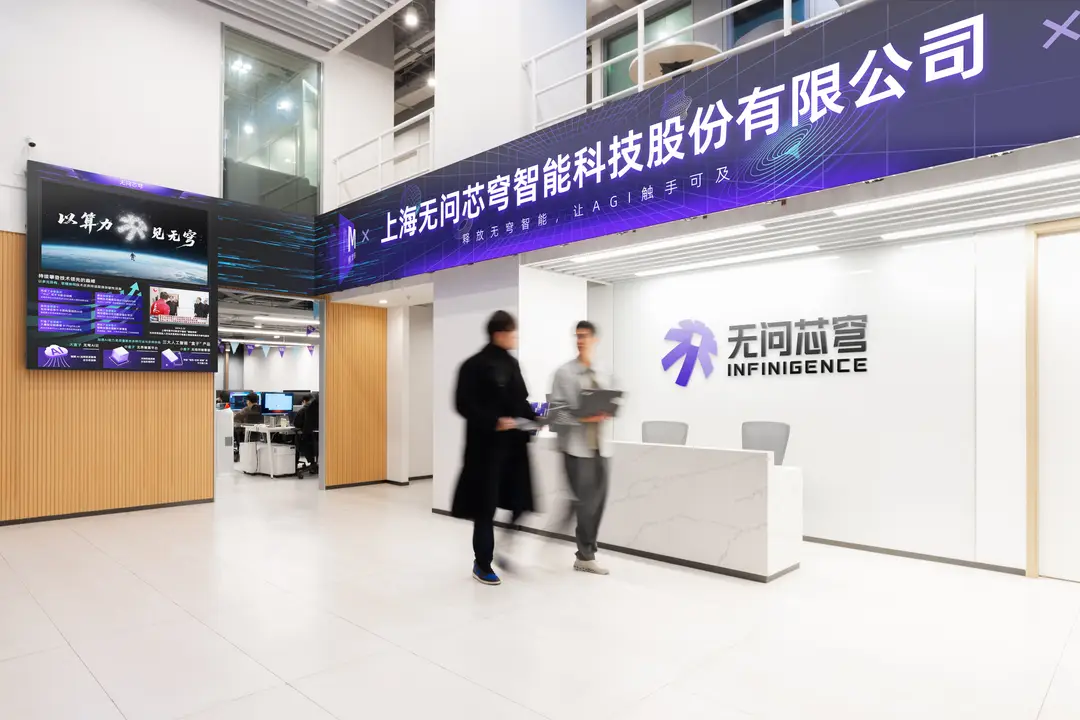
The latest round brings the AI cloud infrastructure provider’s total funding to date to 4.3 billion yuan, as it reportedly prepares for a Hong Kong IPO
By Stone Jin
Infinigence AI recently raised 2.3 billion yuan ($344 million) in its C Series funding, setting a record for the biggest single financing by a company in China’s AI-native infrastructure space.
The round brings Infinigence’s cumulative financing since its establishment to 4.3 billion yuan, ranking at the top of the industry. The company’s investor lineup covers multiple categories, including state-owned institutions, industrial investors and market-oriented financial investment institutions.
Among them, state-owned investors include Hangzhou Hi-Tech Financial Investment, the Social Security Fund Zhongguancun Independent Innovation Special Fund managed by Legend Capital, Zhuhai Sci-Tech Industry Group, Guoxing Investment, Xuhui Capital, Fortera Capital, China Insurance Investment, and Guokai Technology Venture Investment. Industrial investors include Dabanc Holding, Lenovo Capital and Incubator Group (LCIG), Ubiquant Partners, Tongge Venture Capital, Tencent and Baidu; and financial investment institutions include firms such as HongShan, Hongtai Aplus, Grandmount Capital, Qiming Venture Partners, Fortune Capital, Shunwei Capital and Monolith Management.
Infinigence AI is already one of the most highly sought-after “AI infrastructure star unicorns” by investors. What’s more, a recent Bloomberg report said the company has filed confidentially for a listing on the Hong Kong Stock Exchange.
Founded in 2023 and with ties to the electronic engineering department at Tsinghua University, China’s leading sciences school, Infinigence is a standout enterprise from China’s AI-native infrastructure sector.
Relying on a technological foundation of diversified heterogeneity and hardware-software synergy, the company says it doesn’t want to merely be a “token factory,” but instead has adopted a strategic layout of “front shop, back factory, and one center.” That includes a computing power distribution center; an agentic autonomous infrastructure platform; an agentic MaaS large model service platform token factory; and an AI productivity store.
Based on infrastructure, it aggregates energy and chips downward, and supports models and applications upward. That not only ultimately elevates scale and efficiency in transforming underlying resources into AI productivity, but also provides strong AI-native capability in an era of agentic AI by utilizing a swarm of infrastructure agents to empower resource scale expansion, improve token production efficiency, and support the ongoing evolution of agentic AI.
Source: