
By Su Da
Advanced Micro Devices (AMD) brought its AI Developer Day conference to China for the first time, unveiling new initiatives aimed at tapping the country’s deep pool of AI engineering talent and positioning its Ryzen AI Max+ series processors as the foundation for a new generation of so-called “agentic hosts”.
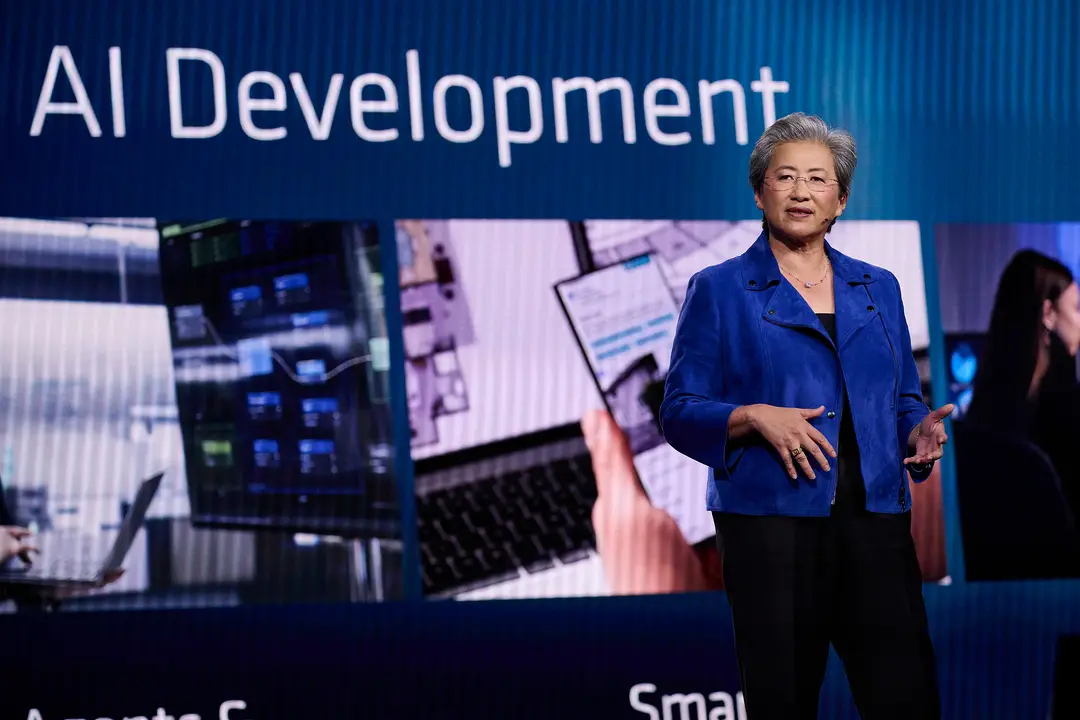
The U.S. chipmaker held its AMD AI DevDay 2026 event in Shanghai on May 19, where chief executive Lisa Su outlined the company’s strategy to expand its footprint in China’s AI ecosystem despite intensifying competition and US-China technology tensions.
“Artificial intelligence is at an inflection point,” Su said at the event, arguing that AMD’s expanding product roadmap would allow it to deliver leading AI performance across a broad range of applications.
AMD said it was deepening support for Chinese AI developers through initiatives including free developer cloud services based on Radeon graphics processors, collaboration with foundation model companies to optimise training and inference on AMD chips, and partnerships with cloud providers including Alibaba Cloud.
The company also announced a dedicated programme for Chinese AI developers aimed at building what it described as a more open AI platform and ecosystem. It includes a free developer cloud based on Radeon GPUs, deeper co-operation with local foundation model companies on training and inference optimisation, and a partnership with Alibaba Cloud to support model communities and innovation spaces.
The Shanghai conference coincided with the 20th anniversary of AMD’s Shanghai research and development centre, which the company said had played a leading role in chip design, system engineering, software and hardware integration, and AI ecosystem development over the past two decades.
AMD promotes ‘agentic computer’ concept
A central theme of the conference was the rise of AI agents — software systems designed to perform tasks independently and interact with users in more personalised ways.
AMD used the event to promote a new concept it called the “agentic computer,” arguing that future PCs would increasingly function as locally deployed AI systems capable of continuously running AI models on-device rather than relying solely on cloud computing.
Su appeared on stage alongside prominent AI investor and former Google China President Kai-Fu Lee for a discussion on the future of multi-agent systems, AI developer ecosystems and how AI could reshape corporate structures and productivity. While Lee declined to comment on specific product roadmaps, he noted that the shift towards autonomous agents would require “fundamentally different” computing architectures, a challenge he said AMD was well positioned to meet.
AMD argued that the emergence of AI agents would place greater demands on local computing power, particularly on central processing units capable of handling inference workloads. It said this would drive a shift towards system-level coordination between CPUs and GPUs.
The company positioned its Ryzen AI Max+ processor series as particularly suited to such workloads because of its combination of CPU and GPU performance, high-bandwidth memory architecture and large unified memory capacity, allowing complex large language models to run locally.
AMD said ecosystem partners had already developed a broad range of products based on the Ryzen AI Max+ series, including all-in-one PCs, laptops and mini AI workstations across multiple operating systems and usage scenarios.
According to the company, more than 35 related product designs have already been launched by manufacturers including HP, ASUS, Lenovo and Acer, alongside several Chinese start-ups and local hardware brands.
Open-source software push
AMD also used the conference to highlight updates to ROCm, its open-source AI software platform designed to compete with Nvidia’s CUDA ecosystem.The company said ROCm now supports AMD’s latest Ryzen AI 400-series processors and can be downloaded through ComfyUI, an increasingly popular interface for generative AI workflows.
Starting with ROCm version 7.2, AMD said the platform would expand compatibility across both Windows and Linux systems, while updated versions of the PyTorch machine-learning framework could be more easily deployed on Windows using AMD software tools.
AMD said ROCm’s unified software stack would allow developers to move workloads more easily between laptops, workstations and data centres using AMD graphics processors, helping developers write code once and deploy it across multiple environments.
The company highlighted support for tools and frameworks including HIPCC compilers, ROCm libraries, PyTorch and OpenClaw AI agent frameworks, which it said would improve testing, fine-tuning and deployment efficiency for developers and open-source communities.
The Shanghai developer conference also drew participation from open-source communities, universities, leading AI development teams and ecosystem partners, underscoring China’s growing importance in the global AI developer landscape even as geopolitical tensions reshape the semiconductor industry
Source:
Financial Graffiti (财经涂鸦)