
By Lian Ran
Tencent’s chief AI scientist has pushed back against criticism that the company has fallen behind in artificial intelligence. Yao Shunyu, head of the tech giant’s cloud and smart industries group, argues that the industry remains in the early stages of a long technological cycle and that the real challenge is no longer building large language models but finding worthwhile problems for them to solve.
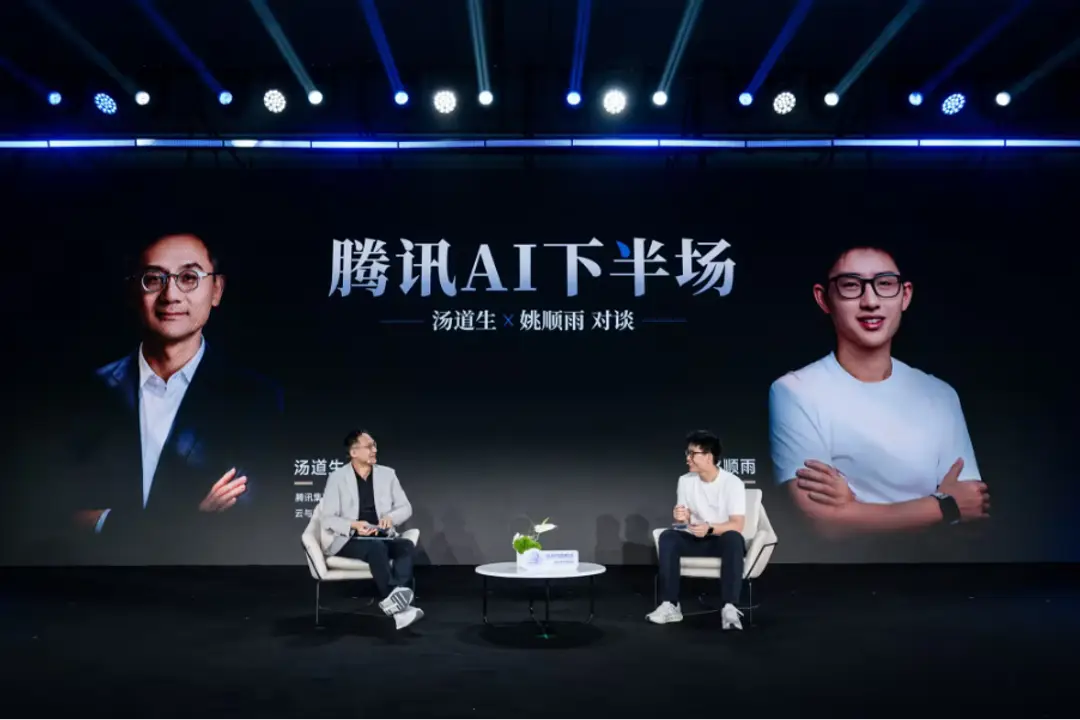
Yao made the comments in a dialogue with Tang Daosheng, Tencent’s senior executive vice-president, during the Tencent Cloud AI Industry Application Conference in Beijing on June 5. He said China’s AI sector has become overly focused on benchmark rankings and technical metrics at a time when the commercial value of AI increasingly depends on products, user feedback and real-world applications.
Yao, who joined Tencent in December 2025 after a research career that included pioneering work on AI agents, said the phrase “the second half” of the AI era, which he himself coined last year, has become overused. In his view, the term reflects a shift from searching for effective AI techniques to identifying valuable applications for increasingly capable models.
He compared today’s foundation models with earlier generations of AI systems designed for specific tasks. Technologies such as AlphaGo were highly effective in narrow domains but difficult to apply elsewhere. Large language models, by contrast, function as a broadly applicable technology that can be adapted to a wide range of problems.
Tencent’s big advantages
That shift makes access to products and real-world usage increasingly important. One reason he moved to Tencent, he said, was the company’s vast ecosystem of consumer and enterprise services, which provides a large supply of practical use cases and user feedback.
As models become more capable of transforming inputs into useful outputs, competitive advantages will increasingly come from access to context rather than model architecture alone. Companies that understand user behaviour, possess proprietary enterprise data and control key application environments will have an edge.
“The importance of context will continue to increase,” Yao said.
The relationship between models and products has become a central element of Tencent’s AI strategy. The company has sought to integrate its Hunyuan foundation model with products including Yuanbao, its AI assistant, as well as enterprise tools such as CodeBuddy and WorkBuddy.
Yao argued that the industry places too much emphasis on public leaderboards and benchmark scores. While benchmarks remain useful, he said, real-world products provide a richer source of information about how models perform.
Preview releases allow developers to uncover weaknesses that formal tests often miss, while user interactions reveal how people actually communicate with AI systems. Unlike benchmark questions, which are typically well defined and accompanied by extensive context, real users often ask vague questions, provide limited information and engage in extended conversations.
Building trust among teams
Those differences have led Tencent to place increasing emphasis on what Yao described as “co-design” between model developers and product teams.
The concept extends beyond technical integration. Product managers, engineers, data specialists and researchers must align on goals, evaluation criteria and desired user outcomes. If different teams optimise for different objectives, models can become unpredictable because they are effectively being trained according to conflicting standards.
“The hardest part is building trust,” Yao said.
He pointed to Tencent’s decision to assign some of its strongest post-training researchers to support Yuanbao before its latest generation of pre-training models was ready. The move was initially questioned internally, but helped build confidence between product and research teams and laid the groundwork for the subsequent rollout of Hunyuan’s latest model.
Yao is perhaps best known internationally for developing ReAct, an influential framework that combines reasoning and action in AI agents. He recalled connecting a large language model to a custom Wikipedia interface in 2022 and watching it conduct multi-step interactions based on information retrieved from the internet.
“It felt like a dim filament suddenly lighting up,” he said.
Early predictions come true
His doctoral dissertation, completed in 2019 under the title “Language Agents: From Next-Token Prediction to Digital Automation,” argued that language models would eventually evolve from simple text generators into systems capable of carrying out complex digital tasks.
At the time, the idea appeared speculative. GPT-2 was state-of-the-art and models often struggled to generate coherent paragraphs. Today, however, many of the research directions outlined in the thesis are becoming mainstream. Yao highlighted web agents and coding agents as two areas where his early predictions have largely been validated.
Coding agents in particular have become a strategic focus across the industry. Yao described them as foundational because, when connected to file systems and computing environments, they become effectively Turing-complete systems capable of performing a broad range of tasks.
Yet he cautioned against viewing coding agents in isolation. Successful coding systems require strong conversational abilities, reasoning, instruction-following and search capabilities. Generalisation, he argued, remains the most important advantage of large language models.
The rapid growth of AI agents has also intensified industry concerns about token consumption and computing costs. While many companies focus on lowering costs through architectural improvements, Yao argued that performance remains the most important determinant of value.
The second half has only just started
A more capable model can ultimately be cheaper than a weaker alternative if it completes a task correctly on the first attempt, reducing both token usage and labour costs.
“The core of cost-effectiveness is performance,” he said.
Addressing claims that Tencent has moved too slowly in AI, Yao argued that such criticism misunderstands the industry’s timescale.
Some observers in Silicon Valley believe AI could replace most jobs within a few years, creating a short window for companies to profit. Tencent takes a different view. AI is a long-term game, Yao said, and the industry remains at an early stage comparable to the emergence of personal computers in the 1970s.
“AI has only just begun,” he said. “The second half has only just started.”
Rather than converging around a handful of dominant products, he expects the sector to become increasingly diverse, creating opportunities in coding agents, multimodal systems, embodied AI and scientific discovery.
If that view is correct, he said, there is little value in debating whether any company is already too late.
Source:
GeekPark Go