A leaked investor presentation from the top Chinese startup highlights the escalating rivalry between the two countries to dominate the global AI industry
By Brent Li
A leaked transcript of an investor presentation given by the founder of artificial intelligence startup DeepSeek has offered a rare, unfiltered glimpse into the intensifying technological rivalry between the U.S. and China. The fallout from the disclosure was swift: days after the July 23 leak, DeepSeek abruptly suspended its second fundraising round according to Bloomberg News, following an initial funding round in June that raised $7 billion.
The transcript of the presentation by Liang Wenfeng, which circulated widely across domestic media channels before being systematically scrubbed from Chinese internet platforms, detailed the company’s long-term strategic roadmap. Liang outlined an ambitious strategy to cultivate a broader domestic software ecosystem designed to dismantle the proprietary software moat established by American semiconductor giant Nvidia.
The leak coincided with a public policy intervention by Nvidia CEO Jensen Huang, who posted an open letter addressed to the Trump administration on X, his debut on the social media platform. Signed by 25 major tech companies — including Palantir, Microsoft, Meta, and Dell — the letter urged Washington to avoid over-regulating open models, arguing that overly restrictive policy controls would severely handicap domestic innovation against foreign challenges.
These overlapping developments underscore a critical inflection point in the global AI race. As proprietary models from Silicon Valley leaders dominate commercial markets, open distribution strategies have emerged as both an aggressive competitive weapon for challengers and an intense regulatory flashpoint in Washington.
The open-source battleground
At the center of the strategic tug-of-war is what’s known as an open-weight AI model. While traditional open-source software usually provides unrestricted public access to complete underlying code, open-weight models distribute only the final learned parameters — the mathematical weights that dictate how a model processes inputs.
By publicly releasing model weights, developers enable outside engineers to download, host, and run artificial intelligence systems on their own private infrastructure without paying recurring platform fees. However, creators typically retain exclusive control over their proprietary training data and core engineering methodologies, preserving their primary trade secrets.
By contrast, the dominant Western models are closed-source — or proprietary. Market leaders keep both their model weights and underlying code strictly behind commercial cloud interfaces. Users interact with these models purely as a “black box,” paying recurring fees to send queries to vendor servers without ever gaining visibility into how the system operates or obtaining the capability to run it independently. While this closed approach allows American tech giants to maintain total control over monetization, security, and safety guardrails, it leaves their enterprise clients entirely dependent on third-party infrastructure and vulnerable to policy changes or price hikes.
According to the leaked transcript, Liang explicitly framed DeepSeek’s commitment to open-weight model distribution as an economic necessity rather than pure altruism. Liang projected that artificial intelligence technologies would eventually generate 10% of global gross domestic product, contending that no single corporate entity could realistically monopolize such expansive economic output
Eroding U.S. dominance
For Chinese startups operating under severe capital constraints and export controls, open-weight distribution represents the most viable strategy to counter Western market dominance. Releasing high-performing open weights allows Chinese developers to rapidly build global user bases, establish default industry standards, and bypass commercial gatekeepers. By offering accessible alternatives that match or approach the performance of closed Western systems, startups like DeepSeek aim to erode the pricing power and platform stickiness enjoyed by dominant U.S. incumbents.
This strategy is already generating geopolitical friction. Chinese developers are gaining international traction with models claiming parity with top U. S. offerings — notably Moonshot AI’s recently released Kimi K3 open-weight model. In response, Washington recently accused Moonshot of violating export controls and illicitly copying, or “distilling,” proprietary U.S. models — an allegation the company has not yet addressed.
These mounting tensions provide crucial context for Huang’s recent lobbying efforts. The open letter shared by the Nvidia CEO and 25 technology firms argues that restricting open models would stifle competition and drive innovation and technological leadership overseas. While Liang’s comments explicitly target Nvidia’s dominance, Huang’s intervention reflects broader corporate anxiety over potential U.S. regulatory bans on open-source Chinese models—a move that would severely shrink global demand for advanced hardware platforms, including Nvidia’s.
Chipping away at Nvidia’s moat
The most sensitive revelations in Liang’s presentation involve hardware. He acknowledged a massive computing resource gap between the two nations. While U.S. companies train frontier models utilizing up to 800 billion active parameters, Liang admitted that capital and hardware constraints limit Chinese firms to significantly smaller scales of tens of billions of parameters. He noted that training a model equivalent in scale to the largest U.S. counterparts would require roughly 50,000 Nvidia GB300 chips or 200,000 of Huawei’s domestic Ascend 950 cards.
DeepSeek relies heavily on Nvidia chips, currently controlling compute resources equivalent to around 20,000 high-end cards. In a comment that highlights the porous nature of U.S. export controls, Liang said the company is able to source “non-compliant” restricted hardware through secondary channels.
More threatening to U.S. dominance, however, is DeepSeek’s effort to break Nvidia’s software monopoly. Nvidia’s market dominance relies heavily on CUDA, its proprietary programming model. Liang claimed this software moat is rapidly crumbling, noting that DeepSeek is using internal AI tools alongside a domestic programming language called TileLang to rewrite the ecosystem, effectively eliminating its reliance on CUDA.
This software workaround would make it much easier for Chinese AI firms to switch to domestic hardware as production scales up. DeepSeek is already collaborating with Huawei to mature its domestic ecosystem. Liang estimated that Huawei’s latest AI chip, the Ascend 950, are about two years behind Nvidia’s GB300 flagship chip, requiring four Huawei cards to match the performance of one current-generation Nvidia card.
Furthermore, Huawei’s supply of 16,000 cards to DeepSeek is a fraction of what Chinese internet giants receive and falls far short of meeting the company’s compute requirements. Despite this gap, Liang expressed optimism that domestic hardware will soon become commercially viable. Even if operational costs run two to three times higher due to power and density requirements, viable domestic alternatives could shift the geopolitical competition from raw hardware scale to cost efficiency.
The race for continual learning and talent
Looking ahead, Liang outlined a clear technical roadmap toward Artificial General Intelligence (AGI). Having moved through earlier development stages — such as reasoning chains (“Chain of Thought”) and autonomous task execution (“AI Agents”) — Liang identified “continual learning” — an AI model’s ability to keep learning new knowledge after being trained — as the industry’s next primary bottleneck. Achieving continuous learning is already a heavily funded priority for all major global AI laboratories. This capability would allow models to dynamically assimilate new information post-training without full retraining runs, reflecting human knowledge acquisition.
Finally, Liang dismissed concerns about a talent gap between the U.S. and China, asserting that the global AI workforce is largely composed of Chinese engineers split between U.S. institutions and domestic firms. Instead, he identified domestic market saturation as China’s primary structural challenge. With too many foundation model startups currently operating in the country, Liang predicted a brutal consolidation, eventually leaving only a few dominant players, similar to the U.S. market which he claims now has only three major players.
Only two nations currently possess the capital, talent, and infrastructure to dictate the trajectory of artificial intelligence. While the U.S. maintains a clear lead in frontier compute, Chinese firms are rapidly adapting through open-weight distribution and software abstraction. If Chinese developers successfully transform the race into a contest of deployment cost rather than raw capital expenditure, the balance of global market power could shift far sooner than Western incumbents anticipate.
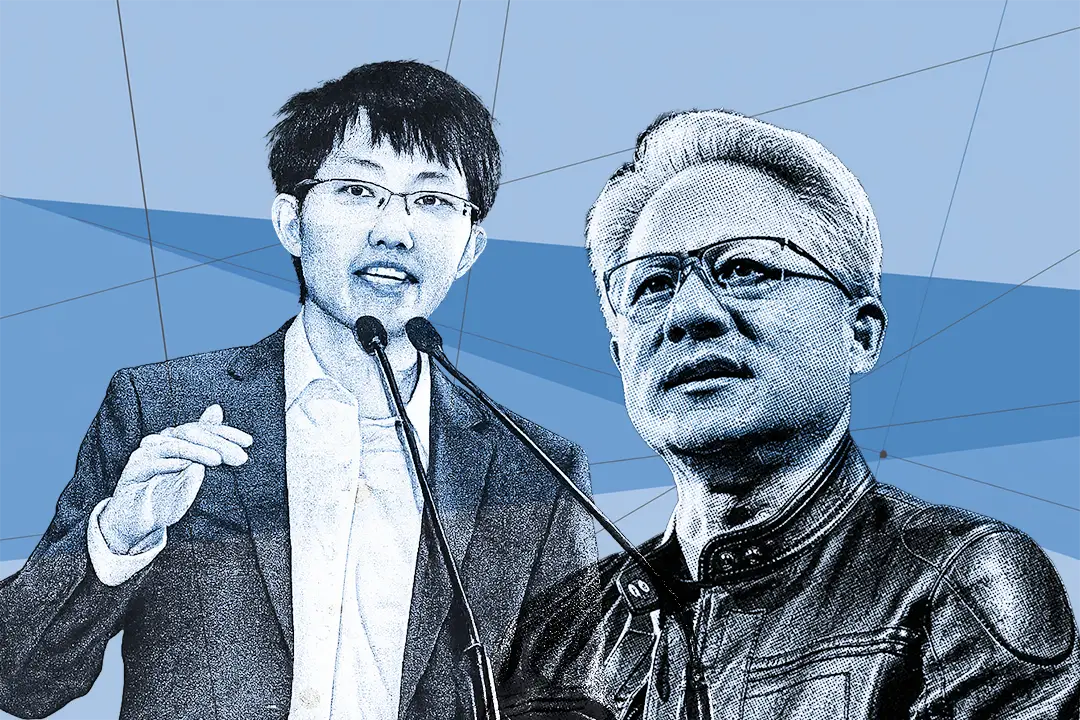
Feature photo: Illustration of DeepSeek’s Liang Wenfeng and Nvidia’s Jensen Huang
Original Sources: