

Samsung, Huawei and Xiaomi face a new competitor just as high prices, manufacturing challenges and uncertain consumer demand test the market.
By Brent Li
In the space of 72 hours in early September, Apple (AAPL.US), Huawei and Xiaomi (1810.HK) all unveiled flagship foldable phones, bringing their rivalry into a niche and expensive corner of the smartphone market. For Samsung (005930.KR), the global foldable shipment leader in 2025, Apple’s arrival adds a new challenger alongside Chinese manufacturers already experimenting with different shapes and homegrown chips.
The market is still small but the competition is intense. Foldables account for about 2% of smartphone shipments, according to Counterpoint figures. The research firm expects Apple to capture roughly a quarter of the market in its first year — a forecast that would put it ahead of Huawei and behind Samsung.
Apple’s new iPhone Duo starts at $1,999. In China, it costs 15,999 yuan (about $2,240), compared with Xiaomi’s 10,999 yuan. Huawei’s new Mate XT 2 starts at 19,999 yuan, although its three-panel or tri-fold design opens into a larger, 10.2-inch screen.
Those prices illustrate the industry’s challenge. Manufacturers are offering more elaborate hardware as the broader phone market weakens. Their task is to persuade buyers that a folding screen provides enough everyday value to justify the premium — particularly when consumer research suggests productivity is not the main attraction.
Different brands, similar shapes
Apple is entering a category whose design vocabulary is already being shaped by Asian rivals. iPhone Duo, Xiaomi’s 18 Fold and Huawei’s earlier Pura X Max have nearly identical inner and outer screen sizes. These three models also share an almost identical D shape when folded, thus showing a D shaped outer screen that’s new to most consumers. Samsung has moved in the same direction, with a slight difference in the corners. This convergence suggests a consensus has formed over how a foldable should look.
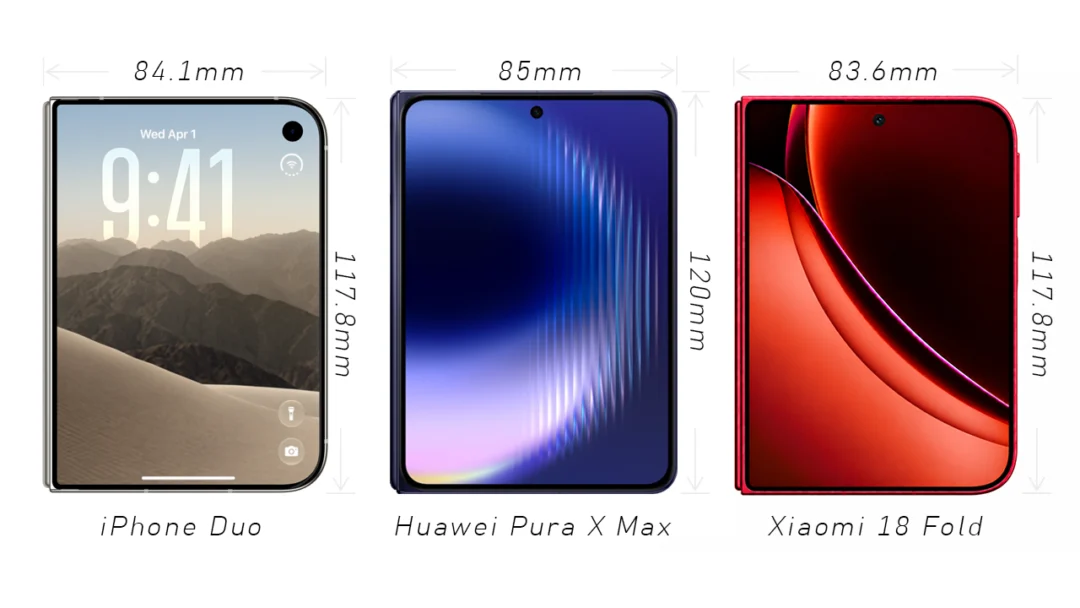
The specifications also complicate any assumption that Apple’s higher price buys better hardware across the board. The iPhone Duo weighs 254 grams and measures 11.3 millimeters thick when closed, against Xiaomi’s 219 grams and 10.68 millimeters. Apple lacks a dedicated telephoto camera; Xiaomi includes one. But Apple advertises IP68 protection, meaning its phone is dust-tight and rated for prolonged water immersion, while its competitors use lower standards.
Apple’s new CEO John Ternus describes iPhone Duo as the biggest transformation of the iPhone since the original. The company emphasizes software that adapts to the unfolding screen. Since Apple has huge influence over software developers, we could foresee that Huawei and Xiaomi may also benefit from Apple’s entry in terms of getting more software that’s adapted for this market segment.
Higher prices, homegrown chips
A sluggish global smartphone market and rising component costs help explain manufacturers’ interest in pushing premium products. IDC figures put second-quarter global smartphone shipments at 277.5 million, down 6.7% from a year earlier, marking a second consecutive quarterly decline.
At the same time, AI servers are competing with smartphones for memory-chip capacity, pushing up the cost of memory. Lei Jun, Xiaomi’s founder, chairman, and CEO, repeatedly cited rising memory prices at the Sept. 7 launch of the Xiaomi 18 Fold. Most of the phone’s components, including its three-link hinge, require customization, while the Xring O3 processor is another major cost.
Higher selling prices could help manufacturers absorb those pressures, protect margins, and generate more revenue from a relatively new market niche.
Premium devices also provide a showcase for Chinese chip development. Huawei’s Mate XT 2 uses its newly launched Kirin 9050 Pro processor, while Xiaomi’s 18 Fold introduces its Xring O3. It’s worth noting that Huawei hasn’t announced a new mobile phone chip for years — new chips in the Kirin series have appeared before the 9050 Pro, but none were formally launched and given the same prominence. This may suggest Huawei is increasingly confident in its ability to secure production of its new chips.
CXMT (688825.SH), a Chinese memory producer, says Xiaomi’s device marks the first commercial use in a flagship phone of its LPDDR6 memory, a new generation of high-speed and low-power mobile DRAM which holds information the processor is actively using.
The production test
The rivalry also runs through shared suppliers. According to supply-chain reporting by 21st Century Business Herald, Samsung Display exclusively supplies the flexible screens for iPhone Duo’s initial models. Samsung therefore participates both as a competing phone brand and through its display business as a supplier.
Making those devices consistently is another challenge. Suppliers told Caijing that precision-hinge assembly remained a constraint on Apple’s production yields — the proportion of units meeting quality requirements. They expected early yields to be low, with greater stability in a subsequent batch.
Caijing also reported that Apple had indicated to suppliers that it anticipated demand for about 10 million phones, but that final orders were unconfirmed. Separately, analyst Ming-Chi Kuo projected third-quarter shipments of 500,000 to 1 million units. Meanwhile, Counterpoint estimates shipments of up to 6 million Apple foldable smartphones in 2026.
A bigger screen needs a better reason
The argument for foldables increasingly includes AI. Apple promotes its AI features alongside multitasking, while some analysts argue that larger displays make room for assistants, documents and work across multiple apps at once — activities that more screen space can accommodate better than conventional phones. Users in China and the European Union, however, remain outside Apple’s AI availability.
Evidence from users complicates this picture. A 2025 iResearch survey of 1,800 Chinese consumers found that “new productivity tool” was the least-selected role for the devices; technology experimentation, fashion and status featured more prominently. Although 8,000–10,000 yuan was the most commonly cited acceptable price, actual purchases clustered lower, at 5,001–7,000 yuan. And on the software side, users’ main complaints centered on excessive blank space and poor visual and interaction experiences.
A wide gap remains between what manufacturers promote and how consumers actually respond to the foldable format. Apple’s arrival could give the foldable industry, and its competitors, a clearer direction. Its approach to software and everyday use could offer Samsung and Chinese manufacturers a stronger basis for deciding where to invest next. Whether that translates into wider consumer demand, however, remains to be seen.
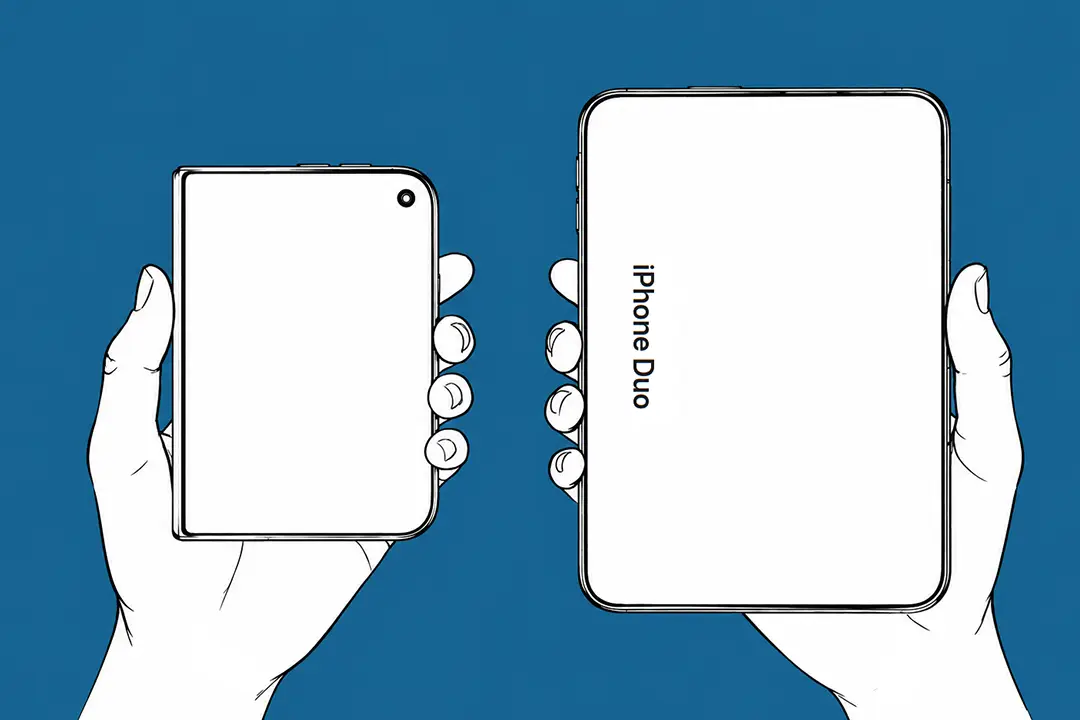
Feature photo: iPhone Duo in folded and unfolded mode, based on photo from Apple.
Sources
- 苹果第一台折叠 iPhone,15999 元起
- 直板机还能打,为什么一起开卷“折叠屏”?
- 苹果发布首款折叠屏手机,供应链准备好了吗?
- 小米18 Fold首发,长鑫LDDR6详细规格公布!
- 史上最贵苹果手机登场,A股受益链一览
- 全球七年共卖出1亿台,苹果会带火折叠屏手机吗
- 小米“芯机”,价格破万
- 麒麟 9050 Pro 现身、余承东秀英文,华为新三折叠太有活了
- 华为这次很“异类”
- Huawei Mate XT 2 Ultimate Design is official with a Kirin 9050 Pro SoC, 5,600mAh battery
- Apple unveils iPhone Duo
- Xiaomi’s wide foldable promises more power than Samsung’s