
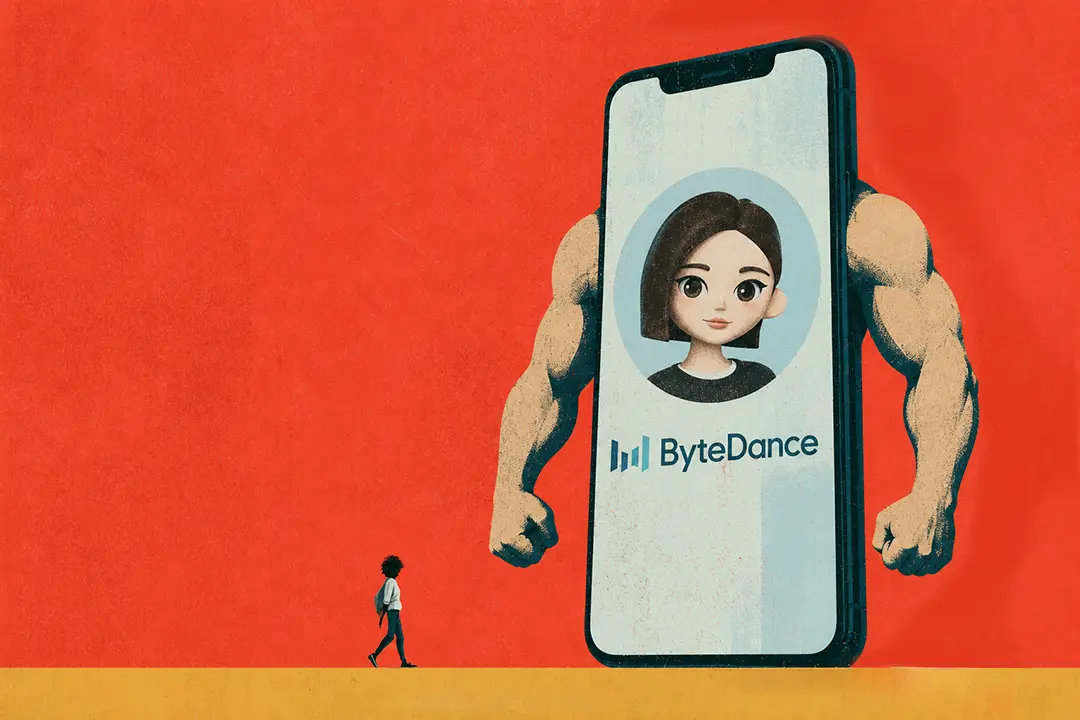
The tech giant’s new AI phone, jointly developed with ZTE, navigates apps for you, sparking a fierce battle with developers over ecosystem control and automation.
By Brent Li
Smartphones are getting smarter, but users still have to do the heavy lifting of tapping, swiping, and switching between applications. Now a new device, jointly developed by Chinese tech giant ByteDance and smartphone maker ZTE (000063.SZ) under its Nubia brand, is trying to change that by handing the steering wheel directly to artificial intelligence.
Launched on Sept. 16, the Nubia NaviX Ultra is being marketed as the world’s first “AI agent phone.” Starting at about $845, the device promises to autonomously execute complex, cross-app tasks rather than just answering user queries.
According to the company, users can simply ask the phone to plan a trip, and the AI agent will automatically open travel apps, search for flights, find a hotel, and draft an itinerary in a notes app.
This aggressive approach to mobile automation contrasts with the strategy of Apple (AAPL.US), which recently launched its iOS 27 with an upgraded Siri AI. While the tech industry agrees that AI assistants are the future, a fierce battle is brewing over how these digital helpers should interact with the walled gardens of modern mobile apps.
The ghost in the machine
The NaviX Ultra relies on a technology called a graphical user interface (GUI) agent. Instead of waiting for app developers to build dedicated integrations for AI — as Apple does — a GUI agent “sees” and understands the user interface and simulates human finger taps to navigate apps.
To protect sensitive actions, the phone features a dedicated AI button with a built-in fingerprint scanner. If an unauthorized user presses the button, the AI agent will refuse to execute sensitive tasks, such as accessing contacts or making payments.
However, this “ghost in the machine” approach has already triggered a turf war. When ByteDance released a technical preview of the phone in December 2025, its AI assistant was quickly blocked by major Chinese super-apps including Tencent’s WeChat and Alibaba’s Taobao, and various banking apps.
These platforms flagged the AI’s simulated taps as security risks or unauthorized plug-ins. But behind these official announcements, apps that rely heavily on advertising revenue have an incentive to block an AI assistant, which can bypass advertising and interact directly with services without generating conventional user engagement.
A peace treaty for the app ecosystem
To resolve this friction, ByteDance has introduced a novel compromise alongside the new phone: the Screen Automation Execution Protocol (SAEP).
Conceptually similar to the “robots.txt” file that websites use to tell search engines which parts of a site they may crawl, SAEP allows third-party apps to set rules governing an AI agent’s automated actions, including restricting or disabling specific functions. For example, an app could allow the AI to search for products but block it from making final payments or participating in promotional lotteries.
The protocol is currently in a 30-day public notice period ending in mid-October. During this time, the AI agent from NaviX will only operate within system apps, ByteDance’s own extensive ecosystem of apps, and third-party apps that have explicitly opted in. After the 30-day period, apps that have neither officially opted out nor configured a mechanism to disable the feature will gradually be opened to GUI automation.
It remains to be seen how many developers will embrace the protocol. While ByteDance is open to integrating AI across its own vast portfolio of entertainment and work apps, developers that are protective of their super-apps may resist this AI-driven disruption to their own ecosystems.
The global race for AI control
The push for mobile automation follows a similar explosion of AI agents on personal computers, where they can move a mouse and type on a keyboard to operate on almost any program. But while users have far greater control over their PCs, smartphones are closed ecosystems dominated by a few major players and individual app developers may be able to prevent AI agents from operating within their apps.
This friction highlights two competing approaches to building the next generation of mobile assistants.
Apple’s newly released iOS 27 features a highly anticipated Siri AI, which boasts on-screen awareness and the ability to control supported apps. However, Apple relies on a permission-based system, requiring developers to actively build support for Siri into their apps. Unlike the NaviX Ultra, however, it does not use GUI simulation to operate apps that have not been specifically integrated with Siri.
Siri AI is currently unavailable in China due to regulatory hurdles, but Alibaba (BABA.US) (9988.HK) has confirmed media reports that it has reached an agreement with Apple to integrate its Qwen AI model into Apple Intelligence for devices sold in mainland China, giving users access to Qwen’s text and image understanding capabilities directly on their devices. Apple has also reportedly trained a large language model specifically for the China market, with support from Alibaba.
Meanwhile, Google is taking a similar permission-based approach with its Android operating system, testing features that require apps to register specific functions for AI use.
The ultimate viability of ByteDance’s AI agent model hinges on whether the industry will accept its new protocol. If successful, it could usher in a new era of personal assistants that truly manage our digital lives. If not, the dream of a fully automated phone may remain trapped behind the walls of the world’s biggest apps.
Sources: