

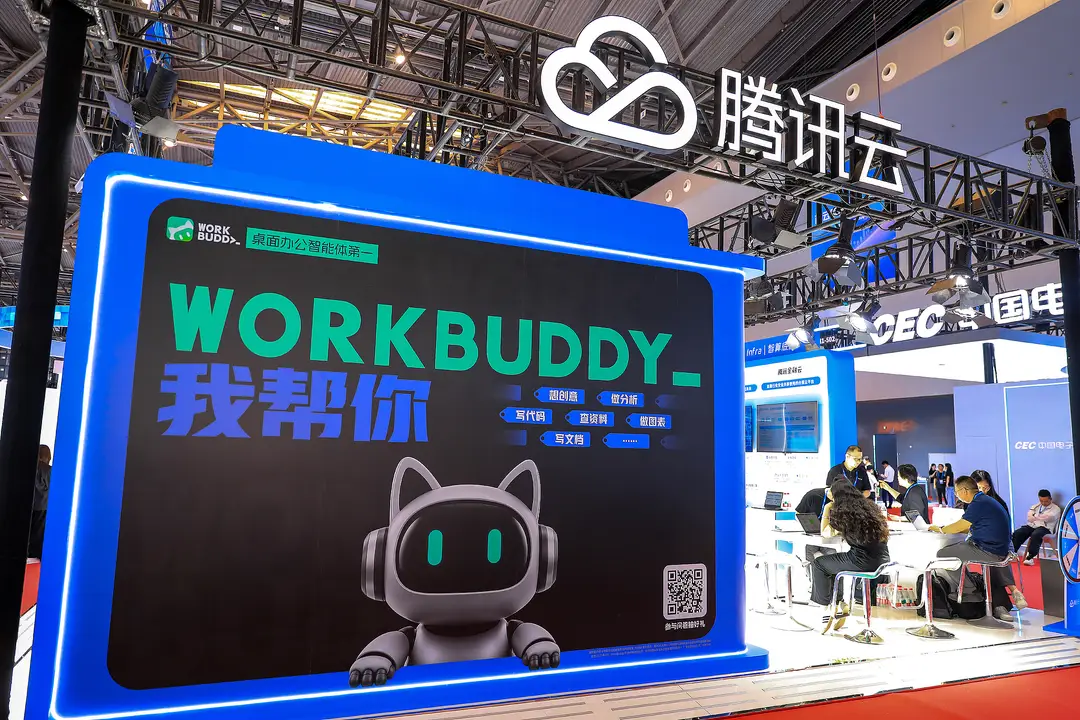
Tencent is opening WorkBuddy’s agent infrastructure to hardware makers, software developers and businesses as competition in AI office tools intensifies.
Tencent (0700.HK) has opened the technology underpinning its WorkBuddy AI assistant to more than 100 companies, betting that a broader ecosystem can give it an edge as China’s AI office market becomes increasingly crowded.
At an ecosystem launch event in Shenzhen on Sept. 2, Tencent launched its open platform, bringing together more than 100 partners across smart hardware, industry applications and developer tools. Nine co-branded smart hardware products and more than 30 industry applications were unveiled, spanning more than 20 fields.
It is WorkBuddy’s first full disclosure of its open-ecosystem strategy since the product launched in March.
Moving beyond the AI office arms race
WorkBuddy has led the recent surge in China’s AI office market. Desktop visits reached 20.97 million in June, according to Analysys, while monthly active users hit 11.15 million in July, according to AI Product Ranking, compared with roughly 30 million for the market as a whole.
Its growth has prompted other technology giants to move aggressively into the sector. Alibaba (9988.HK) (BABA.US) consolidated QoderWork, Wukong and MuleRun into Qianwen Office, ByteDance launched Doubao Work with deep integration with Feishu, and Baidu (BIDU.US) (9888.HK) upgraded its GenFlow product into Kuku AI.
But the products are increasingly similar in their interfaces, product forms and underlying capabilities. “Ease of use” is becoming less of a competitive moat.
WorkBuddy’s answer is to move the competition beyond the application layer by opening its agent infrastructure.
The ecosystem has three parts. WorkBuddy has connected with more than 30 hardware brands across more than 10 categories, covering products including smart glasses, recording devices, headphones, keyboards, PCs and tablets. It is also introducing “Buddy applications” — branded AI workspaces built on WorkBuddy for specific industries and use cases, with initial offerings spanning finance, SaaS, law, healthcare, education and design.
Developers can use the open platform to build and publish their own capabilities through three modules: Skills, Experts and Connectors. Different devices can access the same account and memory, while external services can connect through standardized interfaces such as MCP (Model Context Protocol) or CLI (command-line interface).
Betting on context
The deeper logic is that WorkBuddy needs more than users: it needs context.
An agent’s capabilities depend partly on how much context it can access, how many tools it can use and how much feedback it receives.
The broader the ecosystem, the richer the context, accelerating iteration across the model, product and agent harness — the software layer that manages execution, state and tool use.
Hardware can provide new sources of context. A keyboard captures what users actively enter; smart glasses and recording devices can provide continuous, first-person information without requiring active input.
Skills provide another source of learning. Frequently used skills reveal how particular tasks are best performed, feeding information back into the agent system.
Over time, this could create ecosystem lock-in similar to NVIDIA’s CUDA platform, where software, expertise and workflows built around the technology make switching costly. Leaving WorkBuddy might mean migrating not just a model, but memories, tasks, skills, tools, permissions and business workflows.
Making AI infrastructure a common layer
WorkBuddy’s open strategy rests on three principles: turn difficult AI capabilities into common infrastructure, establish common connection standards and allow applications to build on top.
At the center is its agent runtime. Agents must repeatedly gather context, plan, call tools, observe results and verify them. Real-world tasks can involve dozens of steps, with failed tools, interruptions and the need to restore state or involve humans.
WorkBuddy packages the capabilities needed to manage that process — including understanding, planning, execution, memory and reliability — so partners do not have to build them from scratch.
As Yu Hongxiao, head of WorkBuddy’s open platform, said, AI models are rapidly becoming commodities and increasingly cheap to access. What is scarce is industry-specific know-how and data: “You understand the industry, we understand AI, and each side brings its strengths.”
WorkBuddy is also establishing common standards for connecting hardware and software. Different devices can access the same account and memory, while external services can connect through standardized interfaces such as MCP (Model Context Protocol) or CLI (command-line interface).
That changes the role of both. Software becomes a tool that an agent can call, while hardware becomes an agent’s sensory extension.
Chinese customer relationship management provider Neocrm, known as Xiaoshouyi in China, has built Yiqi, an AI sales assistant for individuals and small businesses that runs inside WorkBuddy. It can create customer profiles from public information, turn spoken notes into records after meetings, analyze messages and emails for customer needs, risks and unresolved questions, and continuously track key sales opportunities to prompt follow-ups. When users return to the same customer, it can also retrieve historical records and provide tailored suggestions.
The principle is straightforward: partners provide industry expertise; WorkBuddy provides the infrastructure.
The ecosystem still has to prove itself
Tencent is betting that WorkBuddy can evolve from a standalone AI tool into an operating system for agents. The strategy is consistent with Tencent’s long-standing emphasis on open platforms.
But openness may also be WorkBuddy’s only viable choice. In AI, switching costs are low: a better model or agent can attract users rapidly. A closed standalone tool may therefore struggle to retain customers indefinitely.
An ecosystem, however, does not become successful simply because it is open. WorkBuddy has not set a target for the number of partners it needs. Lin Zuolu, who leads its open ecosystem, said the company is more interested in seeing applications used frequently by different types of users while generating value for partners.
“Opening up is something we can do; an ecosystem is the result,” Lin said.
That leaves three questions.
First, can the ecosystem generate enough traffic? WorkBuddy lacks the enormous user base that helped drive the success of WeChat mini programs, so partners’ exposure will depend on how quickly WorkBuddy itself grows.
Second, can it build a commercial model? The platform currently offers traffic, operating tools and ecosystem incentives, but the first wave of hardware and software partners has yet to agree clear revenue-sharing arrangements with Tencent.
Third, can WorkBuddy serve both consumers and businesses effectively? The two markets have very different product requirements and business models.
The answers will emerge over the next 12 months. For now, Tencent is making a calculated bet: as competition at the AI tool layer converges, the advantage may go to the platform that can assemble the richest ecosystem — and therefore the richest context. The biggest question is who ultimately captures that advantage.
Source:
JazzYear