

AI is turning baby beds into high-tech systems that could transform the entire sleep industry.
For decades, the baby crib was one of the few home products largely untouched by technology. Its basic form barely changed: four posts, a surrounding rail and a mattress.
That is now changing. Over the past five years, sensors, algorithms and motors have moved into the crib, pushing prices from a few hundred yuan to more than 10,000 yuan ($1,400).
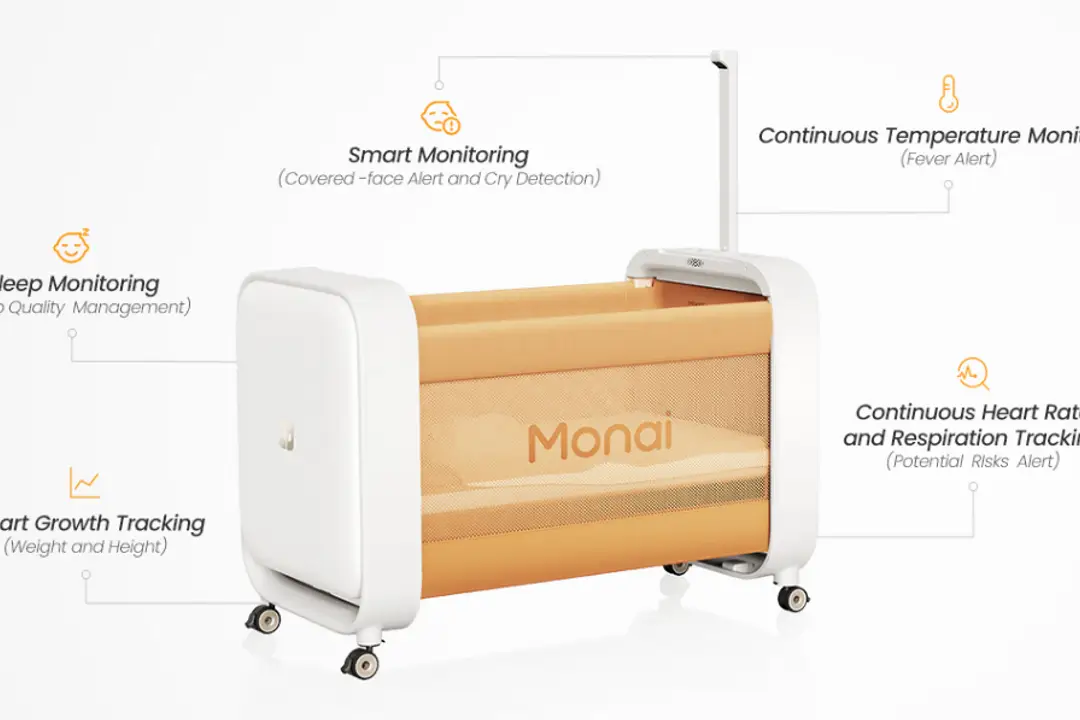
In the U.S., smart crib SNOO sells for $1,695, while Cradlewise costs $1,999. At this year’s Consumer Electronics Show in Las Vegas, Chinese parenting brand Qinbaobao unveiled an AI sleep pod, Monai, priced at 8,999 yuan. Even products offering relatively basic features such as temperature control and video monitoring can sell for more than 4,000 yuan in China.
Startups including SNOO and Cradlewise have already demonstrated that parents will pay premium prices for technology designed to improve infant sleep. Now Bosch has entered the market with its AI-powered Revol crib, while established baby-care brands including HALO and Graco are also following.
The promise is straightforward: safer sleep for babies, more sleep for parents and less anxiety around nighttime care. But as the category increasingly adopts the label “embodied AI,” a bigger question is emerging: is this genuinely a new product category, or simply a marketing gimmick?
What does a $1,400 crib actually do?
SNOO, founded by pediatrician Harvey Karp, is one of the pioneers of the smart-crib market. Its system combines three elements: rocking, white noise and a built-in swaddle that clips to the crib, helping keep babies sleeping on their backs.
Sensors detect the intensity of a baby’s crying, prompting the crib to automatically increase its rocking through four levels. The company says most episodes can be calmed in less than a minute and that babies sleep an average of one to two hours longer each night.
SNOO is designed for babies up to six months old and costs $1,695, with rental options ranging from $159 to $499 a month. It also provides round-the-clock sleep support. Most importantly, it remains the only crib authorized by the U.S. Food and Drug Administration specifically for maintaining babies in a back-sleeping position—a major advantage over competitors.
Cradlewise takes a different approach. Its $1,999 crib combines a camera and microphone with a motor underneath that gently bounces the mattress. Algorithms monitor subtle movements such as rolling over, opening the eyes and making sounds, then begin soothing the baby before they fully wake up. The company calls the approach “prediction over reaction.”
Founded by a husband-and-wife team with backgrounds in semiconductor companies, Cradlewise aims to accumulate sleep data in the cloud and continuously improve its ability to understand individual babies. The crib can also transition from a bassinet to a toddler bed and remain in use until around age two, with features updated over the air.
Qinbaobao, which operates a parenting app and sells baby products, launched its first crib this year, positioning it explicitly around embodied AI. Its sleep pod uses millimeter-wave radar to monitor breathing and heart rate through the mattress, infrared sensors to track temperature and algorithms to identify conditions including face covering, climbing, kicking off blankets, crying and fussing.
When crying is detected, it can automatically play age-appropriate music, stories or white noise. Its built-in weight sensors can also record a baby’s height and weight without requiring separate measurements.
The exact definition of “embodied AI” varies among companies, but the underlying idea is similar: use sensors to perceive a baby’s condition, algorithms to assess it, and physical or digital responses to intervene.
Three questions will decide the market
The bigger the market becomes, the more important three unresolved questions will be.
First, can anyone actually build a reliable infant sleep model?
Infant sleep research remains at an early stage. Unlike adults, babies cannot explain what they need, while their sleep cycles, soothing requirements and changing physical states are difficult to model algorithmically. SNOO relies heavily on pediatric and medical expertise, while companies such as Cradlewise are using data to refine their models. Both approaches still require much more real-world validation.
Second, what happens when the baby outgrows the crib?
A crib may be used for only six months to two years, creating a short product lifecycle and a natural secondhand market. SNOO and Cradlewise already offer refurbished products and rental services. Leasing, subscriptions and products that adapt to multiple stages of childhood are ways to address the problem.
Research firms estimate that the global smart-crib market was worth around $1 billion in 2025, with annual growth approaching double digits. But declining birth rates mean this is not a market with an unlimited natural growth engine.
Third, can companies earn parents’ trust?
AI does not eliminate safety concerns. Parents still need to know whether sensors are safe, whether rocking could harm a baby and whether algorithms can make accurate judgments.
SNOO has addressed part of that concern through FDA authorization. Other companies promoting AI sleep models will need to demonstrate both effectiveness and safety.
Just the beginning
The technology being developed for smart cribs is already moving toward broader “sleep environment management,” including control of temperature, humidity, noise and light, alongside sleep-cycle analysis.
There is already a parallel market for adults. Customized sleep pods can cost 30,000 to 100,000 yuan and create a controlled environment for short periods of rest, including naps during the working day.
If smart cribs can prove that their “perception-to-soothing” technology works, the same capabilities could theoretically be applied to other sleep environments.
That means the bigger opportunity may not be the AI crib itself, but a broader sleep-technology company serving both babies and adults.
The winners will not necessarily be the companies that launch first. They will be the ones that can clear three hurdles: validating their sleep models, earning trust and overcoming the industry’s short product lifecycle.
The race has only just begun.
Source:
Hardwire