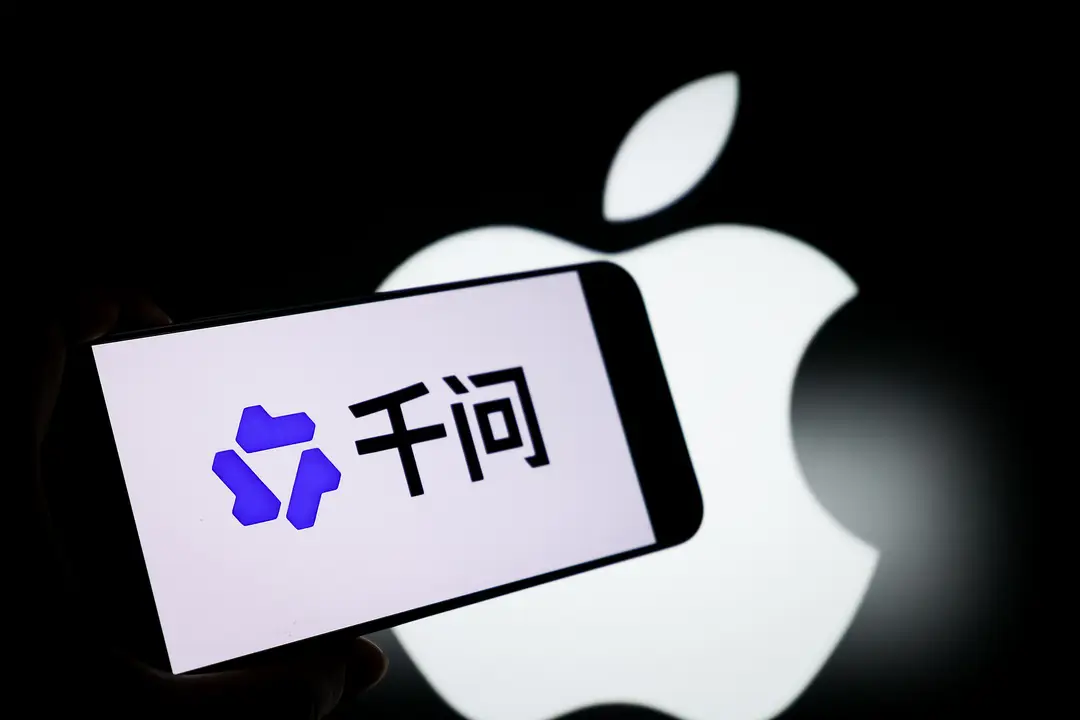
Apple needs a local AI partner to bring Apple Intelligence to China, but Qwen is also building an ecosystem that could challenge the U.S. giant’s control of the user relationship.
By Yan Qiu
When a support document appeared on Apple’s Chinese website on Aug. 8 announcing that Qwen, Alibaba Cloud’s large language model, would work natively with Apple Intelligence on the U.S. tech giant’s devices, the internet erupted. Users could submit requests to Qwen without opening an app; it could analyse photos and documents directly.
For Chinese iPhone users, this appeared to be the Apple Intelligence rollout they had been waiting for. Apple first unveiled Apple Intelligence at its 2024 Worldwide Developers Conference, but its launch in China has repeatedly been delayed.
However, by the next morning the document, titled “Use Qwen with Apple Intelligence on Mac,” had vanished. Apple customer service said they had “received no relevant notice”; other sources suggested regulatory approvals were still pending. The takeaway: even with the finish line in sight, Apple controls the release button.
Apple: the reluctant partner
Apple can’t afford to neglect China. Domestic rivals have already woven AI into their operating systems — photography, search, productivity. The iPhone, Mac and iPad remain powerful products, but as system-level AI becomes a defining feature of premium devices, being absent from the category risks making Apple look behind the curve.
There is also a regulatory challenge. Generative AI services in China are subject to requirements governing the storage and processing of user interaction data within the country. That means Apple’s emphasis on on-device processing and privacy protection has to be adapted for the Chinese market, creating a need for a domestic AI partner.
Since 2023, Apple has courted Baidu, ByteDance, Tencent and Z.AI (Zhipu AI). In February 2025, Alibaba chairman Joe Tsai confirmed: “Apple is very picky. They talked to multiple Chinese companies and ultimately chose us.” A “dual-track” model will see Alibaba’s Qwen handling most generative tasks and Baidu covering search and visual scenarios — a setup confirmed in iOS 27 Beta code in June.
Yet Apple’s ambition is not simply to “buy a model.” Its commercial logic rests on control: components may be sourced, but the product definition, interfaces and user ecosystem remain proprietary. The App Store and Apple Pay generate billions.
Apple has applied this logic to AI. In its Google partnership, it used Google’s technology to train its own foundational models; users interact with Apple’s in-house models. Ideally, when Qwen is integrated, users should feel “the Mac got smarter,” not “I am using Qwen.” Apple would prefer Qwen to be invisible.
But Chinese compliance makes that impossible. Apple cannot erase Qwen’s brand presence. And while data ownership terms remain undisclosed, entering China necessitates a strategic concession of ecosystem control — a painful compromise for a company built on absolute ownership.
The real agenda: power
On paper, Alibaba is the chosen one. With iPhone active users in China exceeding 250 million, even modest Qwen adoption would dwarf its 167 million monthly active users, compared with ByteDance’s Doubao at 382 million.
But Qwen would not necessarily control that traffic. It would provide the underlying technology through application programming interfaces (APIs) without owning the user interface — and the AI industry increasingly suggests that the value is flowing toward the companies controlling the point of interaction.
Alibaba seems to recognise this. The day after Apple’s document was pulled, the Qwen Open Platform launched — an open platform bringing together a range of AI agents. Companies including Didi, AutoNavi, SF Express, Beike have joined with agents covering areas such as transportation, housing and local services. Each agent has its own identity and interface, with Qwen providing the infrastructure for accounts, payments and authorisation.
This is a bid for distribution power. Users can hail a ride or arrange a courier by tagging the relevant agent within Qwen, without app-hopping. The service works across PC and smart glasses. As a “super app,” Qwen aims to bypass Apple and build its own user ecosystem — a direct challenge to Apple’s interests.
Qwen is also beginning to test direct monetization. On Aug. 11, Qwen became China’s second major AI app, after Doubao, to explore paid services. Its model combines subscriptions for office assistance and credit-based charging for AI video generation.
Tug-of-war over value allocation
The emerging strategy therefore has three layers: Qwen can earn technology-service revenue as Apple Intelligence’s underlying model; platform revenue by becoming an AI gateway to other services; and consumer revenue by charging heavy users directly
The deleted Apple document may ultimately prove to have been little more than a publicity mishap. But the episode highlights a much deeper tug-of-war over value allocation.
Data ownership: Apple’s privacy model favours processing data on the device, but Chinese regulations require some data to pass through to Qwen’s domestic servers. As features expand — such as AI image generation or complex contextual understanding — data requirements will shift, which could reignite negotiations over data rights.
Supplier diversification: Apple has never relied for long on a single supplier. If DeepSeek, Zhipu or others show distinct advantages in specific capabilities, Apple may bring in additional providers. That would give Qwen a limited window to prove its indispensability as Apple’s chosen partner through service quality and ecosystem depth.
Baidu’s role: The division of labour between Qwen (generation) and Baidu (search and vision) is clear on paper, but in practice, generative and search capabilities overlap. When a user demands both summarization and retrieval, the two models must coordinate without conflict — an operational challenge yet to be resolved.
How the two models coordinate — and how Apple prevents overlapping or conflicting responses — could become an important test of the partnership.
Ultimately, the Apple-Alibaba-Baidu arrangement is more than a deal to bring AI to Chinese iPhones. It could become an early template for how hardware companies and AI model developers divide data, revenue, branding and ownership of the user relationship.
That is why the real contest is not simply over whose model is smarter. It is over who gets to control the ecosystem built around it.
Source: