
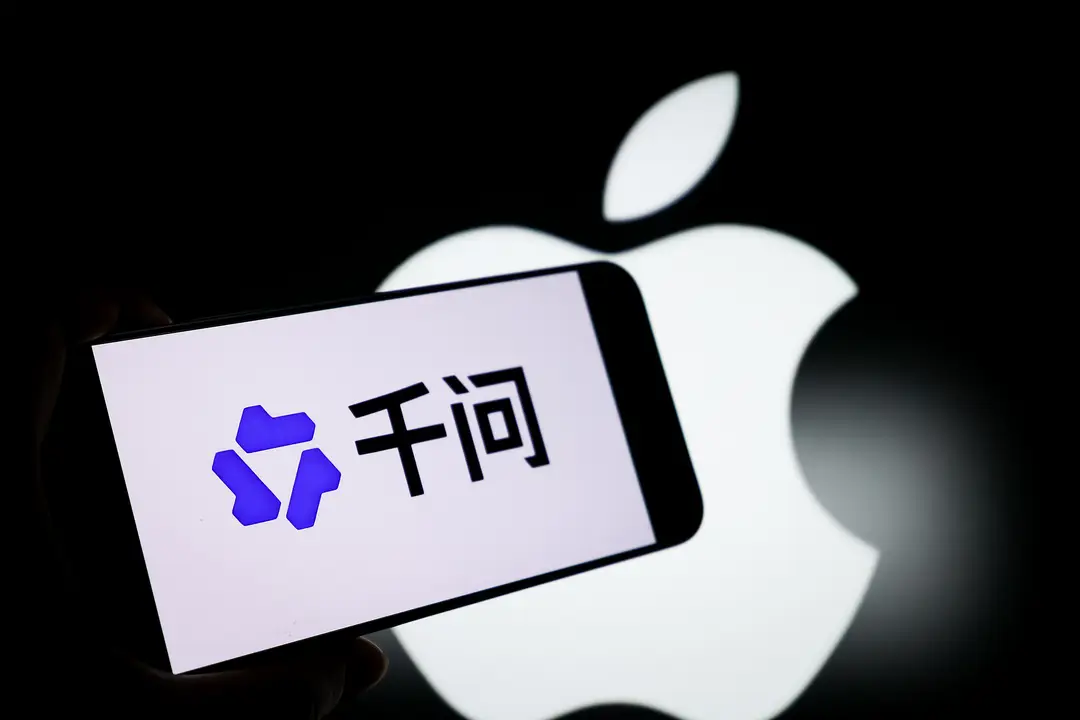
The first Apple Intelligence features will be available in mainland China in December, with Qwen providing an optional AI extension for Siri, writing tools and visual intelligence.
Apple (AAPL.US) will begin testing Apple Intelligence in China on Nov. 4 with the first developer beta of its latest iOS, ahead of a full consumer rollout in December alongside iOS 27.3, the company said in a Newsroom post on Oct. 31, ending two and a half years of waiting since the features were unveiled at the Worldwide Developers Conference (WWDC) in June 2024.
The China version will integrate Alibaba’s (9988.HK) (BABA.US) Qwen model across Siri, Writing Tools and Visual Intelligence, under a partnership the two companies confirmed the same day. The arrangement mirrors how ChatGPT was grafted onto overseas iPhones from late 2024 — handling queries Siri cannot answer, powering a “Compose with Qwen” writing function and answering questions about what the camera sees.
The long approval trail
The launch follows a regulatory path that began in March, when some users briefly saw Siri renamed “Apple Intelligence & Siri” in settings before Apple pulled the change, citing a software issue. On July 15, the Cyberspace Administration of China listed Apple Intelligence among seven registered on-device generative AI services, registered under Apple Technology Development (Shanghai) Co. Ltd. By Sept. 29, several China-market iPhones had completed network access license renewals carrying three large-model registration numbers, corresponding to Apple Intelligence, Alibaba’s Tongyi Wanxiang and Tongyi Qianwen.
Apple executive chairman Tim Cook confirmed approval in Shanghai on Oct. 15, telling The Paper that the first core features would include real-time translation, a Photos app eraser tool and writing tools.
The first wave covers real-time translation in Messages, FaceTime and Phone — one-on-one calls only — plus live translation of in-person conversations through AirPods 4 with ANC, AirPods 5, AirPods Pro 2 and later, and AirPods Max 2. Writing Tools will handle rewriting, proofreading and summaries, while Mail surfaces urgent messages and offers one-tap summaries of long threads. Notifications will be condensed on the lock screen, and audio recorded in Notes and Phone can be transcribed and summarized.
Qwen’s three entry points
In Photos, the Clean Up tool removes unwanted objects (still in beta), natural-language search can jump to a specific moment in a video, and text prompts generate memory movies. Genmoji creates custom emoji from descriptions or from photos of friends and family. Visual Intelligence identifies objects in front of the camera and can summarize or answer questions about on-screen content.
Siri gets a new glowing border and a double-tap-to-type interface at the bottom of the screen, with the company promising it can follow halting speech and maintain context across turns.
Qwen appears in three places: Siri, Writing Tools and Visual Intelligence. Users must sign in with a Qwen account or via Sign in with Apple. Alibaba said requests and responses will not be used for model training, and that user consent is required before any question, document or image is sent to Qwen.
Supported devices are iPhone 15 Pro, iPhone 15 Pro Max, the full iPhone 16 lineup including 16e, the iPhone 17 series, iPhone Air, iPhone 18 Pro series and iPhone Duo, with Siri and device language set to Simplified Chinese or English. iPhone 15, iPhone 15 Plus and earlier models are excluded.
Next-Gen features are still locked out
Apple’s release explicitly excludes “Siri AI and other next-generation Apple Intelligence features announced at WWDC 2026.” Those include a Siri that can search across Mail, Notes and years of photos, take actions inside apps, and appear in CarPlay, plus generative photo editing and the Image Playground app — none of which appear on the China site.
The omission is not purely an approvals matter: Apple’s Taiwan site notes that Siri AI beta initially supports only English, French, Japanese, Korean, Portuguese and Spanish, meaning Chinese-language Siri AI is unavailable in any market, including Hong Kong and Taiwan. Taiwan’s compatibility list also covers iPad, Mac and Vision Pro, while the China list is iPhone-only; Apple said other platforms will follow “upon obtaining necessary approvals.” That leaves this week’s new touchscreen MacBook Pro, M6 iMac and iPad mini without Apple Intelligence in China for now.
Baidu, cited in July reports as a second model partner, goes unmentioned in both Apple’s release and Alibaba’s announcement. Tongyi Wanxiang, Alibaba’s image and video generation model, holds a registration number but has no stated function in the first wave.
Apple’s China privacy section mentions only on-device processing, omitting the “Private Cloud Compute” language used globally — leaving unstated whose servers handle requests too large for the phone.
“Apple Intelligence’s first core features will launch later this year,” the China site now reads, replacing the previous line that timing depended on regulatory approval.
After years of uncertainty, Apple Intelligence is finally approaching its mainland China debut. But the initial launch is a more limited offering than the company’s international AI experience, and the next generation of Siri remains a distant prospect.
Sources:
GeekPark Go
Alibaba