

Apple’s first foldable iPhone attracted launch-day crowds in China, but weak demand and software compatibility issues have curbed expectations of a lucrative resale market.
By Wu Jianan and Shi Enze
Apple’s (AAPL.US) first foldable smartphone, the iPhone Duo, went on sale in China on Oct. 23, marking the company’s first departure from the traditional smartphone form factor in nearly 20 years.
The most expensive iPhone ever released, the device comes in four storage configurations: 256GB, 512GB, 1TB and 2TB, priced at 15,999 yuan ($2,399), 17,999 yuan, 21,499 yuan and 26,499 yuan, respectively.
When online preorders opened at 8 p.m. on Oct. 16, Apple’s website and app were overwhelmed, while initial stocks at official flagship stores across major e-commerce platforms sold out almost instantly. Apple’s website now indicates that orders placed today are not expected to ship until January 2027.
Staff at an Apple Store in Shenzhen said customers booking through the website faced waits until late January. However, stores were expected to receive between dozens and several hundred units each from Oct. 26, offering prospective buyers another chance to secure a device. Stock availability was more likely to refresh around 8 a.m. or 8 p.m., the staff member said.
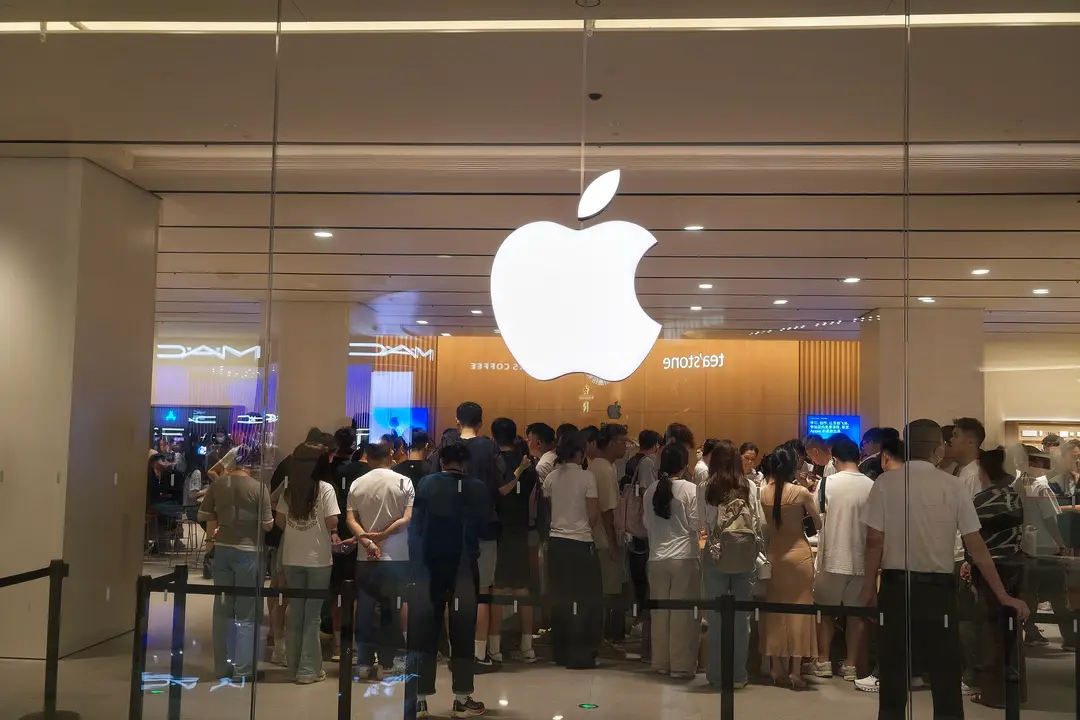
At a Shenzhen Apple Store, crowds of customers queued to collect their phones, while groups of scalpers gathered nearby hoping to buy devices at a premium.
Resale premiums collapse
Resellers quoted premiums of 1,300 yuan for the 256GB model and 1,900 yuan for the 512GB version, according to inquiries by reporters. But the market was already showing signs of cooling.
Around 9 a.m. on launch day, resellers were reportedly asking about 1,500 yuan above retail for both the 512GB and 1TB models, while the 2TB version commanded a premium of only a few hundred yuan, financial news outlet Yicai reported.
The decline is particularly striking for the 1TB model, which carries an official price of 21,499 yuan. According to technology news outlet Kuai Technology, the device’s resale price on the Dewu marketplace reached 79,999 yuan on Sept. 11, a premium of more than 58,000 yuan.
In little more than a month, that premium had fallen to around 1,500 yuan — a drop of more than 97%.
At Apple’s store by Hangzhou’s West Lake, one reseller said he hadn’t had a single deal in the first half-hour after sales began. A customer was reportedly seeking a 2,500-yuan premium for a 512GB model, while a buyer looking to acquire the device for resale was willing to offer only 1,800 yuan above retail.
The premiums have fallen well short of expectations compared with the frenzy surrounding the iPhone 4, which reportedly traded for as much as 15,000 to 20,000 yuan during its heyday.
Software compatibility may be holding back demand
One possible explanation is that the software ecosystem has yet to catch up with Apple’s new hardware. Customers trying the iPhone Duo in stores found that popular Chinese social media apps, including WeChat, Weibo and Douyin, were not immediately available for download.
Earlier tests by a technology blogger of 25 commonly used apps found that about 80% had not completed their adaptations for foldable screens. Apps without foldable-specific optimization could only appear centered on the screen or enlarged proportionally, preventing them from making full use of the device’s 7.6-inch inner display. Adapted apps, by contrast, offered a noticeably better experience for split-screen use and information feeds.
Apple’s customer service team said it had not received reports of compatibility problems involving WeChat, QQ and other apps. It added that iPhone Duo devices undergo testing before release and advised customers to rely on official information, describing reports of incompatibility as findings from third-party testing.
Tencent (0700.HK), WeChat’s parent company, offered a more specific update. Its customer service team said the latest version of WeChat, version 8.0.80, had been adapted for Apple’s foldable devices and could be downloaded or updated through the App Store.
The company acknowledged that this was an initial version of the adaptation and said it would continue to refine the experience. Basic functions were working normally, it added.
Source:
21st Century Business Herald