

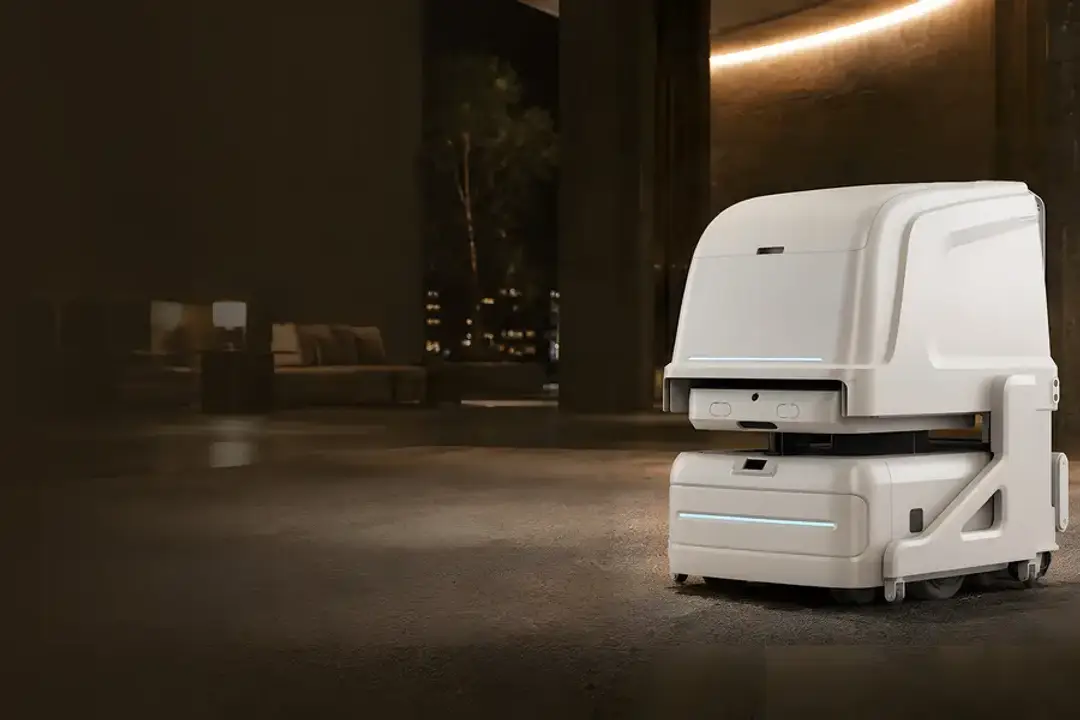
Yunji is expanding beyond hotel robots into AI-driven services and a wider partner ecosystem, but falling core revenue and a plunging share price underscore the risks.
Beijing Yunji Technology (2670.HK) joined an expanding group of Chinese robotics companies seeking public-market funding when it listed in October 2025. Investors initially embraced the company, which makes service robots for hotels, hospitals and other commercial settings using AI to navigate real-world environments and carry out tasks.
Yunji’s shares jumped more than 20% after their trading debut, but the enthusiasm has since faded. The stock has lost nearly 90% of its value from a peak in late June and is trading at about a third of its IPO price.
The company is now trying to convince investors that it can evolve from a hardware manufacturer into a platform business, generating more predictable recurring revenue from software, subscriptions and services.
From robots to recurring revenue
The company’s strategy has drawn comparisons with U.S. auto giant Tesla (TSLA.US) and robotaxi operators, which aim to build networks of deployed vehicles and monetize the services they provide.
“When we discuss things internally, we feel that some of Yunji’s current thinking is quite similar to Tesla’s approach,” CFO Liu Ying told reporters at an event for Chinese media. “First, deploy enough terminals into the network, then have a cognitive and decision-making brain, and finally move towards charging based on results and services.”
The shift is intended to reduce Yunji’s dependence on one-off hardware sales. Its latest business update, released on Oct. 16, offered some evidence of growing network activity. The average daily number of concurrently online robots managed by its network rose 20% to 25% year-on-year in the third quarter, while the number of tasks handled by the fleet increased 25% to 30%.
The company is also developing the software infrastructure needed to support that model. Its HDOS operating system connects service requests arriving through channels such as telephone calls, mini-programs and televisions with robots, employees and other operational resources.
As of June 30, the number of paying HDOS customers had increased 621% year-on-year, according to the company. Paying customers accounted for 83% of the customer base, up 11 percentage points from a year earlier.
Yunji’s UP platform provides another part of the strategy. It combines a standardized mobile robot base with interchangeable functional modules, allowing partners to develop products for different applications without having to build navigation, obstacle avoidance and other core mobility capabilities from scratch.
The company says this architecture can help it expand into markets beyond hospitality, including shopping malls, tourist attractions, residential developments and airports.
Growth comes with a catch
Yunji’s first-half financial results, published in August, showed how quickly its business mix is changing — and why investors remain cautious.
Revenue rose 71.6% year-on-year to 188 million yuan ($28.2 million), while its reported loss narrowed 22% to 111 million yuan. On an adjusted basis, however, the loss more than tripled to 108.8 million yuan from 31.4 million yuan a year earlier.
More importantly, revenue from its core hospitality business fell 12.2% to 88.9 million yuan. Revenue from hotel robots specifically declined 17% to 82.8 million yuan, accounting for about 44% of total revenue, down from 91% a year earlier.
The shortfall was more than offset by sales to ecosystem partners — companies that adapt Yunji’s products for their own applications. Revenue from this category reached 90.5 million yuan in the first half, up from 2.66 million yuan a year earlier. It accounted for 48.1% of total revenue, compared with 2.4% a year earlier.
The figures describe different dimensions of Yunji’s business: revenue from robots and functional kits is a product classification, while ecosystem-partner revenue reflects a customer or sales channel. They should not be treated as separate, additive revenue streams.
The rapid growth in partner sales is encouraging, but it also raises questions about the quality and sustainability of that growth. Yunji is increasingly relying on companies that customize and distribute its technology, rather than selling directly to end users. Investors will want to see whether the new business can deliver attractive margins and repeat orders, and whether growth can eventually translate into profits.
Building a business beyond China
Yunji is also trying to extend its model overseas. The company reported that overseas revenue increased 638.1% year-on-year in the first half of 2026, with 11 representative projects across the United Arab Emirates (UAE), Panama and Thailand. It did not provide an absolute overseas revenue figure, making it difficult to judge the scale behind the growth rate.
In the UAE, Yunji delivered products to four hotels whose operators collectively manage more than 45 hotels in the country. In Panama, its products were deployed at a high-end full-service hotel and five residential, mixed-use or office buildings.
In Thailand, robots were installed at a private international hospital in Bangkok that serves more than 300,000 patients annually. They handle deliveries of medicines, laboratory samples and medical supplies within the hospital.
Such applications illustrate the potential for service robots to move into settings where routine deliveries and other operational tasks can be automated. But overseas expansion will require Yunji to establish reliable local distribution and service networks, as well as demonstrate that deployments can be replicated profitably.
The company’s broader argument is that its installed robot base generates real-world data that can improve its AI systems. More capable systems could then enable robots to perform additional tasks, creating a cycle of deployment, data collection and product improvement.
That could become a competitive advantage, although the durability of any data advantage remains unproven. A large installed base alone does not guarantee that Yunji can convert its operational experience into better margins or a defensible market position.
Stock Connect inclusion could boost profile
Yunji’s shares became eligible for trading through Hong Kong Stock Connect on Sept. 7, opening a route for mainland Chinese investors to buy the stock directly. The inclusion could broaden its investor base and raise its profile in mainland China.
But eligibility does not guarantee fresh demand, and greater access to mainland capital will not resolve the underlying questions about profitability and the transition away from hardware sales.
Yunji has sought to reassure investors by extending the lockup period for shares held by Chairwoman Zhi Tao and CEO Li Quanyin, who collectively own more than 10% of the company. The announcement, released alongside the Oct. 16 business update, did not halt the decline.
Yunji is not alone among listed robotics companies in facing a reassessment of its valuation. Geekplus (2590.HK), Zhejiang Laifual Drive (3952.HK) and Huayan Robotics (1021.HK) have also suffered steep share-price declines over the past six months.
There are still reasons to watch Yunji’s progress. Huaxin Securities forecasts revenue will rise from 458 million yuan in 2026 to 1.25 billion yuan in 2028. But those projections depend on the company sustaining growth while turning its expanding network and partner ecosystem into a more profitable business.
Yunji has demonstrated that it can deploy robots at scale and find new applications for its technology. The next test is whether its shift towards platforms and services can deliver the recurring revenue and financial returns that investors were promised.
Sources:
Bamboo Works
Economic Observer