

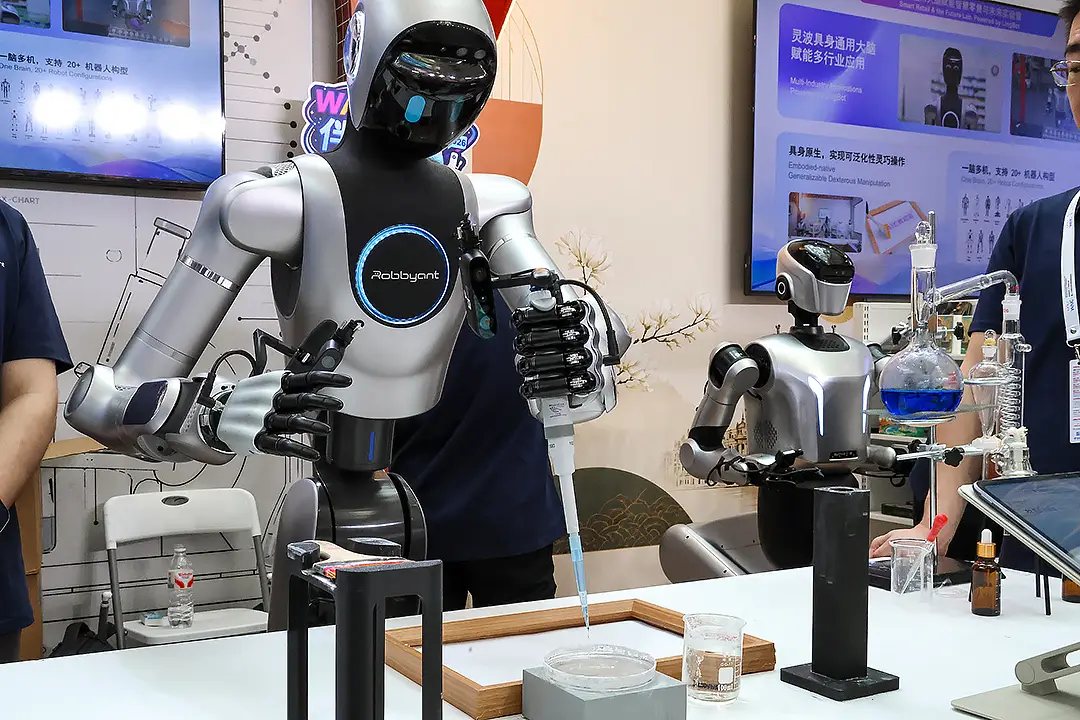
Investors are pouring money into humanoid-robot training data, but the industry has yet to prove that more data will deliver reliable commercial performance.
By Mu Yu
As the robotics industry races to improve humanoid-robot hardware and model parameters, top-tier capital has quietly shifted to a more fundamental bottleneck: robot training data.
Mecka AI, a startup specializing in robot training data, announced on Oct. 7 that it had raised $60 million in a Series B round led by Sequoia Capital. Nvidia, Microsoft’s M12 venture fund, Qualcomm Ventures and Samsung joined existing investors Kindred, Framework Ventures and Neo.
DoorDash CEO Tony Xu, former ServiceNow and Snowflake CEO Frank Slootman, and Milan Kovac, former head of Tesla’s Optimus program, also participated as angel investors.
New York-headquartered Mecka will use the funding to expand its data infrastructure, deepen research and development, and scale commercial robot deployments. Including its $60 million Series A and $8 million seed round, the company has raised more than $128 million. TechCrunch reported that the latest round valued it at about $500 million, although Mecka has not disclosed its valuation.
The investment highlights how robot training data is emerging as a distinct sector within AI infrastructure.
Robots need experience, not just intelligence
Why did Mecka AI win collective bets from global tech giants? The answer lies in the industry’s core bottleneck.
Large language models have advanced rapidly by learning from vast amounts of text available online. Robots lack an equivalent repository of human experience: physical interactions have never been systematically digitized at comparable scale.
There is no comprehensive database showing how people grasp objects, fold clothes or pour liquids, including how much force they apply and when they release their grip. Such information cannot simply be scraped from the internet or purchased off the shelf.
Mecka aims to fill this gap by converting human physical actions into structured data that robots can learn from.
Rather than relying primarily on teleoperation, in which humans remotely control robots to generate training data, the company pays people to wear body sensors and use smartphones to record everyday activities from a first-person perspective. Tasks include making coffee, folding clothes and repairing vehicles.
Algorithms transform these recordings into structured training data. Mecka argues that this approach better captures natural human movements and interactions, while costing less to scale than traditional teleoperation.
Its technology combines custom multisensor hardware, data-collection teams operating in homes and commercial settings, and computer vision and multimodal models. The resulting data includes motion tracking, 3D reconstruction and sensor alignment. The company says its hand-pose tracking achieves sub-centimeter accuracy outside laboratory environments.
From data collection to robot deployment
Mecka also positions itself as a robotics systems integrator. Its services span hardware, data collection, model retraining, system integration and ongoing operations.
Unlike conventional systems that retain their original capabilities after installation, Mecka’s approach collects data at deployment sites and uses it to improve models over time.
Founded in 2024, the company says it surpassed $100 million in annualized revenue in June 2026 and expects to reach $300 million by year-end. Its customers include leading robotics research laboratories and companies among the Magnificent Seven U.S. stocks. It has not disclosed customer names.
Three tiers of robot training data
Nvidia’s GR00T N1 research paper outlines three broad categories of robot training data, each with different trade-offs between cost, scale and accuracy. The base is human video and web data — largest, cheapest, least matched to robot bodies; the middle is synthetic and simulated data — AI-generated, efficient to scale but physically imprecise; the top is real robot data — smallest, costliest, best matched.
Mecka’s approach falls broadly into the base category, although it focuses on structured, high-precision data for enterprise customers.
California-based bipedal humanoid robot developer Figure AI is pursuing a similar strategy through Index, an app that pays people to record household and workplace tasks. The platform, backed by companies including Microsoft and OpenAI, has reportedly attracted 264,000 downloads across 108 countries, more than 44,000 weekly active users and over 16 million uploaded videos.
Figure says internal tests found that pretraining with Index data raised its Helix 2.5 model’s success rate on unfamiliar household tasks from 9% to 56%. The company has proposed a human-to-humanoid scaling law in which doubling the dataset produces predictable improvements in action prediction.
The top category, real-robot data, offers greater fidelity but remains scarce. Manufacturers are increasingly turning robot fleets into data-collection platforms. Tesla plans to deploy its first Optimus robots to Optimus Academy for training-data collection and capability development. Apptronik’s Robot Park collects data using Apollo 2 robots, while Figure’s BotQ factory has delivered more than 350 Figure 03 robots.
Reproducing real-world training data
Yet real-world datasets remain limited. Physical Intelligence’s π0 model used more than 10,000 hours of data, while Toyota Research Institute’s large behavior model used about 1,700 hours and Unitree’s UnifoLM-WLA-1.0 used approximately 2,500 hours.
Even Open X-Embodiment, a collaboration involving 21 institutions and 60 datasets, assembled just over one million trajectories from 22 robot types, most of them robotic arms rather than humanoids.
Synthetic data offers a middle ground. Nvidia researchers used 88 hours of internal teleoperation data to generate about 827 hours of synthetic trajectories, expanding the dataset nearly tenfold. They also generated 78,000 simulated trajectories equivalent to approximately 6,500 hours of human demonstrations, using 11 hours of computing time.
However, synthetic data still struggles to reproduce real-world physics accurately and cannot yet replace real-world training data.
The acid test is deployment
Robot training data is now one of AI infrastructure’s fastest-growing niches. Beyond Mecka and Figure, XDOF, Scale AI, Micro1 and Encord are entering from different angles, competition is intensifying and capital is pouring in.
According to Dealroom figures cited by Tech Funding News, humanoid robotics startups worldwide had raised $8.6 billion cumulatively by the end of July 2026, 1.8 times the total for all of 2025. Investors including Nvidia and Sequoia are backing both robot manufacturers and the data infrastructure behind them.
But a fundamental question remains unanswered: how much data do humanoid robots need to perform paid work reliably outside controlled demonstrations?
Figure’s scaling law measures model prediction error, not operational reliability. Mecka has not disclosed which capabilities its data trains or demonstrated their real-world impact. Companies collecting household videos have also provided limited public information about content-review and data-storage practices.
Tesla’s third-quarter results, due on Oct. 21, could offer investors clues about whether its Optimus Academy is progressing beyond data collection toward practical deployment.
Ultimately, the industry must demonstrate that robots trained on human data can reliably perform tasks for paying customers. Mecka’s funding round signals that the competition is shifting from hardware and models toward data infrastructure. Whether first-person human recordings become a standard approach will depend on results in the real world.