
The smart robotics components maker ends decade-long journey with some blue-chip cornerstone investors including EV giant BYD.
By Lu Zhigao
Xiong’an New Area has delivered its first listed company. Mech-Mind Robotics (9615.HK), which is headquartered in the zone, began trading on the Hong Kong stock exchange on Sept. 1, giving the future city its first public-market champion and underscoring its emergence as a viable incubator of hard-tech unicorns.
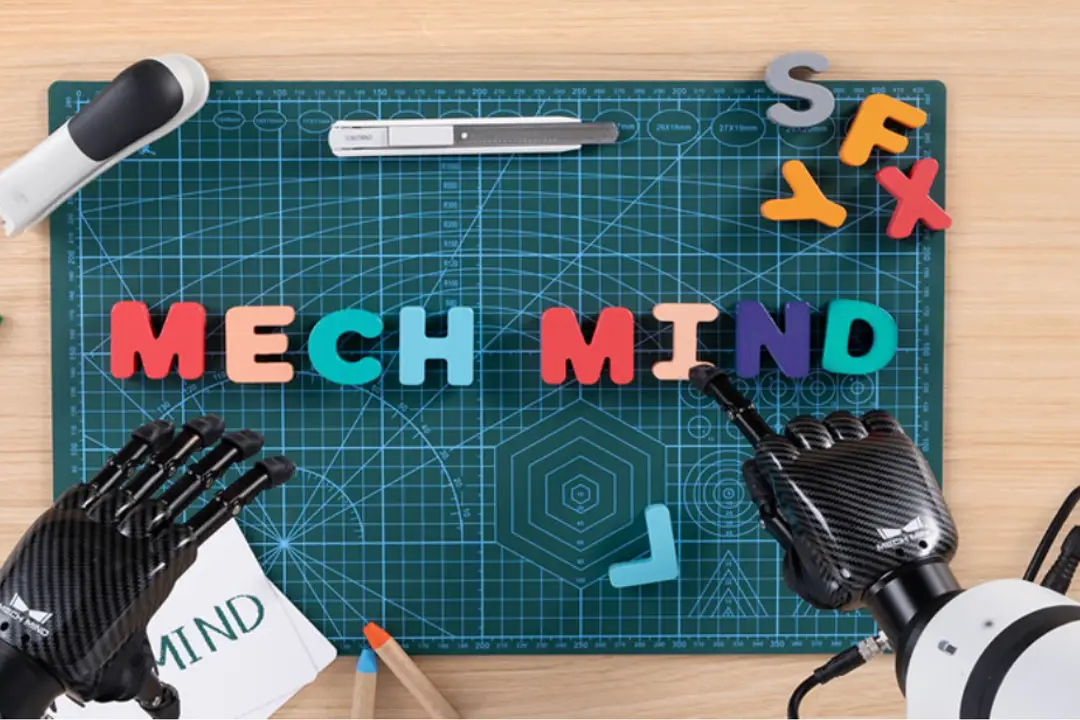
Founded by Tsinghua University alumni led by Shao Tianlan, Mech-Mind has spent a decade developing what it calls the “eyes, brain and hands” of robots: standardized technologies for perception, decision-making, planning and manipulation that can be deployed across different robot bodies.
Xiong’an, a new urban district some 100 kilometers south of Beijing, is one of President Xi Jinping’s flagship development projects, intended to become a high-tech model city and a hub for innovation and advanced industries.
From a programming problem to a business
Shao, who studied computer science at Tsinghua and earned a master’s degree in robotics at the Technical University of Munich, became interested in the problem while working on robotics in Germany. He was struck by how a team of seven or eight graduate students could spend a week programming a robot to perform a task that a human could describe in a couple of sentences.
Industrial robots already had the mechanical ability to perform many tasks. What they lacked was the ability to understand changing environments and plan for themselves. Rather than build another robot body, Shao wanted to solve the problem of how robots “see, think and plan.”
He founded Mech-Mind with fellow Tsinghua alumni Fu Ao and Ding Youshuang in September 2016. They eventually chose to base the company’s global headquarters in the Xiong’an Zhongguancun Science Park, a decision Shao described as a mutual fit: “We are engaged in an industry of the future, and Xiong’an is a city with a futuristic feel.”
The company initially focused on robot vision and planning, launching its Mech-Eye 3D cameras, Mech-Vision software and Mech-Viz programming software in 2017.
The first customer arrived by the end of that year. But working with factories exposed another problem: manufacturing requirements varied enormously from one site to another.
Shao described the market as one that “looks like a trillion-yuan market from afar, but up close is 10,000 markets of 100 million yuan each.”
The company responded by turning problems encountered at individual factories into reusable products rather than repeatedly building bespoke solutions. Shao spent years working directly with customers, effectively becoming the company’s chief product manager.
By 2021, Mech-Mind had entered what it called the “thousands of units” stage, with its own manufacturing facility and the launch of its deep-learning software Mech-DLK. It subsequently expanded into Mech-GPT, a multimodal model, and Mech-Hand, a five-finger dexterous robotic hand.
Standardized ‘eyes and brains’ for factories
The company’s core proposition is to replace some of the engineering work traditionally required to deploy industrial robots with standardized hardware and software.
A robot handling randomly stacked objects, for example, first needs to identify what it is looking at, determine the objects’ positions and then calculate how to grasp them. Mech-Eye provides the 3D spatial information, Mech-Vision identifies targets and Mech-Viz plans the robot’s movements.
The technology is used for picking, sorting, palletizing and loading, as well as inspection and measurement. Mech-Mind says its standardized systems can reduce installation, configuration, and commissioning from weeks of engineering work to hours or days.
That approach has helped the company scale across industries and customers. Its products have been deployed on more than 27,000 robots worldwide, with customers including battery giant CATL (3750.HK) (300750.SZ), electric-vehicle and battery manufacturer BYD (01211.HK) (002594.SZ), consumer and industrial technology group Midea (000333.SZ), and iPhone maker Foxconn (2317.TW) across automotive, new energy, consumer electronics and logistics.
Revenue rose from 181 million yuan ($27 million) in 2023 to 389 million yuan in 2025, reaching 107 million yuan in the first quarter of 2026. Gross margin increased from 39.1% in 2023 to 64.6% in 2025.
The company remains loss-making, however. Net loss was about 360 million yuan in 2025, while adjusted net loss was approximately 109 million yuan, partly reflecting continued R&D investment and changes in the carrying amount of redeemable liabilities.
Eleven funding rounds and an IPO
Mech-Mind attracted investors well before embodied AI became a major investment theme.
Galileo Capital invested 4 million yuan in September 2016, the month the company was founded. Huachuang Capital led a 20 million yuan pre-A round in April 2017, followed by investments from Delian Capital and others.
Qiming Venture Partners invested 42 million yuan in an A+ round in March 2019. Intel and Sequoia China, since renamed HSG, subsequently joined the shareholder base, with Sequoia China investing in four rounds from 2020 and becoming the company’s largest institutional shareholder before the IPO, with a 13.63% stake.
Source Code Capital, Meituan, IDG Capital, Coatue and other investors followed. From April 2022, Mech-Mind completed another two funding rounds, bringing in investors ranging from global institutions such as GIC to industrial investors and Chinese local government-backed funds.
For the IPO, nine cornerstone investors subscribed for a combined $186 million, including Baillie Gifford, Taikang Life, Jane Street, Invus, Ghisallo, NGS Super Fund, BYD, Ruihua Investment and E Fund, China’s largest asset management company.
After 10 years of development and 11 funding rounds, Mech-Mind has reached the public markets with a business built on a relatively simple proposition: make the intelligence behind robots more standardized, reusable and scalable.
For Shao, however, the listing is neither a beginning nor an end, but simply “a normal stage” in the company’s development.
Source:
chinaventure.com.cn