The company’s roughly $9 billion IPO valuation puts the humanoid robot industry under pressure to prove its commercial viability to public market investors.
By Da Cheung
For years, the global robotics industry has been fueled by venture capital hype, with investors pouring billions into startups based on futuristic prototypes and ambitious narratives. Now, the sector is facing the unforgiving scrutiny of the public market.
Unitree Robotics (688836.SH), a major Chinese developer of quadruped and humanoid robots, announced its IPO pricing for China’s STAR market on Aug. 6, which gives it a valuation of nearly 61 billion yuan ($9 billion) based on the IPO price of 150.8 yuan per share, some 45% higher than analysts had expected.
The blockbuster listing establishes a concrete pricing anchor for the emerging humanoid robot sector, which could trigger a fundamental shift in how these companies are valued — from venture capital storytelling to demands for actual revenue and profitability from stock market investors.
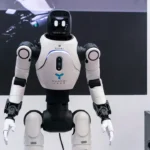
Unitree has positioned itself as a heavyweight in the global robotics market. According to the company’s prospectus, it shipped more than 5,500 humanoid robots in 2025, capturing a 32.4% global market share. It is also a rarity in the cash-burning hardware sector: a profitable company. Unitree reported a net profit of 591 million yuan in 2025, driven by strong sales in both its four-legged and bipedal robot divisions.
However, the IPO marks the beginning of a more grueling race. As the company transitions from a venture-backed darling to a publicly traded entity, it faces mounting pressure to solve the industry’s most complex technical bottlenecks while fending off fierce domestic and international competition.
The race to build an AI brain
Despite leading global shipments and mastering the physical manufacturing of robots, Unitree faces a critical hurdle: developing the artificial intelligence “brain” required to make its machines truly autonomous.
In the robotics industry, physical hardware is no longer considered the primary bottleneck. The true challenge lies in “embodied intelligence” — AI systems that allow a robot to understand complex environments, make independent decisions, and execute precise physical tasks.
Unitree’s net IPO proceeds will amount to roughly 5.9 billion yuan and the company has earmarked 2.02 billion yuan — about a third — for intelligent robot model development and embodied AI research and development. However, this is a high-stakes pivot — Unitree founder Wang Xingxing has publicly admitted that the success rate for the company to develop its own AI brain is less than 50%.
To mitigate the risks, Unitree has entered a strategic partnership with prominent AI model developer DeepSeek. It invested 141 million yuan in the IPO, receiving almost 1 million shares, and signed a joint development agreement to combine its AI models with Unitree’s robotics hardware, specifically for humanoid robots and embodied intelligence applications
Industry analysts suggest this partnership signals a necessary convergence between hardware manufacturers and AI software firms, as neither can easily solve the embodied intelligence puzzle alone.
This heavy investment in R&D is already impacting the company’s bottom line. Unitree projects its net profit for the first half of 2026 will drop by 11% to 22% from the same period in 2025, with much of the decline due to surging research costs.
Undercutting Tesla and global rivals
Unitree has aggressively leveraged China’s vast manufacturing supply chain to drive down costs. The company reduced the average price of its humanoid robots to roughly $23,000 in 2025 — a drop of about $56,000 from 2023.
This aggressive pricing directly challenges the long-term affordability goals of global competitors like Tesla and Boston Dynamics. Elon Musk has long stated his ambition to bring the price of the company’s Optimus humanoid robot down to $25,000, a target Unitree has already undercut.
Domestically, the competition is equally fierce. It is worth noting that market share claims in this nascent industry remain disputed. While Unitree claims the “global first” title for pure bipedal robots with its 5,500 units shipped in 2025, domestic rival Agibot says it has a 39% global share, with 5,168 units shipped in the same year, by including wheeled dual-arm robots in its internal metrics.
A narrowing IPO window for a crowded market
Unitree’s public debut highlights a growing divide in China’s increasingly crowded robotics market. As of mid-2026, at least eight Chinese robotics startups have reached valuations of 20 billion yuan.
These companies have drawn massive investments from a diverse pool of backers. Unitree’s early and strategic investors include global tech giants like Xiaomi, Alibaba, and Tencent, alongside prominent investment firms such as HSG (formerly Sequoia China) and Singapore’s sovereign wealth fund Temasek. State-backed capital has also flooded the sector, with entities like the National Social Security Fund, China National Petroleum Corporation, and various municipal robotics funds taking significant stakes.
However, industry observers warn of an impending shakeout. The IPO window for robotics firms is narrowing. While venture capitalists have been willing to pay massive premiums for future AI capabilities or specialized components, public market investors are expected to demand real-world commercial deployment, verifiable financial data, and sustainable profit margins.
If companies fail to transition their R&D narratives into actual factory orders and consumer sales, the current multibillion-dollar valuations across the sector could face a severe correction.
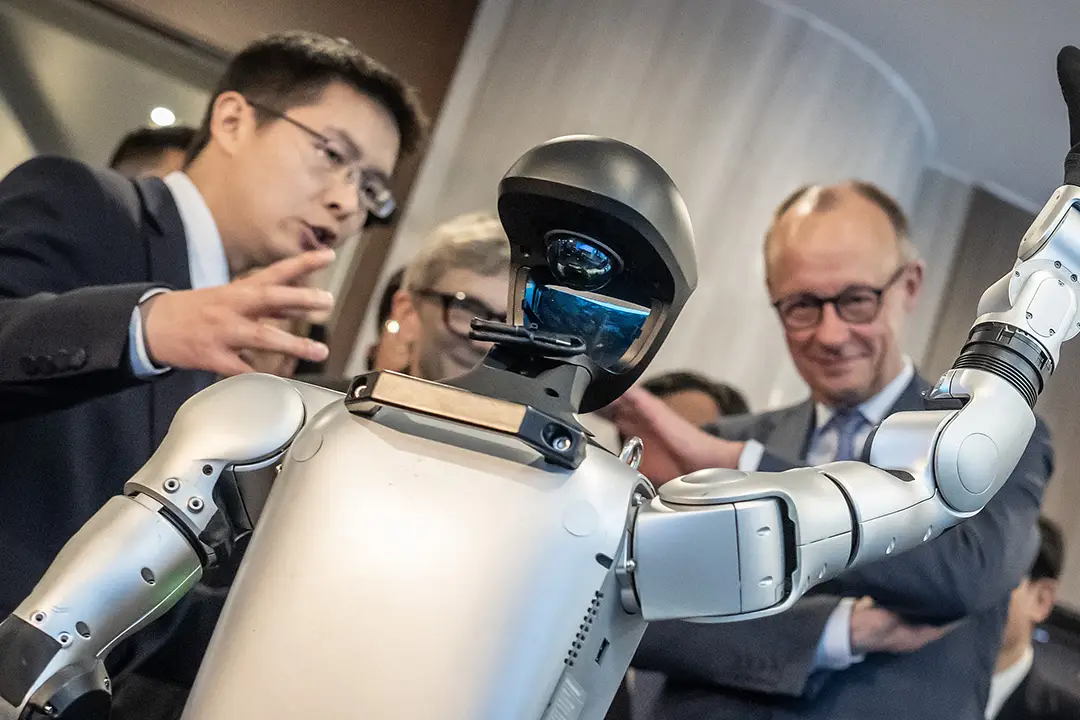
Feature photo: Unitree’s Wang Xingxing (Left) introduces his product to German Chancellor Friedrich Merz (CDU) in Feb. 2026, by CFP.
Sources