

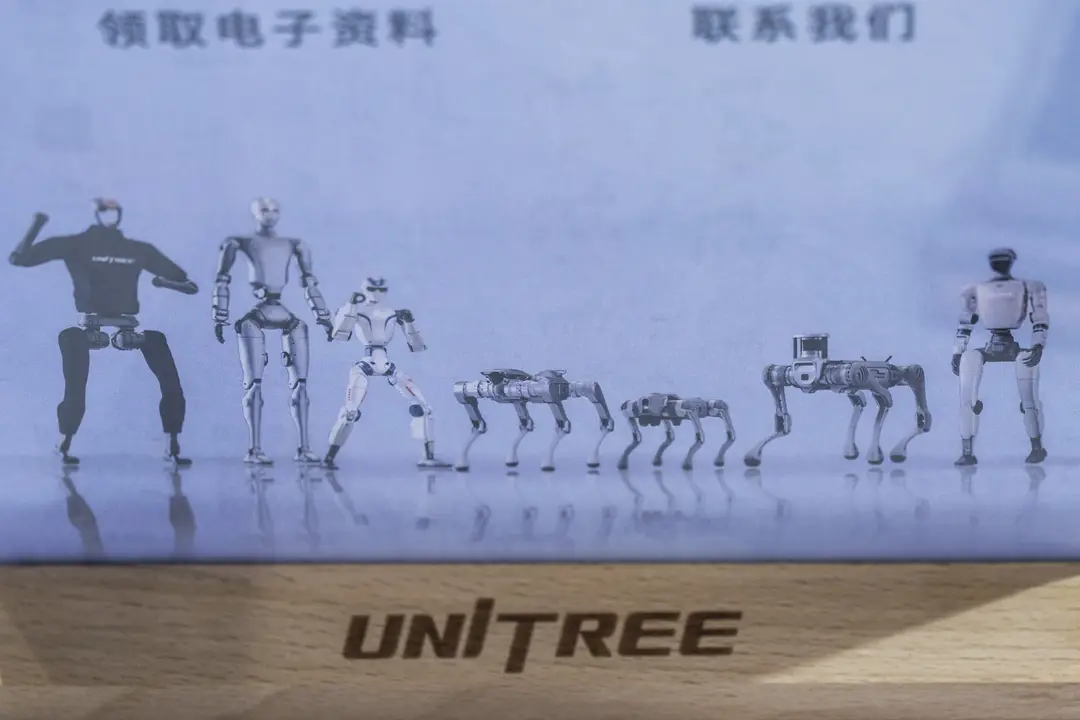
Unitree’s spectacular debut has made its founder a centibillionaire, but a tiny free float means the stock still has to prove it can live up to its valuation.
By Wang Hanxing
Unitree Robotics (688836.SH), the Chinese maker of quadruped and humanoid robots, made its debut on the Shanghai Stock Exchange’s STAR Market on Aug. 19 as the first publicly traded Chinese company focused on embodied intelligence.
The stock opened at 1,100 yuan, 629.44% above its 150.80-yuan IPO price, giving Unitree a market capitalization of 444.9 billion yuan ($66 billion). Investors who won the IPO lottery received an instant paper gain of about 474,600 yuan on a 500-share allocation.
The euphoria did not last long. About 10 minutes after the open, the stock had fallen to around 895 yuan, settling its market value at roughly 360 billion yuan. Even that was well above the expectations of many private-market investors, some of whom had valued Unitree at 200 billion yuan before the listing, while more bullish investors had expected as much as 400 billion yuan.
Founder Wang Xingxing’s roughly 121 million shares were worth 133.6 billion yuan at the opening price, making him a centibillionaire on paper. Meituan (3690.HK) was the biggest outside institutional shareholder, holding 8.684% after dilution. Its roughly 420 million yuan investment was worth about 38 billion yuan at the opening price, representing a paper return of roughly 92 times.
The valuation reflects Unitree’s rarity as the first major Chinese embodied-intelligence company to reach the A-share market, providing a new benchmark for a sector that has until now been valued mainly through private funding rounds. It also reflects stronger-than-usual fundamentals: Unitree reported 1.699 billion yuan in revenue and 590 million yuan in adjusted net profit in 2025, with a gross margin of 60.13%.
But there is a crucial caveat: only 7.44% of Unitree’s shares were freely tradable on its first day. The remaining 92.56% were locked up. The opening price therefore represents the views of a very small pool of investors rather than a broad market consensus.
From zero to 440 billion yuan
Unitree’s journey from startup to blockbuster IPO took a decade. Wang founded the company after winning a robotics design competition with a quadruped robot while studying at university. After a short stint at drone maker DJI, he set up Unitree in 2016 with registered capital of just 100,000 yuan.
The company focused on replacing expensive hydraulic systems with electric motors and cutting costs through its mechanical design, components and control systems. That helped turn quadruped robots from an engineering project into a commercial business.
Unitree’s IPO application cleared the Shanghai exchange’s listing committee in June, just 73 days after acceptance. Its offering raised about 6.1 billion yuan, and the online subscription drew a record 9.78 million investors. The final lottery winning rate was just 0.0181%, the lowest ever for the STAR Market. Strategic placements, accounting for 20% of the offering, were taken by the social security fund, DeepSeek, Tencent and PetroChina. At the open, these strategic investors were sitting on over Rmb7.6bn of paper gains.
At the 150.80-yuan IPO price, Unitree was already valued at about 61 billion yuan, with a price-to-earnings ratio of 219 times — far above the 38.56-times average for the broader equipment manufacturing sector.
Yet market-share data offers a different perspective. Unitree sold more than 5,500 humanoid robots in 2025, according to its prospectus, putting it among the global leaders. Its valuation has also risen dramatically: its last market-based funding round in June 2025 valued the company at 12.7 billion yuan.
The leap from that figure to more than 400 billion yuan in a little over a year shows just how quickly investor expectations for embodied intelligence have changed.
Sustaining a $66 billion valuation
To sustain its hefty valuation, Unitree must overcome three major hurdles.
The first is liquidity. With so few shares available, scarcity itself has inflated the price. Unitree’s first-day trading range — from 1,100 yuan to 882 yuan — showed how unstable such a valuation can be. As locked-up shares are gradually released, the stock will face a much broader test of investor demand.
The second is whether humanoid robots have found genuinely scalable applications. Unitree disclosed that 73.6% of its humanoid-robot revenue in January-September 2025 came from the research and education sectors. Consumer and commercial applications accounted for 17.4%, while industry applications made up just 9%.
Within the industrial category, only 29.3% of revenue came from clearly defined manufacturing or inspection applications. In other words, universities, laboratories and exhibition halls are still doing much of the heavy lifting — not factories.
That is an industry-wide problem. Global embodied-intelligence robot sales exceeded 14,000 units in 2025, but fewer than 2,000 were deployed in actual industrial production, according to Analysys, a digital intelligence and market research firm. Unitree’s revenue growth is already slowing: first-quarter 2026 revenue rose 68.5% year over year, while adjusted net profit fell 52.6%.
The final hurdle is the “brain.” Unitree historically concentrated its R&D on robot hardware and motion control — the body and “cerebellum” — and only began significantly increasing investment in embodied AI models in 2024. It has since released its UnifoLM-WMA-0 and UnifoLM-VLA-0 models but has yet to establish a clear technological lead.
More than 85% of the IPO proceeds will go toward R&D, much of it targeting these AI capabilities. Whether that investment produces a genuinely capable robotic “brain” may ultimately determine whether Unitree’s extraordinary IPO valuation proves visionary — or simply premature.
Source:
Dingjiao One