

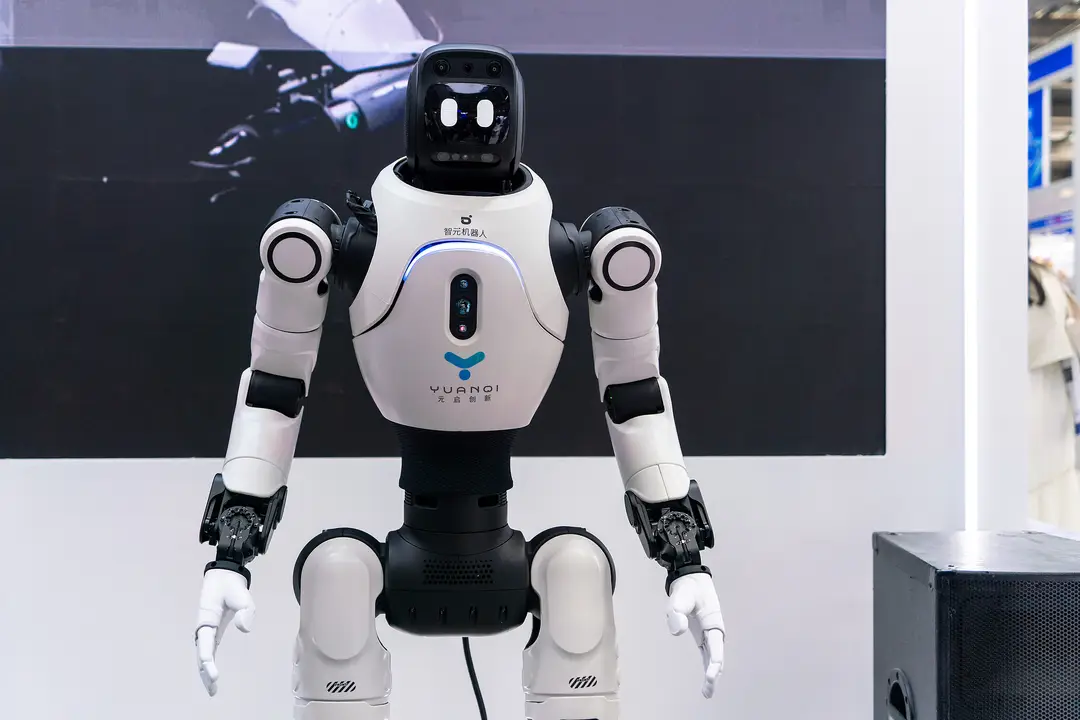
China accounted for over 97% of global humanoid robot shipments in the first half of 2026, with AgiBot and Unitree leading the market.
Humanoid robots are moving out of the lab and into the warehouse at a pace that is reshaping the global market. Chinese manufacturers accounted for more than 97% of all humanoid robot shipments worldwide in the first half of 2026, according to estimates from Smart Analytics Global (SAG). Total global shipments reached 19,100 units, a year-on-year increase of 272%.
Shanghai-based AgiBot (Zhiyuan Robotics) was the market leader with 8,400 units, 44% of the total, while Unitree Robotics (688836.SH) shipped 5,900, giving it a 31% share. Together, the two Chinese companies accounted for about three-quarters of global shipments.
The figures point to China’s growing lead in manufacturing and delivery capacity. But shipments do not necessarily mean that the robots have entered commercial production. Many are still being used for research, training, education and demonstrations.
That distinction will become increasingly important as the industry moves from showcasing what humanoid robots can do to proving that they can perform useful work reliably.
From demonstrations to industrial work
More than 70% of humanoid robots shipped in the first half were purchased for industrial and commercial applications, up from about 50% a year earlier. Automotive factories, electronics manufacturing, logistics and warehousing are among the earliest sources of demand, with robots being used for tasks such as material handling, assembly and inspection.
These environments are relatively well suited to current technology. Their boundaries are defined, workflows can be broken down into specific tasks and results can be measured. A robot does not need to cope with every possible situation if it can reliably perform a particular job on a factory floor.
That makes it easier for companies to calculate productivity, operating costs and potential returns on investment.
Consumer applications are developing more slowly. Humanoid robots designed for interaction or companionship face a much harder environment in the home, where objects and situations are less predictable and requirements for dexterity, safety and environmental understanding are higher.
Why China has pulled ahead
China’s lead reflects the combination of a mature domestic supply chain, strong local demand, and concentrated investment.
More than half of the roughly 100 major global humanoid robot component suppliers are based in China, covering components including reducers, servo motors and 3D vision sensors. A large domestic supplier base can shorten procurement and development cycles while helping manufacturers reduce costs.
Demand and funding are also concentrated in China. The country accounted for more than 85% of global humanoid robot demand in the first half, while Chinese companies attracted close to half of global venture capital investment in the sector early this year.
That creates a reinforcing cycle: larger orders allow manufacturers to increase production, higher volumes generate more operating data and greater scale can lower component and manufacturing costs.
But high shipment volumes should not be mistaken for comprehensive technological leadership.
Many humanoid robots remain better suited to demonstrations, dancing or fixed sequences than to sustained autonomous commercial work. Dexterous manipulation, reliability, battery life and the ability to operate with minimal human intervention remain significant obstacles.
Software is another potential dividing line. Chinese companies have advantages in hardware manufacturing, supply chains and costs, while U.S. companies including Tesla and Nvidia continue to have significant capabilities in AI systems and embodied intelligence.
The eventual winners may therefore not be the companies that simply manufacture the most robots, but those that combine hardware and software well enough to deliver consistent economic value.
Scale does not equate to profitability
Rapid growth is also putting pressure on margins.
Unitree’s revenue more than tripled in 2025 and the company became profitable, but its first-quarter 2026 profit fell 55% year on year as competition intensified and research and development spending increased.
That suggests the market is already entering a phase of price competition. Manufacturers need to reduce selling prices while continuing to spend on algorithms, hardware, testing and adaptation to specific operating environments.
SAG expects global humanoid robot shipments to approach 60,000 units in 2026 and reach 500,000 by 2030, with the market potentially worth $69 billion.
Those are forecasts, however. With 19,100 units shipped in the first half, reaching 60,000 for the full year would require about 40,900 units in the second half — more than twice the first-half total.
The next stage of the industry will therefore be judged less by how many robots manufacturers can ship than by how many can keep working.
China has already established a clear lead in production scale, supply-chain depth, manufacturing costs and domestic demand. The rise in industrial and commercial applications from about 50% to more than 70% also suggests that purchasing is shifting from demonstrations toward real-world deployment.
The critical questions now are whether robots can operate continuously with less human intervention, whether customers can demonstrate measurable economic returns, and whether manufacturers can maintain reasonable margins while cutting prices and increasing research spending.
If those three conditions improve together, China’s enormous shipment advantage could translate into a durable industrial lead. If not, shipment numbers may continue rising while many robots remain stuck in demonstrations and pilot projects.
The real test for the industry is no longer how many humanoid robots China can produce. It is how many can stay on factory and warehouse floors and keep working.
Source:
Humanoid Robot Insight Research