

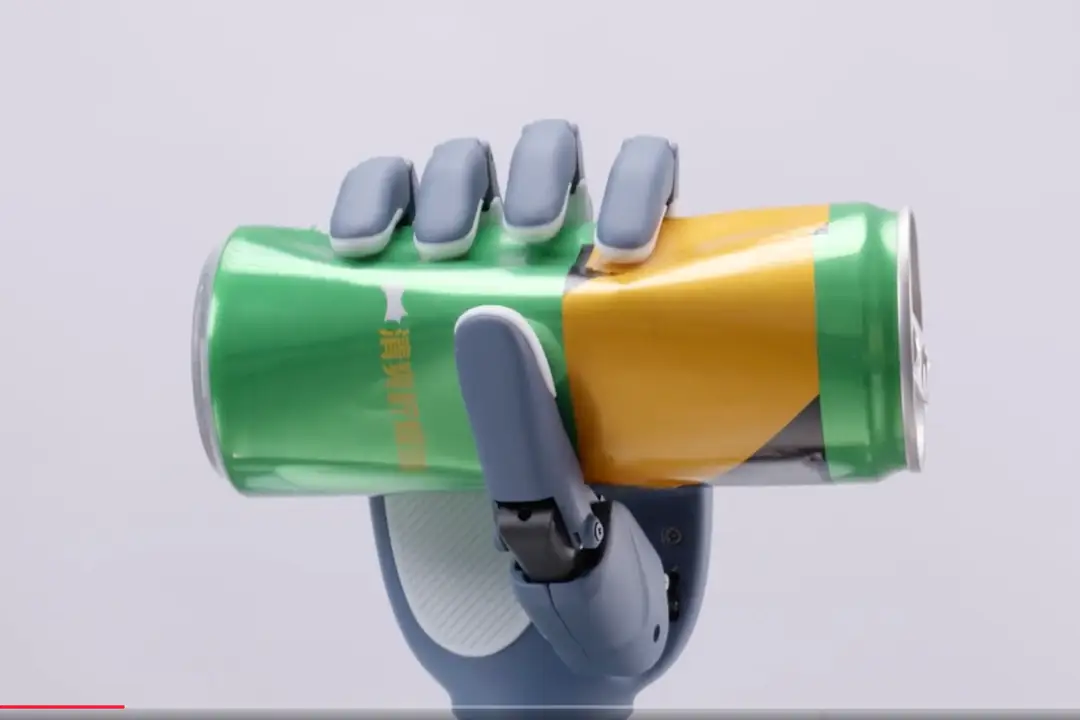
The market is attracting billions in funding, but wildly different technologies, prices and performance metrics underscore the sector’s immaturity.
By Wang Lu
The humanoid robot industry is rapidly maturing. But one crucial component remains stubbornly difficult: the hand
That matters because dexterous hands are expensive. Morgan Stanley estimates they account for about 17.3% of the material costs for Tesla’s Optimus, while industry participants put the typical share at 10%-20%, and above 20% for some high-end configurations.
Investors have already taken notice. According to incomplete data from IT Juzi, Chinese dexterous-hand companies raised about 16.9 billion yuan ($2.51 billion) in 2025. In the first half of 2026 alone, the figure exceeded 25 billion yuan.
Valuations have surged. Linkerbot, a leading Chinese startup specializing in high-degree-of-freedom dexterous robotic hands is targeting a valuation of about $6 billion, while Critical Point, spun out of humanoid robot maker AgiBot, passed $1 billion after four funding rounds in five months.
Yet the industry remains remarkably fragmented. Xuanxiang Robotics CEO Su Jiuyu describes the market as “out of focus,” with no dominant technology or clear mass-market application. This year, he says, could be the beginning of mass production — or the early stages of a bubble.
Three technologies, three different businesses
Players span three fronts: upstream component makers, mainstream full-hand hardware manufacturers, and downstream developers pursuing in-house solutions.
Mainstream hardware approaches fall into three categories: fully direct-drive (independent motors for each joint), cable-driven (motors located at the wrist, actuating via cables), and linkage-based (motors positioned near the fingers, driving movement through structures like parallel linkages).
Linkage and tendon-driven hands are relatively inexpensive and can handle heavier loads, making them better suited to industrial applications. But they have fewer degrees of freedom — the number of independently controllable movement directions per finger — and struggle with fine, human-like manipulation. A hand might pick up an orange or move a box but still be unable to handle a phone or peel the orange.
Direct-drive hands have the highest performance ceiling because each joint has its own motor. They are also much more expensive, generally starting at about 100,000 yuan. Huachuang Securities estimates that motors alone can cost 26,000 yuan to 65,000 yuan per hand.
The motor, lead-screw and encoder supply chain also remains heavily dependent on imports. Companies pursuing direct drive often have to develop their own motors, creating difficult engineering challenges. And while more motors increase dexterity, they can reduce lifting capacity because each joint contains a small motor with limited torque.
Software is less differentiated for now. Developers are broadly pursuing vision-language-action models and world models, but progress has lagged hardware, with most open-source systems still treating the hand primarily as a grasping tool rather than enabling sophisticated manipulation.
No common ruler
The lack of standards becomes particularly obvious when companies announce market-leading figures.
China’s dexterous-hand shipments surged 236% in 2025 to 19,200 units, according to market research firm GGII. Yinshi Robot, also known as Inspire-Robots, says it delivered more than 10,000 units and led the market. Linkerbot claims more than 80% of the global high-degree-of-freedom market, while DH-Robotics has cited more than 200,000 cumulative deliveries of electric end-effectors over eight years.
All three figures can be accurate because they measure different things. One counts shipments, another covers a narrowly defined high-end segment, while the third includes a much broader range of products such as electric grippers.
“Degrees of freedom” are similarly difficult to compare. Companies use different methods to count them, and the number does not necessarily equal the number of motors. Prices also range widely. Linkerbot’s O6 Lite sells for 3,999 yuan after subsidies, while its L30 research model approaches 100,000 yuan. High-end overseas direct-drive hands can cost 400,000 yuan to 600,000 yuan.
That makes shipment numbers a poor measure of commercial success. A company selling 10,000 hands at 3,999 yuan generates about 40 million yuan in revenue; one selling 2,000 hands at 100,000 yuan generates 200 million yuan.
From parameters to practical application
Two external forces are now challenging the existing balance: the self-development push from major robot manufacturers and a technological breakthrough in tactile sensing. Tesla, Unitree Robotics, and others are already developing their own hands. Tactile sensors — “artificial skin” on fingertips and palms — are becoming a key differentiator and are transitioning from optional to essential because they allow robots to detect contact force, slipping, and surface characteristics. Without tactile feedback, a robot may crush an egg or fail to detect that a glass is slipping.
Their adoption rate in dexterous hands has surged from around 10%-20% at the end of 2024 to over 50% a year later.
For the next one to two years, several technology routes are likely to coexist because most smaller robot makers and research customers still need to buy their hands. Over three to five years, however, in-house development by leading humanoid companies is likely to accelerate consolidation.
That will not necessarily eliminate outside suppliers. Mature industrial robotics suggests that major robot makers can develop some critical components themselves while continuing to source others. The companies most vulnerable are likely to be smaller players with no distinctive technology or application.
Ultimately, the winners may be determined less by specifications than by whether their products can do useful work reliably. The industry’s highest-end hands already reach 42 degrees of freedom, compared with roughly 27 in a human hand. Simply adding more is unlikely to be enough.
The real challenge is balancing dexterity, force control and tactile sensing for a specific task. A high-end tactile system can cost about 3,000 yuan per fingertip, or nearly 15,000 yuan for a five-finger hand — an unnecessary expense for applications that do not need that degree of precision.
The industry does not lack products, prototypes or investment. What it lacks is a standard — and companies that can prove their hands can reliably work in the real world and turn technology, applications, and data into a sustainable commercial model.
Source:
DingjiaoOne