
China’s humanoid robotics sector is projecting confidence on stage even as it confronts a reckoning in capital markets.
By Brent Li
At a company conference on Thursday, Wang Xingxing, founder and CEO of prominent Chinese robot maker Unitree Robotics (688836.SH), declared that “embodied AI” — artificial intelligence integrated into physical machines — is nearing a breakthrough. Wang told attendees that the industry is one to three years away from a “ChatGPT moment,” which he defined as a point where a robot can follow voice or text prompts to complete roughly 80% of tasks in 80% of unfamiliar environments.
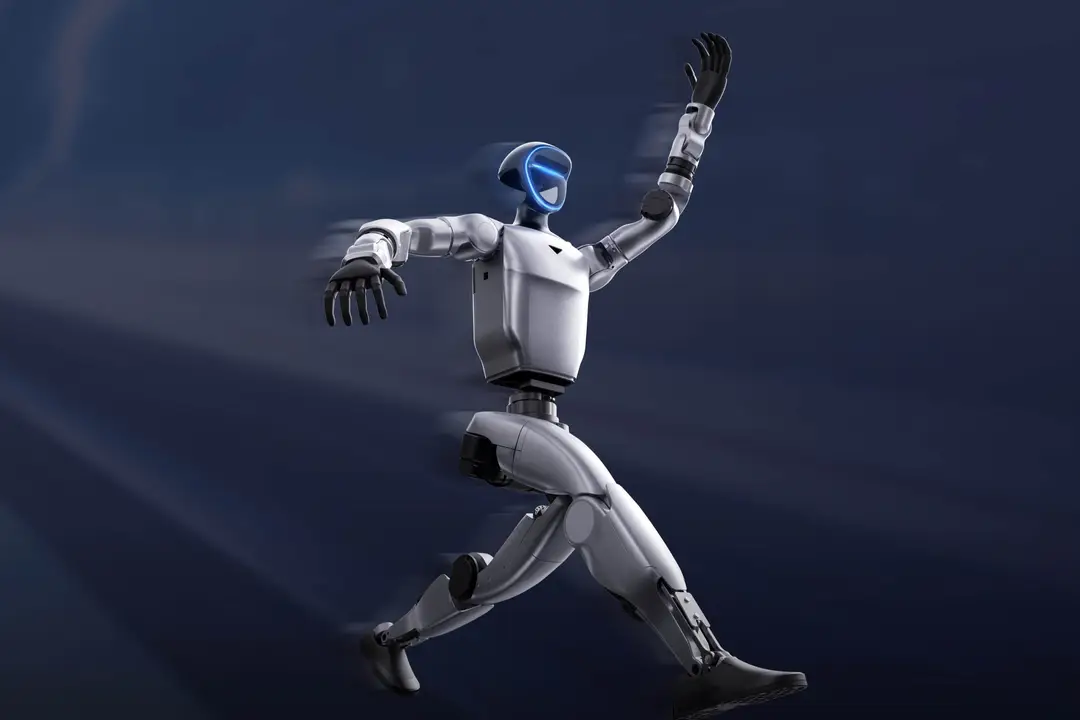
To back his optimism, Wang claimed that OpenAI’s GPT-6 model has been deployed on Unitree robots with “zero training,” enabling the machines to autonomously paint, wash brushes, play board games like Go, and locate tools in a kitchen. A day earlier, Unitree released a promotional video of its new H2-X humanoid robot, which it claims has an eight-hour battery life, leaping off shipping containers, lifting a car, and kicking in a car door.
Yet a closer look at recent academic research and company disclosures suggests that bridging the gap between viral demos and household utility remains a complex challenge. As the hype around flashy hardware collides with the realities of factory floor deployment, both technologists and venture capitalists are reassessing how quickly robots will become commercially viable.
Behind the curtain of ‘zero-training’ autonomy
While Unitree’s promotional materials highlight dramatic physical feats and plug-and-play AI, independent research illustrates the heavy engineering still required behind the scenes.
Unitree did not disclose its H2-X robot’s hardware specifications, testing conditions for its eight-hour battery claim, or how much of the martial-arts demonstration relied on remote control and preset scripts rather than true autonomy.
Similarly, a recent collaborative project called HomeBody between Stanford University at the California Institute of Technology — which used OpenAI’s GPT-6 Astra model to guide a Unitree G1 humanoid through an unfamiliar kitchen to put away groceries and fetch medicine from a drawer — shows that “zero-shot” deployment is far from a simple software login. According to Stanford’s Movements Lab, the system did not require new motion-training data for the specific kitchen, but it relied on an elaborate three-step setup. First, the robot had to scan the room using cameras and laser sensors. Next, it built a 3D “digital twin” of the kitchen inside an Nvidia Isaac Sim simulation platform. Finally, rather than controlling the robot’s joints directly, GPT-6 acted as a high-level planner triggering a pre-written library of motor skills — such as navigating, grasping, or opening drawers — while a separate pre-trained controller kept the robot balanced.
Even with this setup running on a high-end RTX 4090 laptop alongside cloud-based AI — incurring preparation time, computing costs, and pauses between movements — the hardware struggled with prolonged work. QbitAI noted that overheating in the robot’s finger motors remains a practical limitation.
A fractured search for the robot brain
The Stanford experiment highlights a deeper divide within the robotics industry: engineers cannot agree on how to build a robot’s brain. “Every company has its own narrative, and the more you listen, the harder it is to judge which path will actually lead to the future,” an industry expert told Tencent Tech.
For the past two years, many developers favored Vision-Language-Action (VLA) models, which translate visual data and text prompts directly into robotic movements. Now, that consensus is splintering. While HomeBody bypassed learned action models in favor of pre-programmed skill libraries, Chinese startup Guangxiang Tech argues that VLA models are hitting a wall because they rely on statistical guesswork rather than an understanding of physics.
Speaking with Tencent Tech, Guangxiang CEO Zhang Tao and chief scientist Lü Yao said their company is building “physics-native world models” — AI systems designed to understand cause-and-effect, such as gravity and object weight, to prevent robots from making dangerous physical errors akin to chatbot “hallucinations.”
Other Chinese developers argue that smaller, specialized AI models can beat massive U.S. systems. Shanghai-based unicorn ACE Robotics claims its new embodied AI model, built on Alibaba’s comparatively compact Qwen3.5-9B architecture, outperformed OpenAI’s GPT-6 Astra on six out of eight spatial-awareness benchmarks.
Meanwhile, Unitree and companies like AgiBot (Zhiyuan Robotics) are trying to solve what researchers call an expensive “waste” in robotics: having to train a new AI brain for every different robot body. Li Zhongyu, an assistant professor at the Chinese University of Hong Kong, told tech outlet Huxiu that because future workplaces will use everything from humanoids to wheeled bots and simple suction grippers, developers are pursuing “cross-embodiment” systems. By training AI on first-person video recorded by humans, researchers hope to create a single shared brain that understands physical spaces and task progress across multiple machine designs.
Capital cools as commercial reality sets in
As technical debates multiply, China’s robotics investment boom is cooling. According to incomplete statistics from Yicai, funding for China’s embodied AI sector dropped to 33.34 billion yuan (approximately $5 billion) in the third quarter. That’s down from a quarterly average of 46.75 billion yuan in the first half of the year, according to data from research firm IT Juzi.
An industry insider told Yicai that the sector is entering a “value correction” phase to clear out a valuation bubble, triggered in part by a sharp stock pullback following Unitree’s August IPO, tightening listing windows, and scrutiny over inflated robot sales figures. Funding hasn’t dried up completely — XPeng Robotics raised $900 million in August, while startups like Galbot (Xingdong Jiyuan), LimX Dynamics, and Sharpa have secured massive rounds — but investors are shifting from “casting a wide net” to backing only top-tier teams, Miao Tianyi, executive partner at Puzhuo Capital, told Yicai.
The core problem is turning sales into sustainable profits. China shipped more than 40,000 humanoid robots in the first half of 2026, according to government data cited by Robot Outlook. Unitree claims 10,000 to 20,000 cumulative deliveries of its G1 model since May 2024. Yet a recent government-backed report noted that most of the industry remains in a stage of “established growth, unproven profitability,” with early deployments largely limited to theme parks, retail store placements, and factory pilots by firms like AgiBot and AI2 Robotics (Zhipingfang).
That scramble contrasts with the methodical approach of U.S. pioneer Boston Dynamics. Earlier this month, the company appointed its first external CEO, former Amazon AI executive Rohit Prasad, as it transitions from viral parkour videos to factory work. Backed by parent company Hyundai Motor Group, Google DeepMind, and Nvidia, Boston Dynamics is training its Atlas humanoid at a Georgia facility to sort auto parts, aiming for commercial deployment inside Hyundai plants by 2028 and broader assembly work by 2030. Whether in the U.S. or China, the metric for success is shifting from what a robot can do in a video to how reliably it can work a shift.
Feature photo: Unitree Humanoid Robot G1, by Unitree
Sources