

Founded by the team behind LiDAR specialist Hesai, Sharpa has raised more than 4.5 billion yuan as it bets on dexterous manipulation
By Xu Lisi
Chinese robotics startup Sharpa has raised more than 4.5 billion yuan ($630 million) in a funding round backed by Alibaba, Meituan, Tencent, JD.com and Transsion, alongside venture capital firms including Sequoia China, Qiming Venture Partners, Meituan Longzhu and Guanghe Venture Capital.
The company said its post-money valuation now exceeds 22 billion yuan, making it one of China’s highest-valued robotics startups.
Sharpa, founded in 2024, said it will use the new funding to accelerate core technology development, attract and develop top talent, and move general-purpose robots from technical validation into real-world applications.
The company focuses on dexterous manipulation — enabling robots to handle objects and perform complex physical tasks with capabilities closer to those of human hands. Its founders, Li Yifan, Xiang Shaoqing and Sun Kai, were also co-founders of LiDAR (light detection and ranging) maker Hesai Technology (HSAI.US; 2525.HK), making Sharpa their second startup.
From LiDAR to dexterous robotics
For robots to work reliably in real-world environments over long periods, they need to do more than move and perceive their surroundings. They must interact physically with objects, performing tasks such as picking, carrying, assembling and folding while adapting to changes in object position, materials and other sources of uncertainty.
That is the problem Sharpa is targeting. Most tools, equipment and workflows are designed around human hands, so robots entering factories, stores, offices and homes need not only human-like manipulation capabilities but also the ability to sense force, position and the state of objects and correct their movements in real time.
Sharpa has developed a product lineup spanning dexterous hands, humanoid robots and foundation models. Sharpa Wave is a human-sized dexterous hand with 22 active degrees of freedom and more than 1,000 tactile sensing units at its fingertips. Sharpa North is a full-body humanoid platform with 70 degrees of freedom. Its CraftNet model is a hierarchical 0/1/2-level multimodal foundation model for fine manipulation, combining reasoning, vision and tactile information to address the “last millimeter” of physical interaction.
From NVIDIA to ice-cream shop
In June, at NVIDIA’s (NVDA.US) GTC conference in Taipei, the U.S. chip designer, Sharpa, and Unitree Robotics (688836.HK) unveiled a reference design for NVIDIA’s Isaac GR00T humanoid robotics platform. Sharpa Wave provides the dexterous tactile manipulation capabilities, while NVIDIA’s development platform and Unitree’s humanoid robot form the rest of the system.
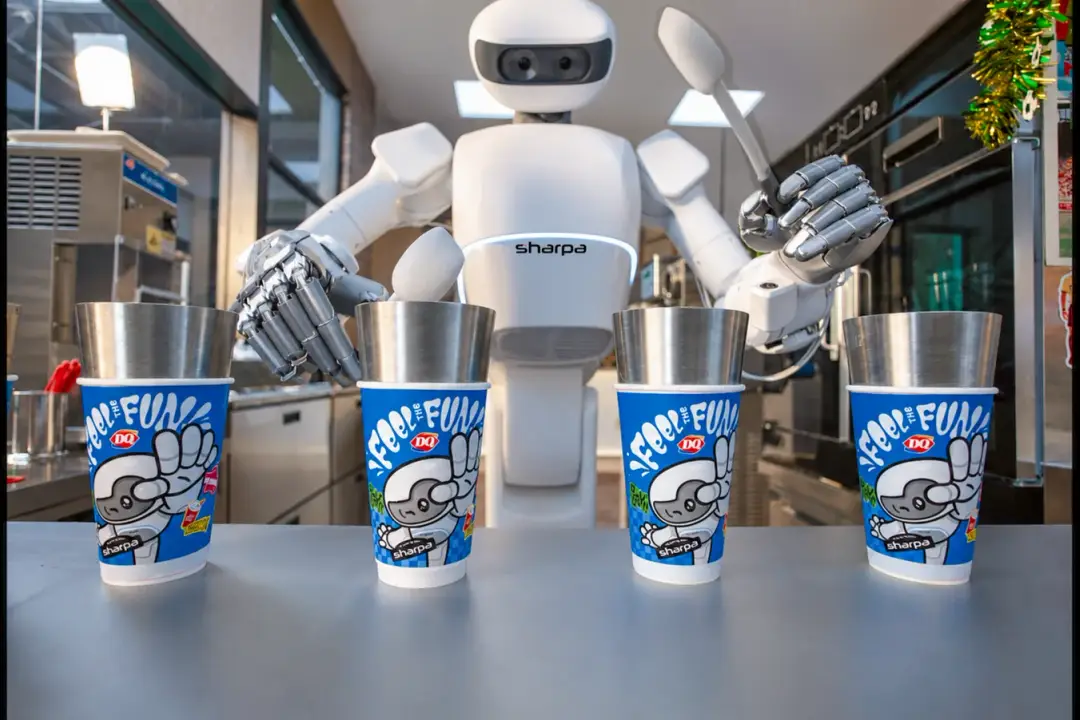
In August, Sharpa and Dairy Queen opened what they describe as the world’s first “no-retrofitting, fully autonomous, year-round” robotic restaurant in Shanghai. The store retains Dairy Queen’s existing supply chain, ingredients, equipment and operating standards, with no changes to the space or workflow.
During a demonstration, a robot completed all 55 steps required to make and deliver a Dairy Queen Blizzard, from taking the order through preparation and handover. The process includes removing a paper cup from a sanitizing tray, picking up and precisely aligning the cup holder, adding ingredients, stirring the thick ice cream without spilling it, and finally turning the cup upside down as part of the preparation process.
The full sequence took about 6.5 minutes, roughly half the efficiency of a human worker.
Sharpa said it has not trained Blizzard preparation as a single, closed procedure for one store. Instead, it breaks the task into reusable skills such as opening cabinets, retrieving objects, separating cups, pushing and pulling, alignment, scooping, mixing, pouring and delivery. The aim is to reduce development work when deploying robots in new environments.
Its products are also being used in robotics research at universities and technology companies, including MIT, Stanford, UC Berkeley, Tsinghua University, Peking University and Shanghai Jiao Tong University.
Sharpa plans to expand into factories, retail stores, hotels and other real-world environments to test how well its dexterous manipulation capabilities can generalize across different tasks and settings.
Dexterity: the next robotics battleground
The robotics industry has spent recent years focusing heavily on mobility, perception and interaction. As robot hardware becomes more capable, the ability to use both hands to perform complex tasks, operate tools designed for humans and fit into existing workflows is emerging as a critical step from robots that can move to robots that can actually work.
Sharpa’s progression from dexterous hands and foundation models to a robot operating in a real restaurant reflects that shift. Real-world deployments can also generate large amounts of operational data, which can be fed back into models to accelerate improvement.
The physical world will not make things easier for robots. Ultimately, commercial orders are likely to go to machines that can reliably perform useful work in environments built for humans.
Source:
Robotics Outlook