
Two CAS alumni are racing to define AI’s next frontier – but can they monetise before the hype fades?
By Da Peng
In June 2026, GigaAI closed a Series B2 round at a post-money valuation of 20 billion yuan ($3 billion). Just 12 months earlier, its Series Pre-A had been a few hundred million yuan. Now, whispers of a Pre-IPO round and a Hong Kong listing as early as the first half of 2027 position the Beijing-based startup as the would-be “first world-model public company” globally.
Behind the numbers lies a technological gamble, a scientific founder’s quest for a “Codex moment”, and a decade of shared academic pedigree.
The two ‘contrarians’
The story begins in the summer of 2023, when China’s AI sector was obsessed with large language models. In Haidian’s Tsinghua Science Park, two researchers from the Chinese Academy of Sciences’ Institute of Automation took the opposite tack: teach machines to see the world, not just talk about it.
Huang Guan, the senior, was a top Huazhong University of Science and Technology graduate who earned his PhD in automation from Tsinghua University, with a stint at Microsoft Research Asia. His career tracked the waves of physical AI: visual perception lead at Horizon Robotics (9660.HK), building the WebFace260M dataset, winning the 2020 ECCV COCO Challenge, and later as co-founder and algorithm VP at Zhen Robotics.
Zhu Zheng, the junior, holds a PhD from the same CAS institute and did postdoctoral work at Tsinghua. He has published more than 70 papers at conferences including CVPR, ICCV, ECCV and NeurIPS, with almost 20,000 citations, and has been named among the world’s top 2% of scientists for four consecutive years. He won China’s Wu Wenjun AI Natural Science Award in 2025.
The pair decided to start a company as large language models were becoming increasingly crowded. Coming from computer vision, they believed they had an advantage in understanding the physical world.
“Just predicting future actions isn’t enough,” Zhu said. “We also need to predict what the future world will become.”
GigaAI was incorporated in June 2023.
Fundraising frenzy
GigaAI’s fundraising accelerated sharply in 2026. Huawei Technologies’ venture capital arm Hubble Technology Investment remains an important shareholder, having invested in its A1 round in November 2025 and continued to back the company.
GigaAI raised nearly 1 billion yuan in its Pre-B round in March, almost 1.5 billion yuan in its B1 round in April, and another 1 billion yuan in its B2 round in June. Its post-money valuation reached about 20 billion yuan, with investors including Singapore-based Lion Capital, China-Belgium Direct Equity Investment Fund, CCB Investment, Wanxiang Qianchao and Fosun RZ Capital.
Huang told Bloomberg during the World Artificial Intelligence Conference (WAIC) in July that GigaAI would become the world’s first listed world-model startup and said its latest financing valued the company at $3 billion, or about 20 billion yuan.
The company subsequently walked back the comments and the reported 2027 listing remains a market expectation rather than a confirmed timetable. The valuation has nevertheless risen roughly 50-fold in 12 months.
Searching for world models’ Codex moment
The more interesting question is what investors are actually betting on.
The definition of a world model — and the technology needed to build one — remains unsettled. At a WAIC forum in July, Zhu compared the industry’s current position with OpenAI’s development of Codex and asked what the equivalent “Codex product” would be for world models.
Codex gave language models a powerful application in programming and helped the industry converge around a clear product direction. World models, Zhu argued, remain stuck in a proliferation of impressive demos without a defining application.
GigaAI has also changed its own strategy. It initially pursued a “one brain, many bodies” approach, trying different robot platforms, collecting data and training models for them. Zhu later concluded that the strategy was too aggressive.
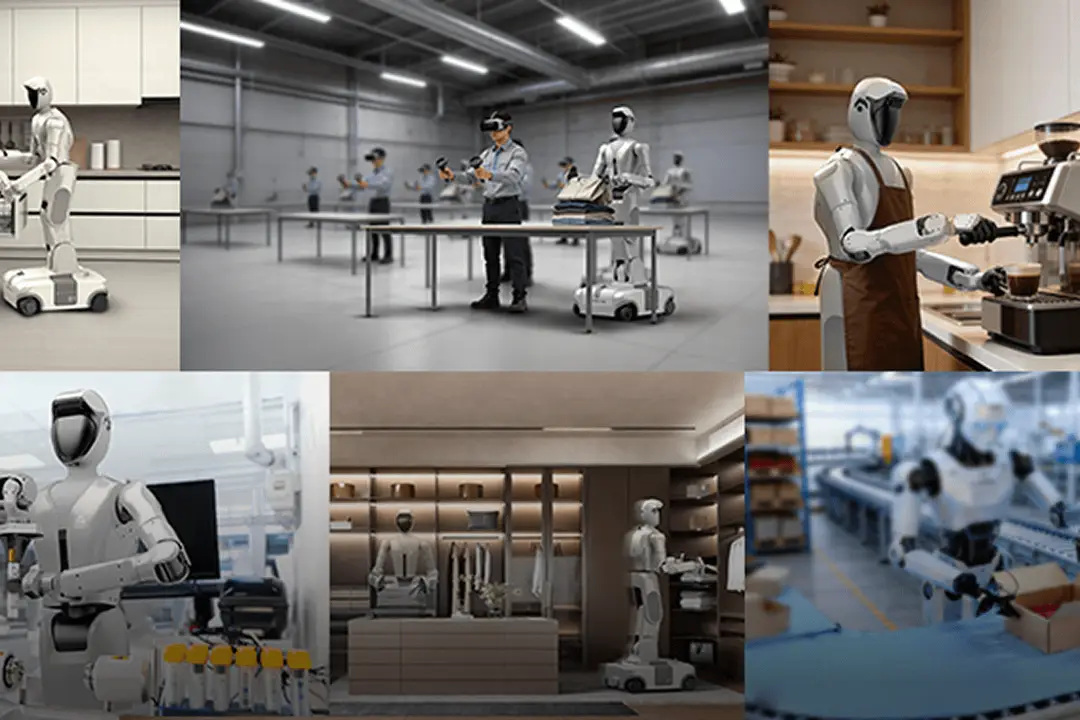
The company now follows a “one brain, one body” model, developing its own Maker H01 robot, collecting data from it and deploying its models back onto the same platform.
His underlying diagnosis: “The real constraint on market adoption remains insufficient model capability.”
VLA scaling hits a wall
Zhu argues that vision-language-action, or VLA, models cannot scale sufficiently to unlock the next stage of embodied intelligence. They are more like early BERT, while world models could become the equivalent of the next ChatGPT.
The difference lies in their architecture. VLA models turn visual information into language representations before mapping them into actions. World models instead use video-generation models to predict or simulate what happens next from a video or state.
GigaAI has chosen the “pixel-generation” approach, directly generating video frames, while others have chosen rival routes — latent-space JEPA models and hybrid architectures.
Its commercial operations span autonomous driving, industrial manufacturing and household robots. Customers in autonomous driving include FAW, JD.com and EMS. In manufacturing, GigaAI and Longsheng Technology plan to deploy 1,000 Maker H01 robots over three years. Its SeeLight home-robot brand has secured orders for 100 S1 units.
Huang’s preferred metaphor is simple: the embodied foundation model is the robot’s “brain,” while the world model gives that brain “imagination.”
The pre-IPO cliff
GigaAI has two clear advantages: a first-mover race with no listed peers, and a 20 billion-yuan valuation that puts it alongside other highly valued unlisted robotics companies such as Galaxy General Robot and AgiBot, also known as Zhiyuan Robotics, and above Unitree Robotics’ (688836.SH) pre-IPO private valuation of around 12.7 billion yuan.
But mass commercialization is distant. Zhu’s roadmap: GigaBrain-2 in late 2026, GigaBrain-3 in early 2027, hoping for a “GPT-3 moment” for embodied intelligence, and household robots only by 2028. That means the revenue capable of justifying today’s valuation may still be years away.
The crucial tests are whether GigaBrain-3 can deliver the promised breakthrough, and whether the 100-unit SeeLight S1 orders and 1,000-unit Maker H01 plan can develop from proofs of concept into meaningful commercial revenue.
“We hope that in the next few years, we can rapidly move from world models for today’s specialized scenarios to truly general-purpose world models,” Zhu said.
For GigaAI, that’s not just a vision. It’s a countdown.