

Robotics companies are using real manufacturing environments to develop dexterous hands, with early trials showing they can now approach human workers’ productivity on complex tasks.
China’s push to develop more capable robotic hands is moving beyond laboratory demonstrations, as manufacturers increasingly use real factory operations to shape hardware design, train robots and test their ability to perform complex tasks.
This week brought two independent developments that together sketch both halves of the same shift: proof that a dexterous hand can run a full factory workflow, and a detailed look at how factory data is reshaping the hand itself.
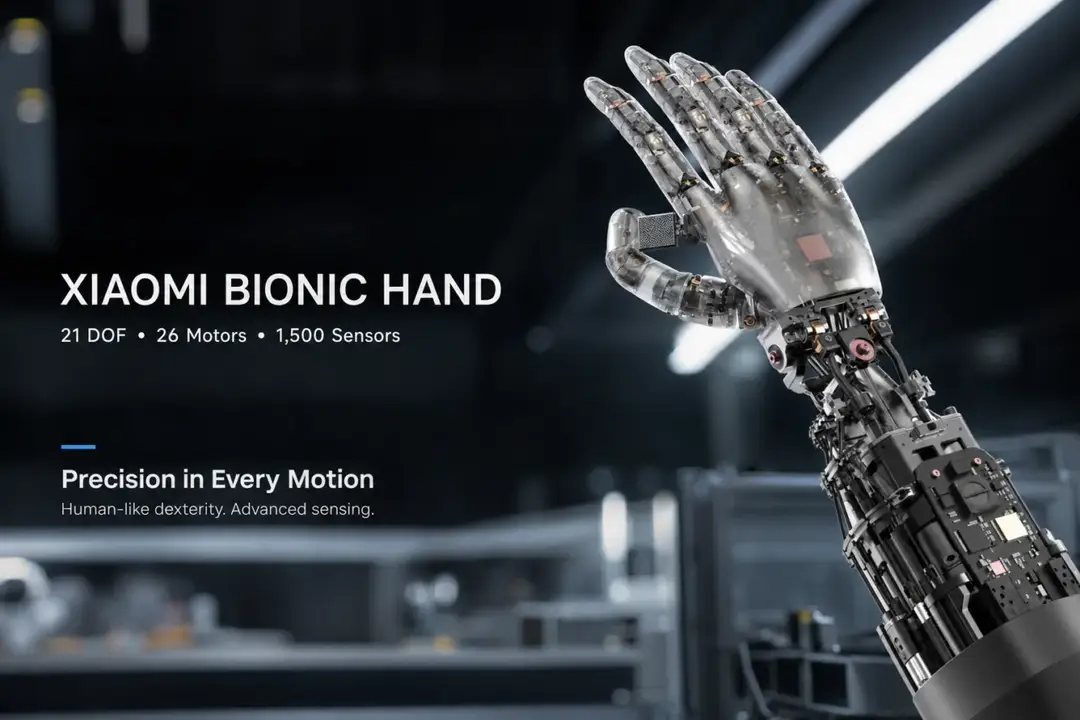
Xiaomi (1810HK) is among the companies advancing the technology. Its latest bionic dexterous hand features a biomimetic design tailored to the requirements of its car factories, has 21 degrees of freedom (DoF), 26 motors and high-density tactile sensing across the palm.
Meanwhile, robotics company Agilink, a spin-off of humanoid robot developer AgiBot, has demonstrated a system capable of autonomously completing a 72-step industrial testing procedure using a robotic arm fitted with a five-fingered hand. The task took 8.5 minutes, compared with about eight minutes for a human worker, suggesting that dexterous robotic hands are beginning to approach human productivity in specific manufacturing applications.
The developments highlight a shift towards designing and training robotic hands around the demands of actual industrial work, rather than simply demonstrating increasingly sophisticated movements.
Xiaomi targets factory operations
Xiaomi disclosed details of its latest bionic dexterous hand on Oct. 27, building on earlier developments shared in March and July. The company first outlined its tactile robotic hand design in March, before revealing that the technology had begun practical training in new roles at its car factory in July.
The latest design is based on data collected from actual manufacturing operations.
At Xiaomi’s automotive intelligent manufacturing pilot center, the team examined 1,827 standard operating procedures (SOPs) across 16 representative production sections. It collected multi-angle videos and motion-capture data covering more than 70.8% of typical manual operations in those sections.
The information was classified, processed, and used to analyse human hand movements and simulate different grasping tasks. The team also created digital models of actual factory tools, components and workpieces to test the robotic hand in different configurations.
This analysis helped Xiaomi determine the appropriate number of degrees of freedom. A 21-DoF design delivered the greatest improvement in factory task coverage and grasping success, while increasing the number to 23 or more produced diminishing returns. The resulting hand has 21 DoF controlled by 26 motors, using a combination of tendon-driven and direct-drive mechanisms.
The tendon-driven motors are mostly in the forearm, keeping the palm to 324 grams and improving response, and there are five direct-drive joints at lower-load positions. A tendon-tension sensor addresses creep in the cables, and a thermal model predicts temperature up to 10 minutes ahead with accuracy better than 3 degrees Celsius — necessary because a single hand can draw more than 100 watts in sustained high-current gripping. It can estimate how long components can continue operating before overheating and adjust task scheduling, joint torque and fan speeds accordingly.
Tactile resolution reaches 1 millimeter at the fingertips and 2 millimeters in the palm, and the tactile glove is replaceable to support data collection matched to the human hand.
Tackling industrial deployment
These engineering challenges illustrate why designing a robotic hand for industrial use requires more than replicating the movements of a human hand. It must also combine precision, strength, reliability and the ability to operate for extended periods.
Agilink livestreamed a proof-of-concept demonstration from a factory operated by Wolong Hill Robot Co., offering a practical illustration of what such systems can achieve.
A single robotic arm fitted with a five-fingered hand completed a 72-step performance test — loading and unloading parts, scanning barcodes, picking up a screwdriver, driving and removing screws, and pressing buttons — entirely on its own. The company reported a 98% task success rate, an 8.5-minute cycle against roughly 8 minutes for a human worker, and continuous operation of 8 to 12 hours.
The workflow tested the hand across three kinds of tasks: flexible assembly of the unit under test, precision screwdriving with a power tool, and operating an instrument panel. Agilink said it had first tried conventional grippers, but the recoil from the screwdriver tended to knock the tool out of the grip; fixing the tool permanently to the arm’s end, meanwhile, left the robot unable to pick up parts or press panel buttons. A five-fingered hand let one arm complete all three task types without swapping end effectors.
Precision, tactile feedback
Agilink’s demonstration also highlighted the difficulty of performing seemingly straightforward tasks with robotic hands.
Accurately positioning the screwdriver bit inside a screw head requires submillimeter precision. The tool’s weight, connecting cables and the reaction force generated during tightening all complicate the operation.
The company demonstrated that its system could respond to deliberate interference. When staff pushed the robotic arm during screw tightening, the hand adjusted its position and orientation, located the screw hole again and continued working.
In another test, staff shifted the fixture base, moving the screw hole and causing the screw to be inserted only partially. The robot detected the failure using force and visual feedback, realigned the tool and completed the task.
Agilink combines reinforcement learning on physical robots with an intelligent-agent system to improve performance and recover from errors. The company said training through real-world reinforcement learning made its screw-tightening operations more than four times faster than teleoperation, while also improving positioning accuracy.
The company frames the arm-plus-hand combination as a cheaper route to automation than deploying a full humanoid, and plans to put the setup into formal production before the end of the year to test long-term stability and deployment cost.
Data collection critical to scaling up
Both developments point to the growing importance of high-quality operational data in advancing dexterous robotics.
Xiaomi uses factory data to inform hardware design and simulate real-world tasks. Agilink is addressing the separate challenge of collecting human demonstrations that can be transferred to robots – the company has introduced OmniGlove Pro, a teleoperation and data-collection glove that captures both hand movements and tactile information, which is now in mass production.
It combines electromagnetic positioning and inertial measurement technology to track fingertip movements, with a stated positioning accuracy of 0.1 millimeters. Its 746 tactile sensing points record contact information with a spatial resolution of 3 millimeters — addressing a weakness of camera-based capture, which struggles with occlusion and cannot record contact.
The resulting data can be processed and mapped onto different robotic platforms, allowing robots to reproduce tasks demonstrated by human operators. Agilink says it has already verified this replay capability on physical robots.
The company plans to move its 72-step testing system into formal factory operation before the end of the year, where its long-term reliability and deployment costs will be tested.
Both companies’ figures are self-reported. Agilink’s 98% success rate and near-human cycle time come from a first-phase proof-of-concept at a single station; whether they hold over months of production, and across sites, is the open question the year-end rollout is meant to answer. Xiaomi’s hand remains in factory training, with grasp success and human-likeness improved over a lower-DOF predecessor but no independent verification has been published.
For China’s robotic-hand developers, the next challenge is no longer simply demonstrating that machines can grasp objects or manipulate tools. It is proving that they can perform diverse tasks accurately, consistently and economically under real production conditions.