
Chinese automotive giants are turning their factories into testing grounds for humanoid robots amid falling profits and slowing sales
By Da Cheung
Chinese electric vehicle giants are aggressively pivoting toward humanoid robots, seeking a “second growth curve” as domestic auto manufacturing profit margins hit a decade-low. Companies like BYD (1211.HK) (002594.SZ) and Xpeng (9868.HK) (XPEV.US) are leveraging their automotive supply chains to challenge Tesla in a high-stakes robotics race.
The automotive sector’s overall profit margin dropped to 3.8% in the first half of 2026, with vehicle manufacturing margins plunging to just 1.5% in the January to May period, industry data show. With profitability and sales under pressure, automakers are looking to robotics to offset cyclical risks.
However, while Elon Musk’s company pursues artificial general intelligence (AGI) – AI that can match or exceed human-level reasoning across any task – for eventual home use, Chinese automakers are prioritizing rapid commercialization by deploying robots directly into their own factories and retail showrooms.
Factory floors as testing grounds
The strategic divergence between U.S. and Chinese firms is stark. Tesla aims to make its Optimus robot “smart first, work later,” training it in closed environments for broad, cross-scenario applications. In contrast, Chinese automakers are adopting a “deploy first, iterate later” model.
Because smart cars and humanoid robots share an estimated 70% of their underlying technologies — including batteries, sensors, electric motors, and AI chips — EV makers are turning their assembly lines into real-world testing grounds.
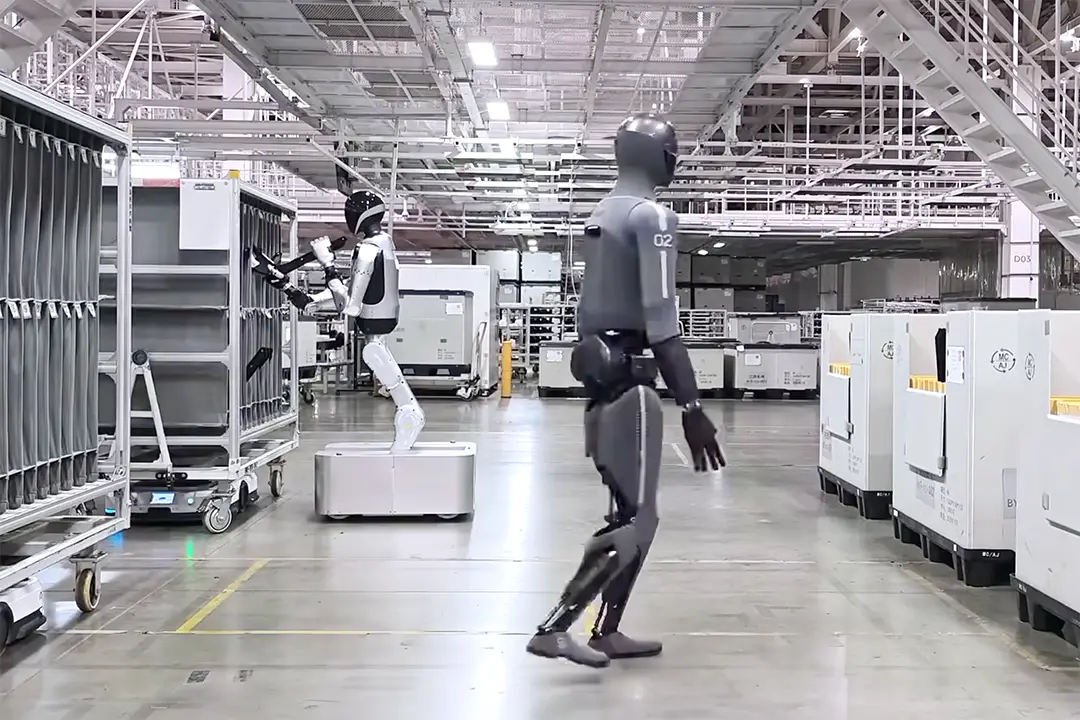
Xiaomi (1810.HK), for instance, claims its humanoid robots have achieved a 98% success rate in specific factory tasks, such as fastening nuts on both sides of a vehicle, after four months of on-site training. The company says its robots are now handling complex, flexible tasks like sorting center console covers and folding reusable containers or bins. Sorting the console covers requires the robot to handle large, irregularly shaped parts through multi-position picking and placing while autonomously adjusting to sudden snags or jams. Though Xiaomi reports a 90% success rate for these tasks, it acknowledges the robots still cannot match the blind-picking proficiency of human workers.
The commercial rollout is also accelerating into consumer-facing roles. BYD confirmed that its first humanoid robot will debut in August at a brand experience center in Zhengzhou. The automaker plans to deploy two to three robots per dealership to complement human staff in sales assistant and receptionist roles. Similarly, Chery (9973.HK) reportedly delivered 220 humanoid robots in April to serve in its Malaysian showrooms. However, while automakers heavily promote these deployments, the practical utility and autonomy of these showroom robots remain largely unverified by independent sources, bearing the hallmarks of corporate showmanship.
Other major players, including SAIC, GAC, and Seres, have also announced robot prototypes or investments in robotics supply chains, signaling an industry-wide rush to jump in.
The burden of proof
Despite the rapid scale-up, the sector is battling intense public skepticism regarding the robots’ real capabilities. The pressure to demonstrate genuine technological progress culminated in a bizarre public relations crisis for Xpeng in late 2025.
The automaker unveiled its IRON robot in November 2025 with a distinctly feminine physique and a fluid “catwalk” gait modelled on a feminine walking style. The humanoid triggered a vicious and immediate backlash, with internet users widely accusing the company of using a human actor in a synthetic suit and of objectifying women in a marketing gimmick. The pushback was so severe that Xpeng’s U.S. stock dropped nearly 4%.
To quell the controversy, CEO He Xiaopeng was forced to post an uncut one-take video on social media, unzipping the robot’s synthetic skin to reveal its metal skeleton. Later that evening, he had staff cut open the robot’s leg wrappings live on stage to prove it was a machine. Following this evidence, the company’s stock rebounded by 9.6%. Today, Xpeng claims its IRON robot has entered small-batch trial production at its Guangzhou factory, with mass production targeted for later in 2026.
A looming bubble?
Automakers are pouring billions of yuan into robotics — Changan (000625.SZ) for example is investing 450 million yuan (approx. $62.5 million) to form a dedicated robot company. However, prominent AI experts are warning of a looming humanoid robot bubble.
Yann LeCun, a Turing Award-winning AI scientist, has publicly criticized the industry, stating that the impressive demonstrations hide a collective hallucination. Similarly, robotics pioneer Rodney Brooks, co-founder of iRobot, argues that investing billions into bipedal humanoid startups is a waste of capital. Brooks contends that human hands are too complex to replicate easily and warns that bipedal robots pose significant safety risks if they fall in industrial settings. He predicts that successful robots in the near future will likely rely on wheels and multiple arms rather than a humanoid form.
Even within the auto industry, some insiders question the trend. An unnamed technical executive at a Chinese automaker told TMTPost that the humanoid form is more of a gimmick than a practical necessity, noting that traditional robotic arms are already highly mature and effective for factory pain points.
Whether humanoid robots can truly serve as a financial lifeline for automakers remains to be seen. Tesla started the war and other major players were ‘forced’ to join in driven by a fear of missing out—or more precisely, a fear of being perceived as irrelevant by investors and consumers alike. For now, the line between groundbreaking innovation and desperate marketing remains heavily blurred.
Feature photo: Xiaomi’s robots working in its EV factory. By Xiaomi.
Sources