
China is building the infrastructure for embodied AI to learn from real-world experience while preparing students to work alongside intelligent machines.
By Fuxiaozi
This summer, two unusual classrooms began operating in China
One is designed to teach robots how to learn from experience and understand the world. The other is designed to teach children how to work with and understand robots.
Together, the projects reflect a broader shift in China’s approach to embodied artificial intelligence, moving beyond demonstrations of humanoid robots toward building the physical infrastructure, training environments and educational systems needed for machines and humans to learn alongside each other.
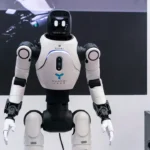
On July 24, Unitree Robotics and Chengdu’s Jinjiang district opened an embodied AI laboratory for primary and secondary education, equipping schools with humanoid robots, quadruped robots, motion capture systems and AI teaching platforms. The district plans to establish embodied AI laboratories in 10 schools in the first phase.
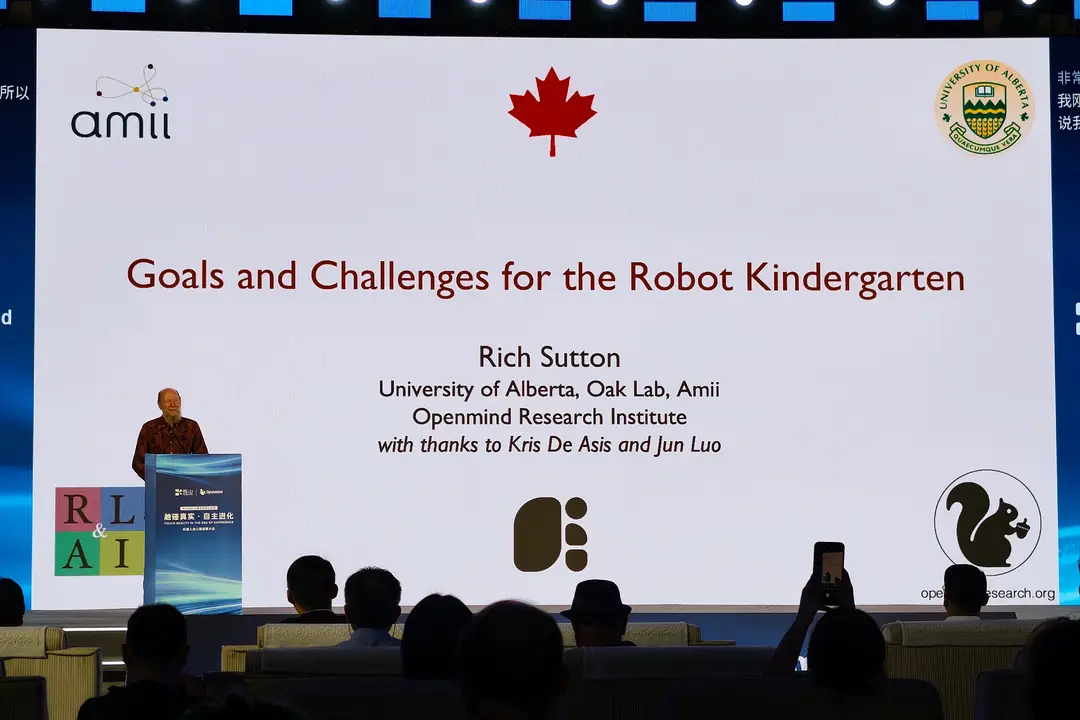
Less than a month earlier, on June 29, a “robot kindergarten” jointly launched by Tashan Technology and OpenMind Global Research, with participation from the research team of reinforcement learning pioneer Richard Sutton, was officially unveiled at Beijing’s Shougang Park. Instead of textbooks, robots are placed in real-world environments where they learn through exploration, touch, trial and error, and feedback.
From imitation to experience
For years, embodied intelligence has relied mainly on human demonstration: a human grasps a cup, the robot records the trajectory; a human completes an assembly, the model learns the motion sequence. Imitation can quickly teach standard actions, but struggles with real-world exceptions. Change the cup’s material or shift a part slightly, and previously correct actions may fail.
In recent years, embodied intelligence has relied mainly on human demonstration: a human grasps a cup, the robot records the trajectory; a human completes an assembly, the model learns the motion sequence. Imitation can quickly teach standard actions, but struggles with real-world exceptions. Change the cup’s material or shift a part slightly, and previously correct actions may fail.
The concept closely follows the vision outlined by Sutton and Google DeepMind researcher David Silver in their 2025 essay Welcome to the Era of Experience. They argue that AI systems trained primarily on human-generated data will eventually reach the limits of existing knowledge, while the next generation of intelligent agents will continue improving through continuous interaction with their environments.
For embodied AI, that distinction is especially important. A chatbot that produces a wrong answer can simply generate another response. A robot that grasps the wrong component may damage equipment or injure people. Experience learning therefore requires robots to combine perception, control, safety and continuous adaptation in the physical world.
That is also why tactile sensing is becoming increasingly important. Cameras can identify where a cup is located, but only force, friction, deformation and slip sensors can determine whether a grip is stable, whether an object is about to fall or whether excessive force could harm a person.
The shift could also reshape the industry’s economics. Instead of focusing primarily on whether robots can walk or perform demonstrations, companies may increasingly compete on their ability to generate real-world operating data, run robots reliably over long periods and transfer learned skills between different tasks. Just as data centers became the infrastructure that trained large language models, physical training grounds could become the places where robots accumulate experience.
Teaching children to work with robots
As robots begin learning more like children, Chinese educators increasingly argue that children also need to learn how to collaborate with machines.
The embodied AI laboratory opened in Chengdu combines remote operation systems, motion capture technology and AI teaching platforms with humanoid and quadruped robots. Rather than treating robots as exhibition pieces that perform scripted demonstrations, students are expected to operate, program, debug and design tasks for the machines themselves.
The approach gives AI education a physical dimension. Instead of studying algorithms alone, students can observe how sensors collect information, how AI models make decisions, how mechanical systems execute commands and how small errors are amplified in the physical world.
The initiative also aligns with China’s Artificial Intelligence Plus Education Action Plan, released in 2026, which calls for expanding AI education throughout primary and secondary schools, incorporating AI into local curricula, encouraging interdisciplinary teaching and building dedicated AI education centers. The emphasis is not simply on teaching students to use AI tools, but on developing curiosity, innovation, AI literacy and complex problem-solving skills.
The strategy could also reshape talent development. Rather than recruiting only university graduates, leading robotics companies may increasingly cultivate future engineers and developers from primary and secondary education by familiarizing students with their software and hardware ecosystems at an earlier stage.
Building a human-robot ecosystem
Taken together, the robot kindergarten and school laboratories point to a broader vision of human-machine collaboration. Robots learn how to operate in human environments, while people learn how to assign tasks, design feedback systems, understand risks and work alongside increasingly autonomous machines.
This logic is moving from pilot project to industrial action. The 2026 Humanoid Robot and Embodied-Intelligence Real-Scenario Training initiative, launched by the Ministry of Industry and Information Technology and the State-owned Assets Supervision and Administration Commission, aims to validate key products in representative application scenarios, establish more than 100 high-value use cases and support deployment at the scale of tens of thousands of robots by the end of 2026.
Industrial-scale training facilities are already emerging. One center in Wuxi spans more than 7,000 square meters, where nearly 100 humanoid robots train simultaneously across logistics, assembly, inspection and service scenarios. Some of the robots have already moved into long-term operations in automotive logistics, creating demand for jobs in data collection, annotation, algorithm development and maintenance.
The industry’s most valuable assets may therefore extend well beyond robot hardware. Training grounds, simulation platforms, data services and the software that connects robots with real-world tasks could become as strategically important as the machines themselves.
Safety, education and access
Despite the optimism surrounding embodied AI, the path toward widespread adoption faces significant challenges.
As robots become more capable of autonomous learning, developers must establish clear boundaries for experimentation and accountability. As robots enter classrooms earlier in children’s education, schools will also need to address questions surrounding safety, ethics and equitable access. China is already developing standards covering both the technical performance and safety of humanoid robots, reflecting a shift toward managing risk across their full operating life cycle.
Educators also face the challenge of integrating robots into teaching rather than treating them as technology showcases. When Chengdu launched its embodied AI laboratory, it simultaneously introduced an “AI Plus Future Teachers” training program, acknowledging that teacher expertise and curriculum development may prove a greater constraint than the availability of robots themselves.
Cost presents another obstacle. Humanoid robots remain expensive to purchase and maintain, suggesting that regional shared laboratories, cloud-based simulation platforms and standardized teaching materials may offer a more practical way to broaden access than requiring every school to buy large numbers of robots.
Ultimately, the robot kindergarten is not simply training robots, and school laboratories are not simply producing students who know how to operate machines.
Together they are exploring a new division of labor in which robots extend human physical capabilities, while humans define objectives, exercise judgment and remain responsible for outcomes. In that future, the most valuable robots may not be those that leave the factory as the smartest machines, but those that continue learning most effectively from experience—and the people best equipped to learn alongside them.