

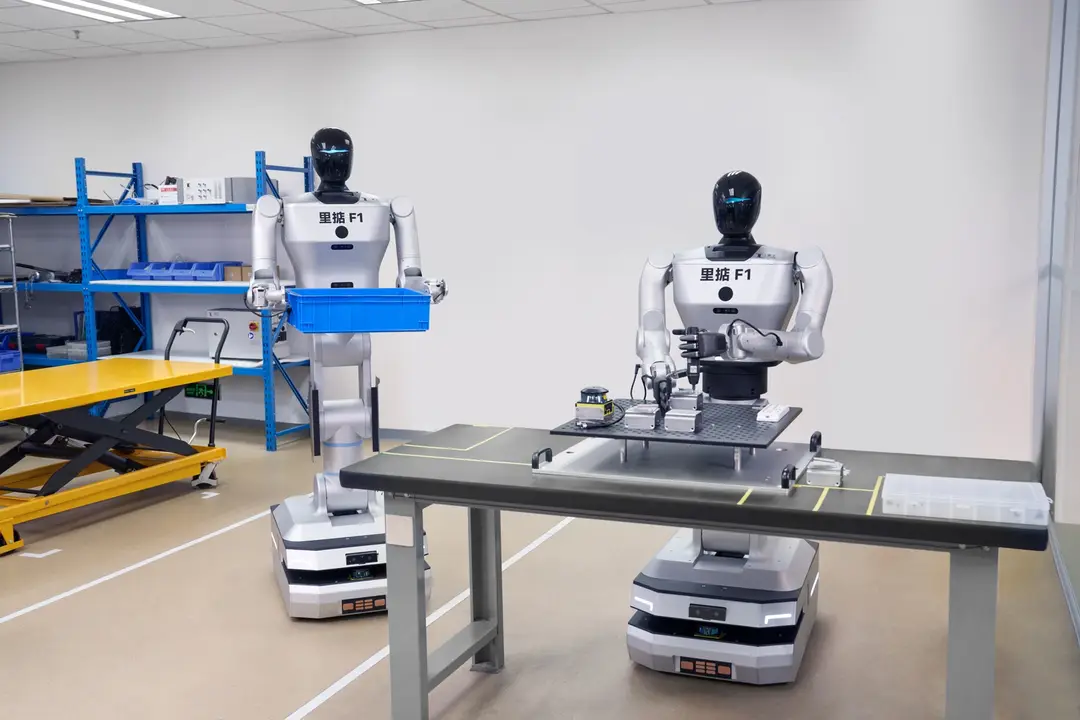
Li-Gong Industrial found customers wanted robots that can work, not look human, as it built a data and software business around them.
By Zhong Chen
When Li Weichong’s engineers first sat down with customers to design a new robot, nobody asked for a humanoid.
They asked for two things. Could it carry more at once? Could it carry something heavier?
“Customers don’t need a humanoid,” Li said. “Customers need two arms.”
That conclusion, reached with customers rather than in a lab, has shaped the unusual trajectory of Guangzhou Li-Gong Industrial, a 40-year-old manufacturer that now builds robots — and one of a growing number of Chinese firms betting that the real market for embodied intelligence lies not in demonstrations, but in the unglamorous work of moving things around factories and warehouses.
Li, the company’s president, said demand is not hypothetical. The company says it has delivered several hundred robots and holds orders for more than 2,000 units awaiting delivery, most of them humanoid. On an order-backlog basis, its combined robotics, humanoid and data-and-software business is worth more than 300 million yuan ($44.7 million), according to figures Li provided.
Li-Gong’s own history explains why it ended up here. Founded in 1985 as a workshop making rubber seals, the company moved into industrial automation. The turning point came in 2015, after it bought its first robot and watched the machine sit idle for months. Li-Gong began developing its own robotics software and formally launched a dual-arm robot project at the end of 2023. The first bipedal humanoid took about 10 months; a wheeled version, built on an existing chassis, took roughly six.
But the technology was never the starting point. The starting point was the customer.
What factories actually need
Li-Gong’s robots are aimed at being deployed mainly in two areas: logistics and handling on production lines for new-energy vehicle parts, and larger-scale warehouse sorting and picking. Both are defined by variety, small batches and high turnover — the kind of work that is hard to automate with fixed machinery and unpleasant for people to do for long stretches.
Beyond those two, Li-Gong is developing robots for three smaller markets: auto body repair and painting, where the work is hazardous; pharmaceutical cloud-warehouse packing, which still relies heavily on manual labor; and smart laboratories, a niche but strategically important bet on “AI for science.”
In warehouse sorting, Li said, customers set an accuracy target of 99.99%, and Li-Gong delivers it.
Speed is a different matter. “A humanoid robot is not faster than a person,” Li said. Its advantage is endurance: it can work 24 hours, with less fatigue, producing steadier output. By the company’s own measurements, that adds up to roughly three times a human’s effective output.
The robots are not cheap. Depending on configuration, prices run from about 300,000 to 600,000 yuan. Li argues that the pitch to industrial customers is not about price but payback.
“If a customer pays 600,000 yuan and gets 1.2 million yuan of benefit, they will buy it,” he said. “If it costs 8,000 yuan just to try it out, they might buy one, but they won’t buy 100.”
That logic — what Li calls “capability economics” — is central to his view of the industry. The question, he said, has shifted from whether a robot can move to whether it can work: which scenarios it can enter, how long it can keep going, what its success rate is, and how quickly it pays for itself.
The gap between kung fu and elder care
Li is unusually candid about where the technology still falls short, including his own earlier misjudgments.
Two years ago, he said, the company overestimated the precision and stability of humanoid hardware. Strong movement ability, he found, does not translate into sustained precision.
“A basketball player has very strong arms and great explosive power,” he said. “But does that mean he can do fine embroidery? Not necessarily.”
Li-Gong also ran into problems with components whose specifications were misleading. Some parts, he said, met their nominal ratings — but only for two seconds. For industrial work, where a robot must not only lift a load but hold it steady, that is a defect. The company now puts parts through strict testing before they reach customers, a process Li described as painful but largely resolved, and a precondition for taking large orders.
He is equally skeptical of customer expectations that outrun reality. Li recalled a nursing-home director who assumed that because a humanoid robot could perform kung fu, it could also care for the elderly. Such misunderstandings, he said, are widespread — and a reason the industry needs a grading system, similar to the tiers used for autonomous driving, so that companies and the public share a common standard.
Li-Gong screens scenarios on two criteria: whether today’s technology can do the job, and whether the problem is a common one across society. Tasks that are heavy, repetitive and hard to staff — moving goods in a warehouse, for instance — pass both tests.
Teaching robots what workers know
Part of the challenge is data. Industrial settings, Li said, are where useful training data is scarcest and hardest to obtain, because customers are protective of their processes. Li-Gong positions itself as infrastructure: it does not keep the data, but helps customers extract and structure skills that were previously locked in workers’ hands.
Li describes the difficulty of collecting that data as an “impossible triangle” of accuracy, consistency and stability. Of the three, he argues, consistency matters most — if data from the same task varies too much, it cannot be used, and a model trained on it has no value.
Stability is harder still. Sensors drift, and a device that works perfectly on day one will not perform identically after three years, just as a phone battery degrades over time. Li puts the unavoidable variation at 5% to 10%. The goal is not to eliminate that drift but to widen the window in which the data remains usable.
“Sometimes moving embodied intelligence forward isn’t about going an extra kilometre,” he said. “It’s about being off by 0.01 millimetres less, or 0.01 seconds less. Extreme intelligence is often studied in the smallest places.”
Its flagship data-collection glove weighs just 42 grams. The point of making it so light, Li said, is that the tool must not change the worker’s behavior — if a glove makes a technician’s hands heavier or slower, the data no longer reflects real skill. The company calls it “low-intrusion” collection.
Li says the company ultimately wants to become the “Siemens Industrial” of embodied AI. The ambition is not to compete with every robotics company by building every component itself. Instead, Ligong wants to extract human skills and industrial data, train models that can work across different robot platforms and help robots enter factories more broadly.
The company, which has largely funded itself so far, plans to raise 500 million yuan to 800 million yuan over several rounds, targeting a valuation of 4 billion to 5 billion yuan before filing for an IPO, which it hopes to complete by 2030.
No single breakthrough year
Li does not expect a single “humanoid boom” year. Adoption will be layered, he said: warehousing and logistics are already under way, while precision assembly will take longer and elder care longer still. He points to electric vehicles, which took about a decade before growth accelerated sharply, and suggests five years is a reasonable horizon to watch.
As for whether embodied intelligence must wait for artificial general intelligence, Li argues the two can be decoupled. Progress, he said, comes from solving one real task at a time.
“If every project is like renovating a house — completely custom, redone from scratch — then data, skills and models can never really accumulate,” he said.
That is why Li-Gong ships improved versions of existing robots rather than constantly launching new models, and why the company measures itself by a simple question: is the 101st deployment easier than the first?
“We are not perfectionists,” Li said. “We are evolutionists.”
Source:
Robotics Outlook (机器人前瞻)