

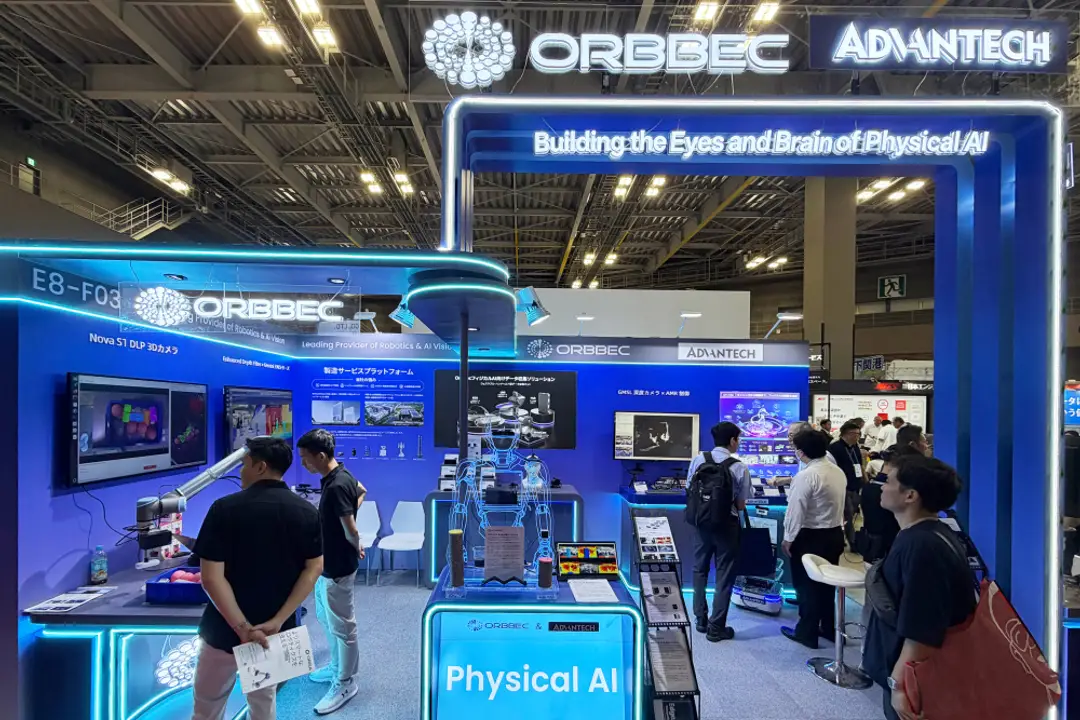
Just as it turns a profit and sheds its Shanghai STAR Market ‘unprofitable’ designation, the maker of robot ‘eyes’ plans a second listing amid slowing growth and insider selling
By Su Wanqing
It was the unseen star of the 2026 Spring Festival Gala where humanoid robots from Unitree Robotics (688836.SH), AgiBot and Ubtech (9880.HK) grabbed the headlines. But they all used the same set of 3D vision products supplied by Orbbec (688322.SH), a Shenzhen-based specialist that recently returned to profitability after four consecutive years of losses.
Having shed its “unprofitable” designation, Orbbec is now preparing to issue H shares in Hong Kong.
It doesn’t build robots, but almost everyone who does relies on it. It has more than 70% of China’s 3D vision sensor market for service robots and supplies all four of the humanoid robot makers with the highest global shipments: AgiBot, Unitree, Ubtech, and Leju.
The company has nearly 2,000 patents and is one of only a handful of businesses globally — and the only Chinese company — capable of mass-producing million-unit-scale area-array 3D vision sensors.
Fresh off four years of losses and its first annual profit in 2025, Orbbec’s timing seems bold. Yet, the capital moves are puzzling. Just a month before the Hong Kong announcement, it completed a 980 million yuan ($148 million) private placement, and on the day of the announcement, it revealed plans to use 900 million yuan in idle proceeds to buy wealth management products. If cash is ample, why rush for a new window?
More jarring is another timeline. While the company talks of global expansion, founder Huang Yuanhao has been cashing out on the secondary market, offloading about 487 million yuan worth of shares between June 17 and July 1. This juxtaposition—the firm’s expansionary narrative against the founder’s retreat—raises a question: strategic vision, or something else?
From hard technology to robots
Huang, born in Guangdong in 1980, studied at Peking University before spending a decade at research institutions in Hong Kong, Canada, Singapore and the U.S. He returned to Shenzhen in 2013 and founded Orbbec, focusing on two difficult areas: 3D perception chips and cameras.
The strategy required substantial capital, but the gamble paid off. In 2015, Orbbec developed China’s first 3D perception chip, the MX400, and began mass-producing consumer 3D cameras. It became the first company in Asia, and the fourth globally, with mass-production capabilities for deep-computing chips.
Orbbec listed on Shanghai’s STAR Market in July 2022 at 30.99 yuan a share and became known as China’s “first 3D vision stock.”
Robotics has since emerged as its biggest growth opportunity. In the first quarter of 2026, orders from humanoid robot customers doubled from the previous quarter, while domestic robotics revenue more than tripled from a year earlier.
An increasingly entrenched supplier
3D vision has high technical barriers. Companies with million-unit-scale mass-production capabilities include Apple, Microsoft, Sony, RealSense, Huawei, Samsung and Orbbec.
The company competes head-on with RealSense, which was spun out of Intel. In the Korean industrial mobile robot 3D vision market, Orbbec leads with a 46% share against RealSense’s 32%, and its dominance extends to 74% in the commercial segment. In a symbolic coup, Intel itself began collaborating with Orbbec in 2025.
Its client roster is a who’s who of Chinese robotics, and the company says its software integrates with Nvidia’s Isaac, Apple’s macOS, Microsoft’s Windows, and AMD’s ROCm.
Its tightest link is with Chinese fintech giant Ant Group. Since 2018, Ant has poured over 1.4 billion yuan into the company and its stake peaked at nearly 15%. In 2025, Ant-related sales surged 462%, accounting for 27% of Orbbec’s revenue, even as the fintech group trimmed its stake by selling 556 million yuan worth of shares in the first quarter of 2025. It still held 9.18% at the time of this article.
The slowdown and the hidden cracks
Orbbec’s 2025 results appeared to mark a turning point. Revenue rose 66.7% to 941 million yuan and net profit attributable to shareholders reached 128 million yuan, its first full-year profit since listing.
On April 21, 2026, its stock ticker changed from “Orbbec-UW” to “Orbbec-W,” removing the “U” designation for unprofitable companies.
But the first half of 2026 was much weaker. Revenue rose just 0.49% year on year to 438 million yuan, while net profit fell 30.8% to 41.6 million yuan. Second-quarter revenue declined 3.97% and net profit plunged 70%.
Orbbec also had accumulated unrecovered losses of 1.48 billion yuan at the end of June. Overseas revenue was only 87 million yuan in 2025, or 9.22% of total revenue, while more than 60% of sales came from its five largest customers.
Cash flow is another concern. Operating cash flow was a negative 117 million yuan in the first quarter and receivables were equivalent to 84.4% of net profit.
But expansion requires capital. That is likely to be a central reason for the Hong Kong listing as the humanoid robotics industry moves toward early commercialization.
For investors, the contrast is hard to ignore: the company is seeking fresh capital to finance its next stage of growth while its controlling shareholder is taking money off the table.
The more awkward question is Huang’s share sale, which is likely to attract investor scrutiny. Orbbec still has a strong position in a rapidly developing industry, but competition from global players remains intense.
The Hong Kong listing may give the company another source of capital. Whether it can turn that capital into sustained growth is another question.
Source:
Investorscn.com