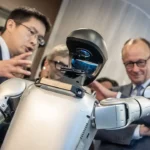


The humanoid robot maker has launched life-sized AI companions, betting that emotional interaction rather than factory automation will provide a profitable path to commercialization
By Da Cheung
While global tech giants race to build humanoid robots capable of assembling cars or folding laundry, one leading Chinese robotics firm is betting its future on a more intimate market: emotional companionship.
Shenzhen-based Ubtech Robotics (9880.HK) unveiled its UWORLD U1 series of life-sized, ultra-bionic humanoid robots on June 30. The pivot from the Walker series of industrial and commercial robots to hyper-realistic, humanoid robots aimed specifically at adults has generated a level of public attention not seen in China’s robotics industry since Beijing hosted a robot half-marathon in April.
The news triggered an 18% intraday surge in Ubtech’s Hong Kong-listed stock, which eventually closed up 7.48%, giving the company a market capitalization of HK$51.75 billion ($6.6 billion).
The U1 series — priced between 119,800 yuan ($16,500) and 990,000 yuan — features 1:1 human modeling that the company says replicates pores, veins, fingerprints, and the tactile feel of human skin.

Ubtech’s official press release claimed that pre-orders for the robot had reached 13,361 units by launch day, a significant leap compared with the 1,079 industrial robots the company sold in all of 2025.
Mass deliveries are scheduled to begin in September and the company aims to eventually expand overseas when it obtains international certifications. However, industry analysts question whether this sci-fi vision can translate into a sustainable business model.
A strategic pivot from factories to bedrooms
Ubtech made history in 2023 as the world’s first publicly traded humanoid robot company, but it has struggled financially. The company posted a loss of 1.26 billion yuan for the year 2023 when it listed, and although losses narrowed to 1.16 billion yuan for 2024 and 790 million yuan for 2025, it’s still deep in the red.
This financial strain stands in stark contrast to its competitors. Domestic rivals, including prominent stars Unitree Robotics and AgiBot, and U.S. companies such as Tesla and Figure, are aggressively pursuing the mass production of low-cost, general-purpose robots for factory and household labor. Unitree, for instance, shipped over 5,500 robots in 2025, achieved profitability as early as 2024, and recently priced its G1 model at a highly competitive 99,000 yuan.
Unable to compete on price in the industrial sector, Ubtech has pivoted to the emotional companion market. Officially, the company markets the U1 series for elderly care and lonely individuals, promising features like medication reminders and psychological comfort.
However, the company only allows adults to buy. This policy, combined with the robot’s hyper-realistic physical design, has fueled speculation that Ubtech may also be targeting the lucrative sexual companion market — a market that has historically helped drive the adoption and commercialization of some emerging technologies. The company hasn’t publicly addressed such suggestions and it’s unclear whether the robot possesses explicit functionalities.
The illusion of life and technical hurdles
To create a convincing companion, Ubtech claims to have integrated advanced artificial intelligence with complex hardware. The U1 series features 88 degrees of freedom — meaning it has 88 independent, controllable joints or movable parts — allowing for basic interactions like hugging, holding hands, and nodding.
The robots are powered by an emotional AI model that the company says can recognize over 20 subtle emotions with 90% accuracy. It claims the onboard computer delivers 200 TOPS of AI processing performance, a standard measure of AI inference capability, allowing it to run visual tracking, speech processing, emotion recognition and multimodal interaction models simultaneously.Customers who pre-order can customize their robot’s personality and voice via an app, interacting with a digital avatar whose memories will transfer to the physical robot upon delivery.
Despite these ambitious claims, significant technical uncertainties remain. While Ubtech’s press release says its robot has a voice-to-lip synchronization delay of under 20 milliseconds to eliminate the “robot feel,” live demonstrations paint a different picture. The 21st Century Business Herald noted a slight conversational lag during the launch event and pointed out that the demonstration of the robot did not include it walking.
This highlights a broader industry challenge: while AI software can easily simulate conversation, seamlessly integrating that “brain” with a physical, moving “body” in the real world remains a monumental hurdle.
Commercial viability in a skeptical market
Ubtech CEO Zhou Jian said that the company aims to deliver all pre-ordered units by the end of the year. Yet, history suggests that scaling ultra-realistic companion robots is notoriously difficult.
Western pioneers in this niche have historically struggled to turn a profit. Realbotix, a U.S. technology and AI company, has explored the combination of AI and silicone bodies for a decade but projected deliveries of only 19 robots from March to May of 2026, generating roughly $350,000 in quarterly revenue, according to Youjie UnKnown, a technology and business analysis commentator on the Chinese platform TMTpost. Similarly, Clone Robotics from Poland has developed highly advanced synthetic muscle systems but has yet to prove its bodies can function reliably long-term.
While Ubtech’s initial pre-order numbers indicate strong consumer curiosity, the company must now prove that these orders will translate into actual sales, and that it can mass produce a reliable, lag-free physical product at scale. Until then, the U1 series remains an unproven experiment in human-machine intimacy.
Sources