
By Da Cheung
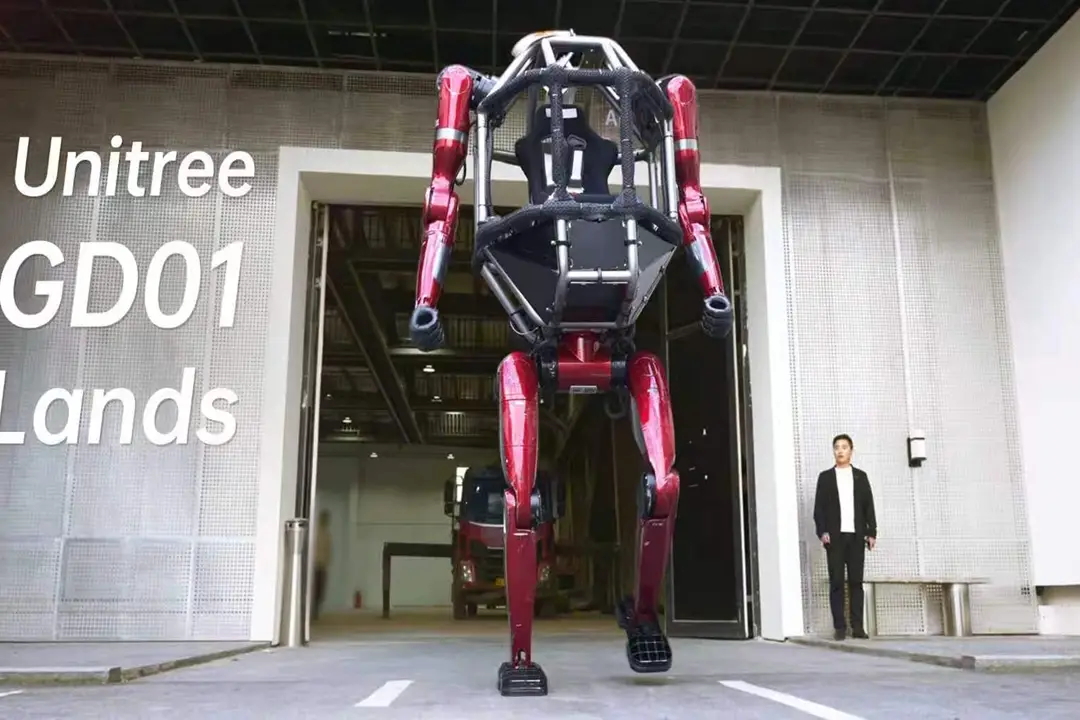
Chinese robotics startup Unitree Robotics released two vastly different robots this spring. On April 30, it released the R1 Air, a dual-arm humanoid robot with a base price of 26,900 yuan ($3,700). Barely two weeks later, on May 12, it introduced the GD01, a manned mecha — essentially a giant pilotable robot — starting at 3.9 million yuan.
According to the company, the R1 Air strips away the legs to focus on practical, high-precision tasks. It weighs between 11 and 32 kilograms and boasts a 10 TOPS computing capacity. TOPS, or Tera Operations Per Second, is a standard metric indicating how many trillions of operations an AI processor can handle every second. With a repetition precision of ±0.1 millimeters, the R1 Air is positioned as a highly capable productivity tool for factories and laboratories.
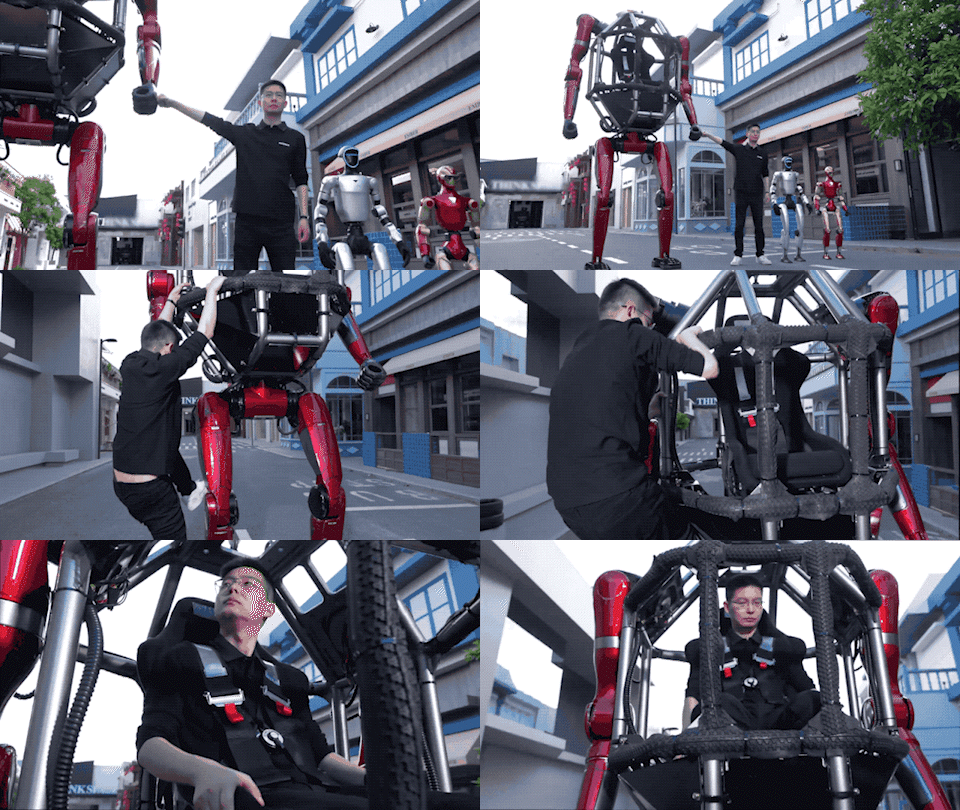
In stark contrast, the GD01 is a 3-meter-tall, 500-kilogram steel behemoth that can seamlessly switch between humanoid and quadruped modes. The company says the mecha can carry a human driver and possesses enough strength to punch through a brick wall while maintaining its balance.
Marketing stunts and IPO ambitions
While the GD01’s staggering price tag suggests it functions primarily as a marketing stunt, the robot aligns perfectly with Unitree’s broader financial goals. On March 20, the Shanghai Stock Exchange officially accepted the company’s application for an IPO on the tech-focused STAR Market, where it aims to raise over 4.2 billion yuan.
Launching such a sensational product serves as an impressive “calling card” for the company — it grabs investor attention, lifts valuations, and acts as a psychological price anchor that makes Unitree’s other products seem far more affordable.
Unitree has a proven track record of using viral content to promote products. Its demonstration videos featuring robot dogs and humanoids performing synchronized backflips and navigating extreme environments have been widely shared globally. In fact, some videos were so unbelievable that viewers suspected they were AI-generated, prompting founder Wang Xingxing to record a debunking video — a move that garnered even more attention. Foreign institutions also leverage Unitree’s robots to generate buzz; for instance, a Unitree G1 model was recently “ordained” as a robot monk at Jogyesa Temple in South Korea, according to iFanr.
Conversely, the R1 Air represents Unitree’s ambition for mass deployment. The company says the robot is designed to push the boundaries of embodied AI — a concept defined by NVIDIA as the integration of AI into physical systems, enabling them to perceive and interact directly with the physical world. By pricing the R1 Air below a high-end laptop, Unitree aims to foster a massive developer ecosystem, though a researcher told the 21st Century Business Herald that large-scale industrial deployment still needs further validation — especially around task complexity and efficiency.
Overshadowing a listed rival
Unitree’s explosive visibility has increasingly overshadowed another major Chinese player, UBTech Robotics, which went public in Hong Kong in 2023 and is widely known as the “first global robot stock.”
Although UBTech’s 2025 total revenue reached 2 billion yuan, surpassing Unitree’s 1.7 billion yuan, it remains unprofitable, reporting a net loss of 790 million yuan for the year. That compares with Unitree’s 2025 net profit of 600 million yuan excluding non-recurring items.
The two companies are pursuing different market niches. UBTech has pivoted heavily toward the industrial robotics market, deploying its humanoid robots in automobile factories like those of BYD and FAW. Unitree, on the other hand, still relies largely on the academic and research sectors, which accounted for over 70% of its applications in 2025. Furthermore, Unitree’s research and development spending is far lower, roughly one-ninth of UBTech’s outlays in recent years.
A generational shift in Chinese tech
Beyond their differing R&D and market strategies, the contrast between the two companies highlights a broader generational shift within China’s technology sector. UBTech’s founder was born in the 1970s, while Unitree’s Wang Xingxing represents the rising wave of post-90s Chinese entrepreneurs.
Growing up in China post-2000 is an entirely different narrative from coming of age in the 1980s. Over those two decades, the country experienced unprecedented transformations in educational standards, global perspective, and entrepreneurial culture.
This evolution has cultivated a new breed of founders. Young innovators like Unitree’s Wang, Moonshot AI’s Yang Zhilin, and Insta360’s Liu Jingkang are not just bringing innovative companies and products to the global stage; they are accelerating the reshaping of China’s business landscape.
Beyond Unitree’s IPO ambitions, two very different robots already tell the story of a new kind of Chinese tech ambition — one built on spectacle, price disruption, and a founder who grew up expecting to compete with the world, not just copy it.
Sources: