

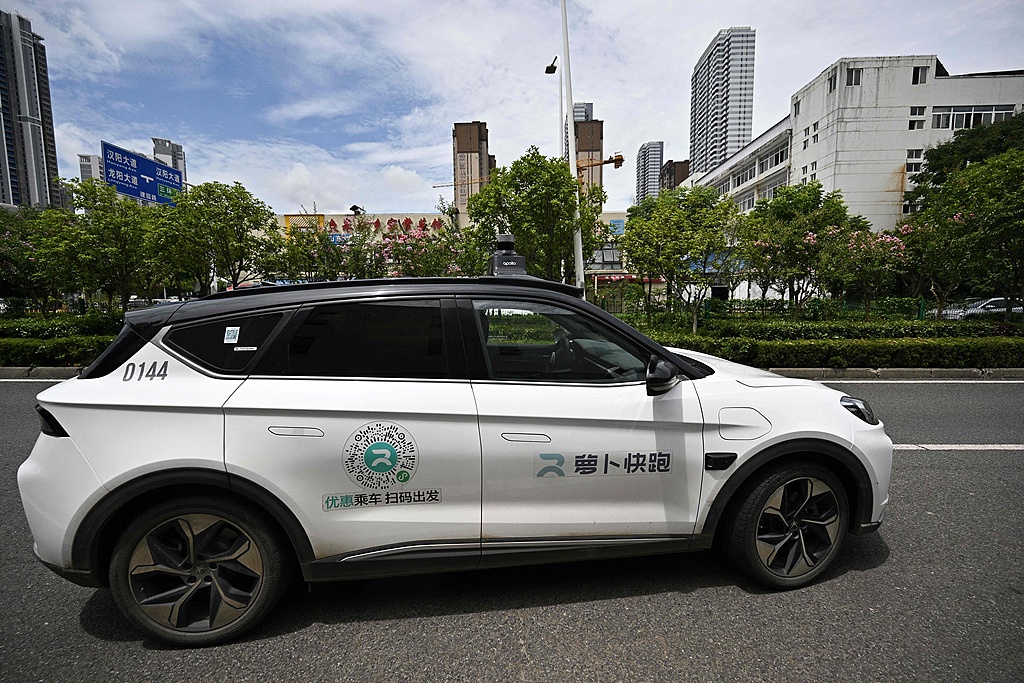
By Hu Minghe
China appears to have hit the pause button on its push to roll out robotaxis at scale after recent safety incidents, a move that could delay a key part of the state’s program to encourage autonomous driving by a year or more. But the setback may ultimately strengthen the industry by forcing companies to address a critical weakness: public trust in a technology that still feels unfamiliar and, for many riders, slightly unsettling.
Analysts had projected China’s robotaxi fleet could nearly triple this year as operators expanded beyond pilot programs. Those forecasts now look optimistic following a major outage involving Baidu (BIDU.US; 9888.HK) and a broader pause on new permits that signals regulators are prioritizing safety over speed.
China’s robotaxi sector was supposed to be entering an era of scale, as operators put more of their vehicles on the road after years of testing. Instead, it’s now getting a safety audit – which some may argue was overdue.
A February report from the China Academy of Information and Communications Technology described 2025 as a turning point for autonomous driving as robotaxis and autonomous delivery vehicles moved from pilots toward commercialization. It framed autonomous driving as a strategic part of global technology competition, and not simply another transport business.
But now China has reportedly tapped the brakes on the robotaxi program after several recent incidents, including one that left the streets of a major city clogged with stalled driverless cars.
From vehicle safety to system safety
On March 31, multiple robotaxis from Baidu’s fleet of Apollo Go robotaxis suddenly stopped on the roads in Wuhan, capital of Central China’s Hubei province. Local police assigned preliminarily blame to a system failure, with no injuries reported, while local media said some passengers were trapped inside stalled vehicles for nearly two hours.
The incident stood out from single-vehicle cases of the past because it appeared to reflect a fleet-level failure. One robotaxi malfunction is a product problem. A hundred robotaxis stopped in traffic suggests an infrastructure problem.
China paused new autonomous-vehicle licenses following the outage, according to several foreign media reports, a move that would slow new pilots and fleet expansions. On April 14, three ministries also called for nationwide self-inspections and stronger emergency-response supervision for intelligent connected vehicle road tests. In Dongguan, Apollo Go was reportedly being put through safety drills and vehicle inspections.
Wuhan was the biggest bump in the road for the industry to date, but it wasn’t the first warning sign. Last December, a Hello autonomous vehicle in the city of Zhuzhou, in Central China’s Hunan province, was involved in an accident that reportedly left two people needing hospital treatment and resulted in the temporary suspension of local service.
Public trust is critical for any new technology to gain traction. But it’s especially important for robotaxis, which have the ability to lead to injuries to humans and cause major traffic problems. Riders caught up in the Wuhan outage complained not only about becoming trapped in stalled cars, but also poor SOS support. Passengers may tolerate slow, awkward rides if they are cheap and convenient, but they react strongly when they get stranded or their safety is jeopardized.
The scale of the Baidu outage relates to its leadership in China’s robotaxi race. The company does not break out Apollo Go revenue or profit in its financial reports but provides information about the scale of the service. It said Apollo Go delivered 3.4 million fully driverless operational rides in last year’s fourth quarter, with weekly rides peaking at more than 300,000 and service available in 26 cities.
An increasingly crowded field
While Baidu was one of the earliest companies to embrace robotaxis in China, it has since been joined by others in an increasingly crowded field. Pony AI (PONY.US; 2026.HK) and WeRide (WRD.US; 0800.HK) have entered the race in both China and other global markets, showing rapid robotaxi revenue growth but also the heavy cost of fleet expansion. Pony AI’s fleet currently exceeds 1,400 vehicles, while WeRide has reported triple-digit robotaxi revenue growth. Both companies’ robotaxi businesses are still losing money at the operating level.
Apart from those leaders, XPeng (XPEV.US; 9868.HK) says its VLA 2.0-equipped robotaxi has started public road testing, with trial operations planned for later this year. Caocao (2643.HK), the ride-hailing arm of Geely, has said it plans to deploy thousands of purpose-built robotaxis globally in 2027 and is targeting 100,000 vehicles by 2030.
Outside China, names like Alphabet-backed Waymo and Tesla (TSLA.US) are leading the race, while others like Uber (UBER.US) are placing their bets through investments and partnerships with direct operators like Pony AI and WeRide.
Some forecasts see global autonomous taxi services becoming a multibillion-dollar market by 2035 as more vehicles exit the testing lane and move into the taxi mainstream.
The geopolitical factor
Geopolitics is also becoming an increasing part of the global robotaxi story. In the U.S., autonomous driving is increasingly viewed through a national-security lens, with new rules restricting some China- and Russia-linked vehicle-connectivity systems and automated-driving software.
China has a real edge with its lower EV costs, dense city pilots and support from local governments. But as the Baidu incident shows, safety problems are also an important factor that can’t be overlooked as companies scale up. Investors have started pricing in that risk. After reports emerged on the permit pause, Baidu’s Hong Kong-listed shares fell 2.8%, while Pony AI and WeRide dropped 5.5% and 4.7%, respectively.
While the outage marks a setback, China’s robotaxi race certainly isn’t ending. Instead, it is entering a new qualification round. In the end, the winners may not be the companies with the most cities, cheapest vehicles, or highest ride count. Rather they will be the ones who can demonstrate that driverless fleets can behave like public infrastructure: useful when everything works, and still safe and quickly recoverable when something breaks down.