
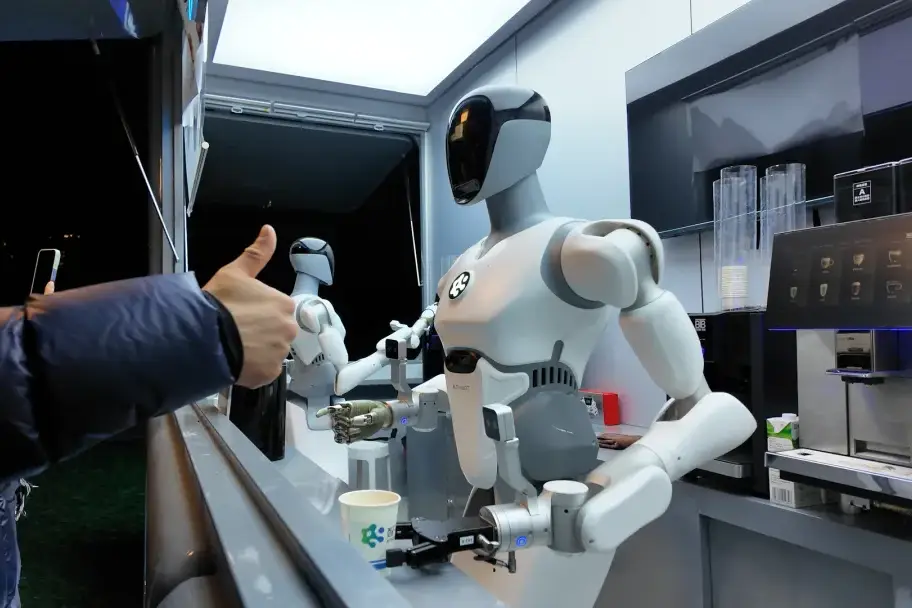
Coffee-serving robot developed by AI Square Robotics
By Da Cheung
The race to commercialize embodied AI in China is pivoting away from perfecting mechanical hardware and toward building the sophisticated artificial intelligence that will power it.
Two Shenzhen-based embodied AI startups—AI Square Robotics (Zhi Pingfang) and X Square Robot (Zibianliang)—simultaneously announced on June 29 that they had reached valuations of 20 billion yuan ($2.75 billion), signaling a high-stakes consolidation phase in the sector. Embodied AI refers to artificial intelligence systems that interact with the physical world through a robotic body.
Investors are pouring capital into what the market calls the software-first business model —a strategy that prioritizes a company’s proprietary AI foundation model over the hardware, which is increasingly treated as a commodity or an off-the-shelf peripheral. The core bet is that the intelligence layer, rather than the physical mechanics, will ultimately dictate market dominance.
Yet a critical look at the industry reveals a stark gap: while these brain-focused startups command staggering valuations based on future promise, nearly all remain in the commercial pilot stage, with their progress measured largely by self-reported benchmarks and ambitious revenue projections rather than proven mass adoption.
Commoditized hardware versus proprietary software
This dynamic has separated China’s robotics industry into two distinct factions.
The hardware faction, typified by companies such as Unitree Robotics, has tangible, near-term sales — mostly in the research and education sectors — and is advancing toward IPOs backed by concrete cash flow. These companies win on cost, supply-chain efficiency, and reliable physical execution.
In the opposing camp sits the brain faction,the companies pursuing the software-first strategy, which includes X Square Robot, AI Square Robotics, Galaxy General, Astribot, and ACE Robotics. Their core business is developing physical-world foundational AI models known as vision-language-action models (VLAs), which translate visual and linguistic inputs directly into motor commands. For these firms, the robot body functions essentially as a data-gathering vessel; its primary job is to generate real-world interaction data to refine the software, rather than to serve as the primary source of long-term value or profit margin.
The market’s appetite for this software-first approach is perhaps best illustrated by X Square Robot’s extraordinary funding path. Founded only in December 2023, the company announced its Series B round in late April 2026 — and then quietly closed three further rounds within just two months, pushing its post-money valuation past 20 billion yuan.
More striking still, it is the only domestic embodied AI company to have secured lead-investor backing from four traditionally fierce tech rivals simultaneously—Alibaba, ByteDance, Meituan, and Xiaomi. This rare alignment of competing giants underscores just how critical they believe the software “brain” will be to the future of robotics, even if the hardware remains, for now, a secondary consideration.
These internet giants have been joined by state-backed funds, including the National AI Industry Investment Fund, and industrial capital from automakers like Chery and consumer electronics brands like Honor. This diverse group of investors is not just looking for financial returns; they are seeking to integrate advanced robotic brains into their own assembly lines and service networks. Yet, justifying a $2.75 billion valuation for a company whose main business is still in the pilot phase remains a significant gamble for them.
Divergent paths to a smarter brain
To address key constraints in robot responsiveness and energy efficiency, X Square Robot and AI Square Robotics are taking divergent technological paths, though both rely heavily on end-to-end architectures. An end-to-end system directly translates what a robot sees and hears into physical movements, skipping the traditional intermediate steps of manual programming.
X Square Robot is advancing world models — AI systems that simulate and predict how physical environments behave over time. According to the company, its newly released WALL-WM model uses event-level prediction — anticipating sequences of actions rather than just single frames — to align visuals, language, and actions. The company claims its open-source models outperform mainstream competitors in autonomous task completion, though these benchmarks are self-reported and lack independent third-party verification.
AI Square Robotics, which recently raised nearly 5 billion yuan, is pioneering a biomimetic approach — in other words, one modeled on biological systems. The company says its “NeuroVLA” system replicates the human nervous system to improve efficiency.
“If everyone continues forward along the same large model route, we will need 10 times the data and 10 times the electricity. But the real world does not have infinite data and energy,” AI Square Robotics CEO Guo Yandong told Chinese tech outlet Jazzyear [8].
Although its system is end-to-end in training, AI Square Robotics has designed it with specialized internal layers. The company says its architecture divides tasks into three layers: a “cortex” for slow thinking and semantic understanding, a “cerebellum” for high-frequency movement coordination, and a “spinal cord” for instant reflexes. This setup reduces robotic jitter by 75% and allows for reflex responses within 20 milliseconds. These performance metrics are derived from company press releases and have not been independently verified.
The gap between valuation and reality
Despite their unicorn status, these software-first startups face significant uncertainty. The core challenge is proving that their AI models can generalize across diverse, unpredictable real-world industries, rather than just perform well in controlled laboratory settings.
AI Square Robotics claims it is already making commercial headway. The company cites a three-year, 1,000-unit cooperation agreement with display panel manufacturer HKC (001399.SZ) signed last year as a key reference project, though it is unclear whether this represents firm purchase orders or a framework partnership. Separately, in the retail sector, the company has deployed robots called Aibao Smart Cube serving coffee and ice cream across multiple Chinese provinces. It also plans to build a new production line with a capacity for tens of thousands of units in the second half of 2026.
However, these ambitious manufacturing targets contrast sharply with the current reality of the software-first startups, which generally lack the mass-manufacturing experience and proven cash flow of hardware-first competitors. The massive valuations of X Square Robot and AI Square Robotics ultimately reflect a speculative bet by top-tier capital. Investors are wagering that the software brains being developed today will eventually become the universal operating systems for the physical world — a lucrative vision that is still far from guaranteed.
Sources