
Fintech giant launches new AI vision models as industry abandons viral laboratory demonstrations to focus on pragmatic, high-intensity factory automation.
By Da Cheung
For years, the robotics industry has captivated the public with viral videos of humanoid robots performing complex tasks, promising a future where a single machine could assemble cars by day and fold laundry by night. But as the calendar turns to the second half of 2026, artificial intelligence firms are facing a harsh reality check.
The gap between controlled laboratory demonstrations and the unpredictable variables of the real world — a problem known as the scene chasm — is proving exceptionally difficult to cross. Robots that flawlessly execute tasks in promotional videos frequently fail when faced with minor lighting changes, moved objects, or transparent surfaces in real environments.
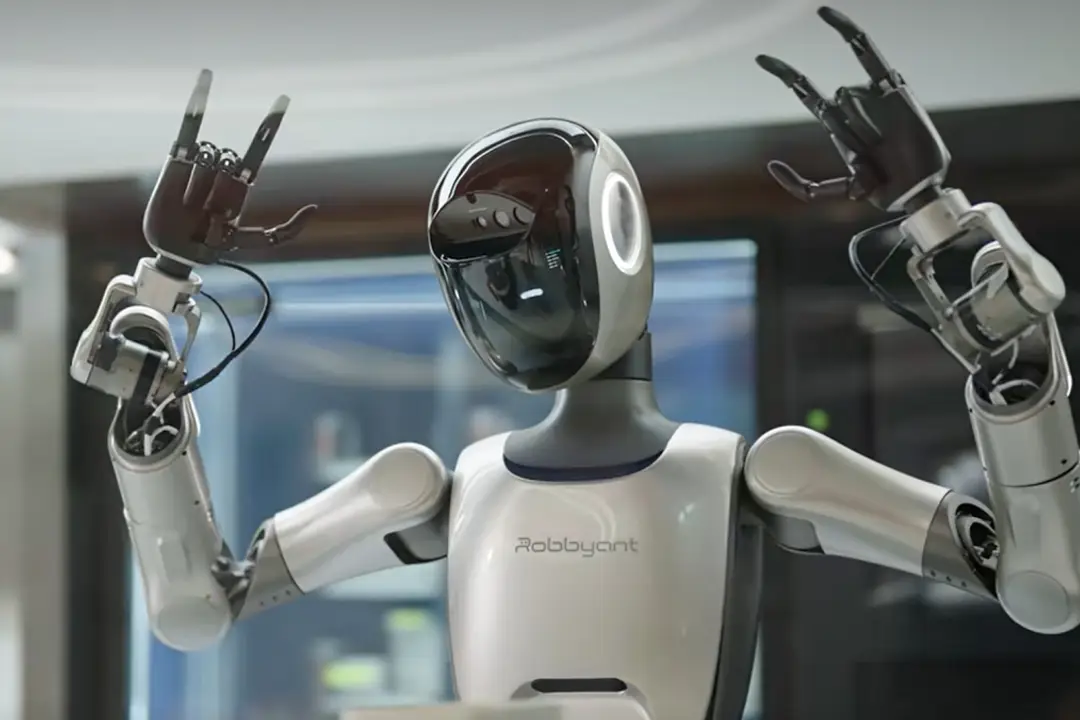
To address these fundamental perception failures, fintech giant Ant Group’s robotics subsidiary, Robbyant, unveiled a new suite of open-source vision models on Tuesday that will be showcased at the upcoming World AI Conference in Shanghai. The new models highlight a broader industry pivot away from overhyped, do-it-all general robots and toward solving the gritty, foundational problems of machine vision and industrial reliability.
Factory first, home last
Drawing lessons from the autonomous driving sector — which spent years promising imminent fully self-driving cars before settling into a slow, iterative reality — the robotics industry is adopting a pragmatic strategy. Industry insiders now widely accept a “factory first, commercial next, home last” deployment path, acknowledging that highly variable and unpredictable consumer environments remain too complex for current technology.
“Industrial scenarios have relatively lower requirements for model generalization,” Sun Rongyi, vice president of Spirit AI, which develops models for embodied AI, told the industry publication Gaishi Embodied AI. “Robots only need to complete fixed processes at fixed stations. But in home scenarios, the needs of thousands of households vary wildly, placing extremely high demands on generalization.”
Robotics startups like AgiBot and Galbot have already deployed units for continuous, high-intensity tasks on assembly lines for major manufacturers. AgiBot integrated its robots into a factory assembling vehicles for automaker SAIC-GM in March, while Galbot deployed units to battery giant CATL for material handling and sorting.
Meanwhile, the novelty of robots in less demanding sectors is wearing off rapidly. According to Li Jinke, secretary-general of the Humanoid Robot Scene Application Alliance of China, the daily rental price for entertainment robots has plummeted from 10,000 yuan ($1,380) to 1,000 yuan — a sign of severe market saturation and a warning that companies must find real utility to survive.
Giving robots spatial common sense
Even in structured factories, robots frequently fail because of basic vision problems. Traditional AI vision models excel at semantic recognition — identifying that an object is a glass cup, for example. However, robots need spatial common sense to interact with the physical world. They must understand the cup’s geometric boundaries, its depth, and whether it is blocked by another object.
Robbyant’s new models, LingBot-Vision and LingBot-Depth 2.0, claim to tackle these notorious robotic blind spots. Standard depth sensors often fail when looking at transparent glass, reflective surfaces, or complex lighting. For instance, a robot looking at a stack of transparent glasses might see fragmented or empty data, causing its mechanical arm to miss the target entirely.
Robbyant says its models train the AI to understand geometric boundaries and depth, effectively filling in the blind spots of 3D cameras. By focusing on the edges of objects, the AI can better map out safe walking paths and precise grasping points. The company has partnered with Shenzhen-based 3D camera maker Orbbec (688322.SH) to integrate these models into commercial hardware [9].
The company claims its new vision base model outperforms mainstream alternatives, such as DINOv3, in spatial recognition, despite using a pre-training dataset that is an order of magnitude smaller. Robbyant also claims its depth model secured 12 first-place finishes across 16 benchmark tests.
A commercial watershed
Industry leaders view 2026 as a commercial watershed. The survival of robotics firms now depends on delivering reliable, cost-effective hardware alongside full-stack service systems — comprehensive packages that integrate software, physical machinery, and operational support — rather than competing solely on single-point technological breakthroughs in the lab.
Zhu Xing, CEO of Robbyant, said that the industry faces massive hurdles, including the high cost of adapting robots to new environments — where even a slightly different floor plan can render a model useless — and the lack of hardware stability for long-term operations.
As the industry shifts from viral demos to pragmatic applications, the focus is squarely on reliability. Much like the autonomous driving industry before it, the robotics sector is waking up from the fantasy of a one-step leap to general artificial intelligence, settling instead for the slow, grinding work of making robots function reliably in the physical world.
Sources