
By Da Cheung
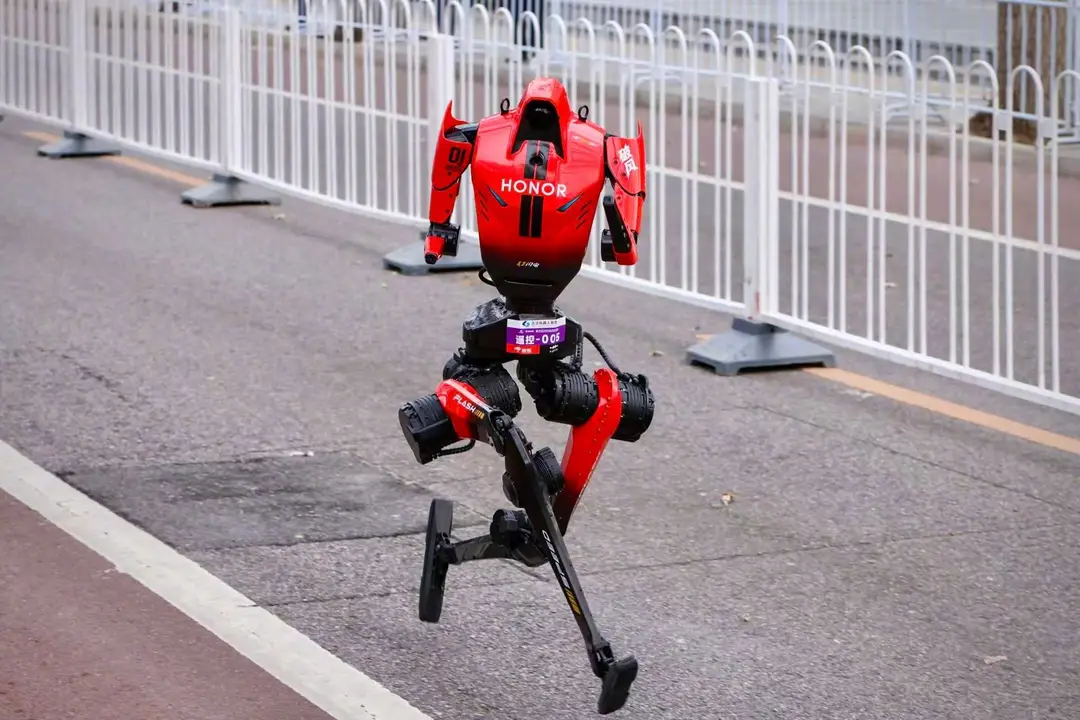
A humanoid robot called Lightning developed by smartphone maker Honor ran a half-marathon in Beijing in 50 minutes 26 seconds, beating the men’s world record by nearly 7 minutes.
The event, which took place on April 19, highlighted a staggering leap in robotics over a single year. In the inaugural 2025 Beijing E-Town Humanoid Robot Half Marathon, the winning robot clocked in at over two hours and 40 minutes. Out of 20 teams, some 70% of the robots required human operators to constantly guide, catch, and reboot them. This year, nearly 40% ran entirely autonomously without remote controls.
Running blind and staying cool
While the visual of autonomous robots sprinting might evoke images of highly intelligent, seeing machines, the reality is more utilitarian. Most top-performing robots, including Honor’s Lightning, navigated without advanced visual artificial intelligence.
According to tech outlet Qbit AI, using end-to-end visual AI consumes too much computing power and weight — two extremely precious resources in a long-distance race. Instead, the robots ran essentially “blind,” relying on a combination of LiDAR — laser sensors that map the physical environment in 3D to avoid obstacles — and RTK, a highly precise, enhanced GPS system that pinpoints location down to the centimeter. Because the robots constantly calculate and correct their deviations from a pre-set path without visually “seeing” the track, they often display a weaving, snake-like running posture, struggling to walk in a perfectly straight line like a blindfolded human attempting to maintain balance.
Beyond navigation, a marathon is an ultimate stress test for continuous motion control and thermal management. The intense power output historically caused older models to overheat and shut down. To solve this, companies implemented advanced liquid cooling systems.
Honor’s engineering team seized the opportunity to advertise their consumer tech roots — their robot’s thermal management is directly borrowed from the company’s smartphone cooling technologies. Even under current temperatures, after running the full 21 kilometers, the motors are ice-cold to the touch, according to the company. To further minimize downtime, Lightning performed a hot-swappable battery change at the 10.6-kilometer mark that took less than 10 seconds — akin to a race car pit stop — without needing a system reboot.
However, Honor’s humanoid design appears optimized strictly for long-distance running rather than complex tasks. If a future robot sports event were to focus on dexterity and agile movements, competitors like Unitree Robotics might take the crown. Unitree announced right before the race that its H1 robot model had broken the world record for robotic sprint speed, reaching 10 meters per second.
An industry sprinting to the future
The marathon acts as a high-profile stress test for an industry flooded with capital. According to TMTPost, China’s embodied AI sector raised between 51.1 billion yuan ($7.1 billion) and 73.5 billion yuan in 2025. The momentum has continued, with the first quarter of 2026 seeing nearly 30 billion yuan in new investments.
This financial influx is backing massive production scales. CCTV reports that in 2025, China’s humanoid robot shipments reached 14,400 units, commanding an 84.7% share of the global market. As hardware production surges, software development is benefiting from a massive talent migration from another high-tech sector — electric vehicles (EVs).
“More autonomous driving technology will be passed down to humanoid robots next year,” Zhang Xiaobai, founder of High Torque Robotics, told Qbit AI. He explained that many engineers are leaving the electric vehicle sector to build humanoids, bringing with them a shared technology stack that translates well from smart cars to walking machines.
For Zhang, the sight of robots outstripping human athletic limits holds deep historical significance. Much like how Olympic runners represent the absolute physical peak of carbon-based life, these marathon machines are beginning to map out the upper limits of silicon-based entities — signaling that the race for the robotic era is well and truly underway.
Sources: