
With its free Green Bubble hub, the tech giant is deploying social recommendations and AI content to defend user screen time.
By Da Cheung
China’s largest internet companies are opening a new front in the battle for mobile screen time, squaring off over ultra-short, soap-opera-style videos known as micro-dramas.
Tencent (0700.HK) has quietly rolled out Green Bubble (“Lüpaopao” in Chinese), an official, free micro-drama hub inside its ubiquitous WeChat super-app. The October rollout marks Tencent’s fourth attempt to crack China’s booming micro-drama sector, a market that research firm DataEye projects will exceed 121 billion yuan ($18 billion) in 2026, up from nearly 90 billion yuan in 2025 as estimated by the China Netcasting Services Association.
Analysts view Tencent’s move as a defensive counterattack against TikTok parent ByteDance. Over the past three years, ByteDance’s standalone app Red Fruit (“Hongguo” in Chinese) has turned free, ad-supported micro-dramas into a massive cash cow.
By pairing ByteDance’s vast web-novel library with traffic from its superapp Douyin, the Chinese version of TikTok, Red Fruit reached 168 million daily active users in July 2026, according to data compiled by QuestMobile. That eclipsed the combined 155 million daily users of China’s top four Netflix-style long-form streaming platforms: Tencent Video, iQiyi, Youku, and Mango TV. On average, Red Fruit users spend 125 minutes a day on the app.
Tech outlet GeekPark reported that the number of daily users climbed to roughly 220 million by October and helped ByteDance apps capture a record 41.8% of total user time among China’s top 50 mobile apps in August — though those figures rely on unspecified third-party monitoring data. More concerning for Tencent, QuestMobile data from February 2026 shows Red Fruit has amassed over 40 million users aged 50 and older, steadily poaching lower-tier-city and older demographics whose online time previously belonged to WeChat.
From passive landlord to active operator
Until now, micro-dramas have mostly shifted toward an in-app advertising model, where viewers watch episodes for free with commercials inserted between clips. While ByteDance perfected that closed loop, Tencent’s earlier efforts were fragmented across paid long-form tiers and minor apps.
Ironically, WeChat already hosts China’s largest pool of micro-drama viewers. As of February 2026, 427 million monthly active users watched micro-dramas via WeChat mini-programs — lightweight apps that run inside WeChat without separate downloads — surpassing the 335 million monthly users on standalone apps, according to QuestMobile. However, that traffic was scattered across dozens of third-party mini-programs, leaving Tencent as a passive infrastructure provider collecting service fees.
Now, Tencent is centralizing that traffic. Citing anonymous sources close to the company, 21st Century Business Herald reported that WeChat founder Allen Zhang previously hesitated to aggressively commercialize micro-dramas to preserve the app’s uncluttered user experience. But the launch of Green Bubble executes CEO Pony Ma’s January mandate to build ad-driven video products.
“Previously, WeChat’s role in the micro-drama market was running a shopping mall and renting out storefronts,” Zeng Xianru, founder of industry research firm GrowData, told 36Kr. “Now, it wants to open its own store.”
Social algorithms and the AI content paradox
The rivalry pits two distinct internet models against each other. ByteDance relies on algorithmic recommendations and costly paid ad campaigns to drive downloads for a standalone app. In contrast, Tencent is embedding Green Bubble directly into WeChat’s 1.4-billion-user social network.
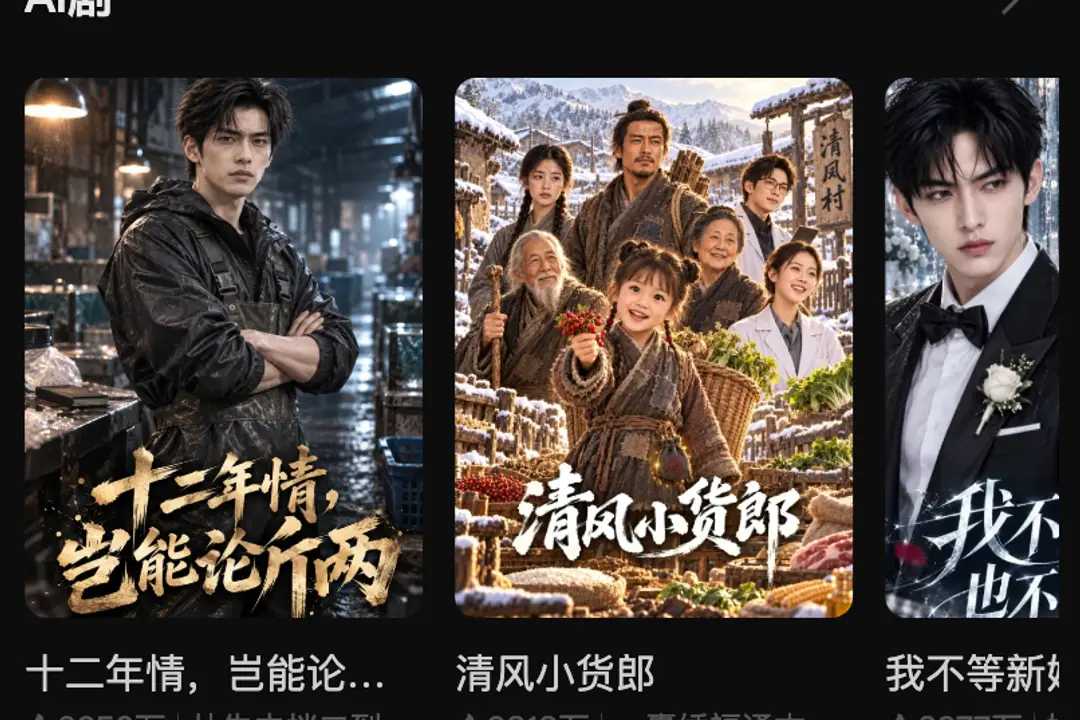
Rather than producing shows in-house, Tencent aggregates third-party live-action, animated, and AI-generated dramas. Users can watch episodes in a floating window while replying to text messages, share clips in group chats, and browse a “friends are watching” feed that recommends shows based on contacts’ viewing habits.
Production studios have welcomed a counterweight to ByteDance’s near-monopoly, sparking an Oct. 9 rally in Chinese media stocks including COL Group (300364.SZ) and Mango Excellent Media (300413.SZ). To lure creators during the fourth quarter, Tencent replaced the industry’s standard click-count metric with “effective watch time” — requiring at least 10 minutes of viewing per user — to reward retention in preference to three-second clickbait.
Still, Tencent faces a glaring content gap. According to GeekPark, Green Bubble relies heavily on older 2024 reruns, and its top-ranked show trails the popularity metrics of Red Fruit’s top 100 hits.
To close that gap, Tencent is leaning heavily into AI-generated dramas, which accounted for over 95% of the 122,000 new micro-dramas released in the first quarter of 2026. According to the company, Green Bubble users watch five times longer than the WeChat ecosystem average, and an exclusive AI drama titled Empress Yaya drew “hundreds of millions of views” and millions of yuan in ad revenue within three days. Furthermore, there’s a structural mismatch: while cheap AI shows dominate Green Bubble’s charts, live-action dramas still outperform AI content in the long watch times Tencent’s payout rules actually reward.
Privacy hurdles in a defensive war
Industry insiders largely expect Green Bubble to cannibalize smaller WeChat mini-programs rather than unseat Red Fruit. Several producers told STAR Market Daily that they plan to test WeChat’s temporary subsidies while keeping Red Fruit as their primary launchpad, citing ByteDance’s mature payout system and uncertainty over WeChat’s post-December commission rules.
Moreover, Tencent’s social distribution bet faces a cultural test. Because melodramatic micro-dramas are often consumed as a private guilty pleasure, some analysts say that it is uncertain whether WeChat users will tolerate features that broadcast their viewing habits to friends and colleagues.
Sources