
The tech giant aims to cut costs and rival Apple, but a precarious financial transition poses significant challenges.
By Da Cheung
Chinese tech giant Xiaomi (1810.HK) is aggressively expanding its in-house semiconductor capabilities, unveiling three new proprietary chips designed to power its smartphones, artificial intelligence applications, and electric vehicles. The move, announced on Aug. 24, highlights the company’s strategic pivot to reduce its reliance on suppliers like Qualcomm, MediaTek, and Nvidia amid surging component costs and a precarious financial transition.
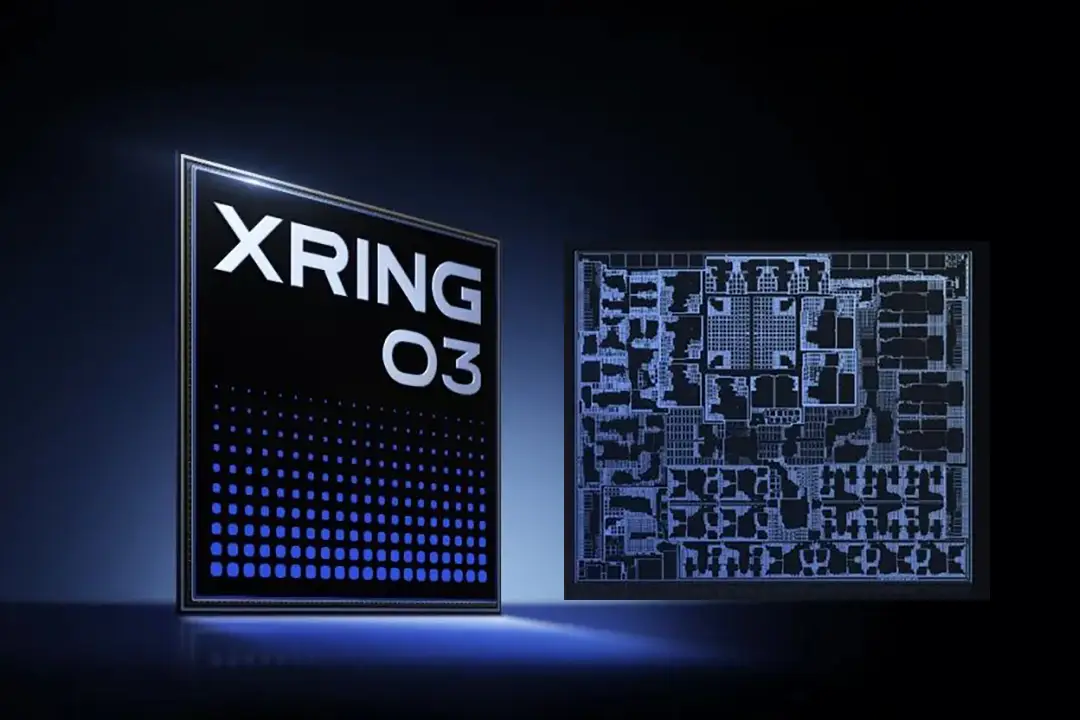
The new lineup includes the Xring O3, a flagship smartphone system on a chip (SoC) — a single component combining a device’s computing, graphics, and AI brains — as well as the Xring O100 for AI acceleration and the Xring D100 for autonomous driving.
The chip push comes as Xiaomi attempts to build a self-sufficient supply chain, a narrative that resonates strongly in China’s broader tech ecosystem but faces a looming reality check on the global stage.
Squeezing the limits of older technology
While industry rivals are migrating to the next-generation 2-nanometer manufacturing process, Xiaomi has opted to maximize the older 3-nanometer technology for its Xring O3. In semiconductor manufacturing, nanometers measure how small and tightly packed a chip’s transistors are; smaller dimensions generally yield faster and more power-efficient chips.
According to the company, the O3 chip features 24 billion transistors and will debut in the upcoming Xiaomi 18 Fold smartphone in September.
The decision to stick with older technology is driven by a mix of economics, supply chain bottlenecks, and geopolitical hurdles. Tencent Technology notes that 2-nanometer wafers can be as much as 66% more expensive to produce. Furthermore, TSMC (2330.TW) (TSM.US), the contract manufacturer producing the chips, has its advanced capacity fully booked by Apple and others.
Crucially, U.S. export controls reportedly place a red line at 30 billion transistors for certain advanced chips. Moving to a 2-nanometer process could push Xiaomi’s transistor count past 35 billion, potentially triggering international trade restrictions.
Despite using older manufacturing tech, Xiaomi claims the O3 outperforms Apple’s current A19 Pro chip by nearly 40% in multi-core processing. A review by tech channel GeekerWan suggested the chip’s graphics performance even nears that of Apple’s M5 computer chip. But these performance claims should be treated with caution. GeekerWan tested a specialized developer board, which does not reflect the thermal constraints and battery limitations of a retail smartphone. Furthermore, Xiaomi is comparing its newest chip against Apple’s older models. Both Apple and Qualcomm are expected to unveil their own next-generation 2-nanometer processors in September.
The O3 chip does mark another milestone for China’s domestic supply chain. It is the first mobile processor to support LPDDR6. This is the latest generation of consumer memory technology that acts as a device’s short-term workspace, allowing applications and AI models to process data much faster. According to 21st Century Business Herald, Xiaomi will partner with domestic manufacturer ChangXin Memory Technologies (688825.SH) (CXMT) to deliver this feature, challenging the long-standing monopoly of foreign memory giants like Samsung Electronics, SK Hynix, and Micron.
According to Xiaomi, the O3 chip also features a neural processing unit (NPU) deeply optimized for large language models on edge computing, which improves first-token output speed by 40% and inference speed by 45%.
A costly transition phase
Xiaomi’s heavy investment in silicon — which the company says will total 50 billion yuan ($7 billion) over a decade — arrives during a difficult financial transition.
In the second quarter of 2026, Xiaomi reported revenue of about $15 billion, a 6.1% decline year-over-year, alongside a 20.3% decline in overall profit.
The company is facing a dual hit right now — a sharp drop in smartphone shipments and heavy cash burn in its rapidly growing electric vehicle business. To protect profit margins against soaring memory chip costs, Xiaomi has executed a strategic retreat from low-end phone models. This pushed its average selling price to a record 1,351 yuan, but cost the company significant market share. According to IDC, Xiaomi’s domestic smartphone market share dropped to fifth place in the second quarter, while rivals Huawei and Apple both saw shipment increases.
Meanwhile, Xiaomi’s automotive division is growing but remains a financial drain. The company delivered over 104,000 vehicles in the second quarter, generating about $3.3 billion in revenue. However, the division still posted an operating loss of about $364 million as it eats through cash to build scale.
The AI and automotive horizon
Looking beyond smartphones, Xiaomi introduced two additional chips aimed at the future of edge computing and mobility.
The Xring O100 is an AI accelerator chip utilizing a 6-nanometer process. While the nanometer size is not cutting-edge, the chip employs an advanced 3D wafer-level stacking design — essentially stacking memory directly on top of the processor vertically to drastically speed up data transfer, which aligns with Huawei’s Tau (τ) Scaling Law. The Xring D100 is a 3-nanometer chip designed for autonomous driving, capable of running massive AI models onboard the vehicle rather than in the cloud.
Both the O100 and D100 have completed development and are scheduled for commercial deployment next year, according to the company. We’ll find out in the next few years whether Xiaomi’s proprietary chips will really help the company.
Feature photo: Xiaomi Xring O3 smartphone SoC, sources from Xiaomi, edited by The Insight Asia.
Sources