

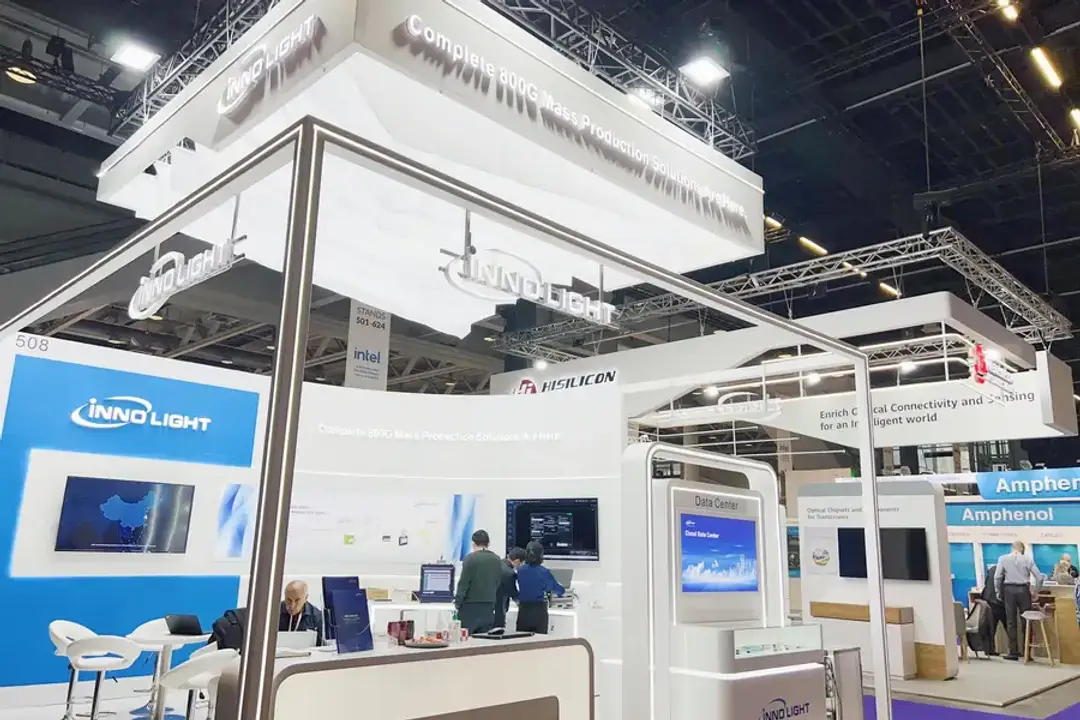
InnoLight’s first-half revenue surged 182% as global AI infrastructure spending fueled demand, but weaker Chinese investment and rapid expansion raise new risks.
By Doug Young
The first financial report from Zhongji InnoLight (3308.HK; 300308.SZ) offers a revealing snapshot of the AI infrastructure boom — and where that spending is, and isn’t, happening.
The optical transceiver maker reported triple-digit growth in both revenue and profit in the first half of 2026, driven by surging demand for hardware used in AI computing infrastructure. But the report also highlights a striking gap between AI investment in China and overseas markets.
While global technology giants including Google and Microsoft continue to spend heavily on AI infrastructure, capital expenditure by China’s major internet companies has grown much more slowly. That matters because InnoLight gets the overwhelming majority of its revenue from international customers. It had raised HK$53 billion ($6.76 billion) in its July IPO, providing substantial funding for expansion.
The company is also expanding rapidly to keep pace with demand, increasing investment and taking on more debt in the process. That could become a vulnerability if the current AI infrastructure spending boom loses momentum.
Investors appeared cautious about those risks. InnoLight’s Hong Kong-listed shares closed 11.3% lower on Monday Aug. 24, the first trading day after the results were released.
The company makes optical transceivers that convert electrical signals into light signals for transmission over fiber-optic networks. The components are essential for moving data around the large computing clusters being built to train and run AI models.
According to third-party data cited in InnoLight’s IPO prospectus, the company holds 21.2% of the global market for optical interconnect solutions. Its latest report says demand for large-scale computing clusters began accelerating in 2022 as AI training and inference workloads expanded.
That trend has intensified over the past two years. Innolight’s revenue rose to 41.8 billion yuan in the first half from 14.8 billion yuan a year earlier, 182% jump. The pace was far faster than in 2025, when revenue rose 60% to 38.2 billion yuan. Growth moderated slightly in the second quarter, reaching 175% year-on-year versus 192% in the first three months.
China trails global AI spending
The geographical split in demand is perhaps the most revealing part of the report.
China is often portrayed as spending on AI infrastructure at a pace comparable with the U.S. and other major markets. But InnoLight’s figures suggest a more uneven picture. Alibaba, Tencent and Baidu spent a combined 64.7 billion yuan on capital expenditure in the first quarter, up just 18% from a year earlier, according to figures cited by Innolight from their published results.
The corresponding figure for Microsoft, Amazon, Meta and Google was $164.9 billion, an increase of about 86%.
The difference is even more apparent in Innolight’s own sales. International revenue soared 210% in the first half to 39.6 billion yuan, while revenue from China increased just 7.7% to 2.16 billion yuan. International sales consequently accounted for 95% of total revenue, up from 86% a year earlier.
That international exposure protects InnoLight to some extent from weaker Chinese demand. But the company is also growing far faster than the overall market. Its IPO prospectus forecasts average annual growth of 31.6% for the global optical interconnect market from 2025 to 2030, taking the market to $111 billion by the end of the period.
InnoLight’s first-half growth is therefore unlikely to be sustainable. If AI companies slow their infrastructure spending, the company could find itself with substantially more production capacity than the market requires.
Expansion brings a new risk
That possibility is particularly relevant given the scale of InnoLight’s expansion.
Net cash generated from operating activities fell to 1.79 billion yuan in the first half from 3.22 billion yuan a year earlier, with the company citing increased payments for raw materials. Meanwhile, net cash used in investing activities surged to 6.8 billion yuan from 696 million yuan.
As a result, net cash declined by 4.2 billion yuan during the six months to June 30, although that does not include the HK$53 billion raised in the July IPO. The company’s gearing ratio more than doubled to 17.1% at the end of June from 8.26% at the end of 2025.
The IPO proceeds give InnoLight considerable financial firepower to continue expanding. For now, that looks rational given the strength of global demand. But a sharp slowdown in AI infrastructure spending could leave the company carrying large amounts of underutilized capacity.
The latest results also showed the benefits of scale. Gross margin rose more than seven percentage points to 45.8% from 38.7% a year earlier, helping first-half profit surge 243% to 13.7 billion yuan from 4 billion yuan.
Overall, the report is broadly strong, reflecting the extraordinary spending now taking place on AI infrastructure. The weakness of Chinese demand is notable, but Innolight’s heavy reliance on international customers limits its immediate impact.
The bigger question is whether its aggressive expansion will prove well timed. As long as global AI infrastructure spending keeps accelerating, InnoLight stands to benefit. If that spending cycle begins to cool, however, its newly built capacity and higher financial commitments could become considerably harder to manage.
To subscribe to Bamboo Works weekly free newsletter, click here