The tech giant is raising funds in a share placement as cash burn accelerates amid the global race to secure computing power for AI
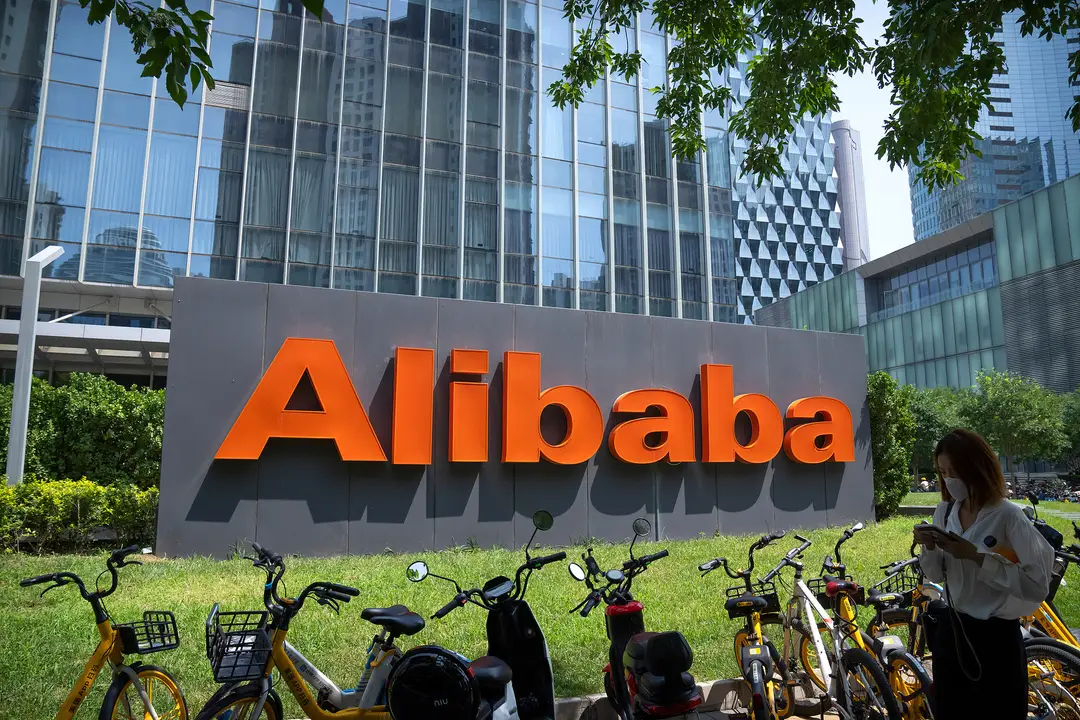
Alibaba Group (9988.HK) (BABA) has launched a HK$80 billion ($10.2 billion) placement of new shares in Hong Kong, marking its first such offering since its dual primary listing in the city in 2019. The proceeds will be allocated entirely to its artificial intelligence business, including computing infrastructure, large language model development and commercialisation.
The placement, announced on Aug. 23, was oversubscribed within an hour, drawing interest from sovereign wealth funds in the Middle East, Europe and Asia. It is the largest follow-on offering by a Hong Kong-listed company on record.
Alibaba’s cash burn
The key question is not why Alibaba needs to raise money, but why it is willing to go so heavily into AI when its balance sheet hardly looks cash-strapped. On paper, the company is not short of money. It held about $70 billion in cash and other liquid investments as of June 30. But its free cash flow tells a different story.
In the March 2025 quarter, free cash flow plunged 76% year-on-year to 3.74 billion yuan ($526 million), with the decline attributed to rising cloud infrastructure spending. By the end of the June 2025 quarter, cashflow turned negative for the first time, with an outflow of 18.8 billion yuan. In the June 2026 quarter, capital expenditure reached 67.7 billion yuan, up 75% year-on-year, with free cash outflow widening to 44.7 billion yuan .
Choosing equity rather than debt means Alibaba can fund the expansion without adding financial leverage or interest costs, although existing shareholders will face roughly 3% dilution.
At the heart of the spending is a simple proposition: computing power is becoming basic infrastructure for the AI economy.
“Capital expenditure must come first to gain business growth later,” Alibaba CEO Eddie Wu told analysts. The placement effectively replenishes ammunition for an already massive spending programme.
A global computing arms race
Over the past century, industrial strength was closely tied to electricity generation. In the AI era, computing power is increasingly playing a similar role.
Energy is converted into computing power, which is then used to generate AI output measured in tokens. Tokens are the “language” of the AI era, powering everything from chatbot queries to autonomous vehicle decisions.
China’s daily token usage rose from around 100 billion at the beginning of 2024 to 100 trillion by the end of 2025, and exceeded 140 trillion in March 2026.
Alibaba is not alone. Tencent Holdings’ (0700.HK) capital expenditure in the second quarter of 2026 surged 176% year-on-year to 52.8 billion yuan. Baidu (9888.HK) spent 11.4 billion yuan, a near 200% increase. ByteDance has reportedly raised its 2026 capex plan to 200 billion yuan.
The same race is unfolding overseas. The four U.S. tech giants — Amazon, Google, Microsoft and Meta — are expected to invest more than $750 billion collectively on computing-related capital expenditure in 2026. Alphabet announced in June that it would raise $84.75 billion through a share offering, primarily to fund AI infrastructure.
The race for talent
Computing power is only one part of the competition. Talent is becoming another.
China’s core AI industry is now worth more than 1.2 trillion yuan, but the sector faces a talent shortage of more than five million people. AI job postings rose 21% in the first half of 2026, according to Liepin data, while demand for architects jumped 76.7%, far faster than the 12.8% increase for algorithm engineers.
The shift reflects a change in the industry itself. Companies increasingly need people who can connect algorithms, software, hardware and specific business applications, rather than simply optimize models.
Alibaba is adjusting its hiring accordingly: more than 80% of its 2026 campus recruitment positions are AI-related, with the company also seeking experienced professionals who combine technical and industry expertise.
Opportunities and challenges
But the bigger question is whether all this investment will generate sufficient returns.
The scale of China’s AI-related industries is expected to grow by more than 30% in 2026. Applications are emerging across manufacturing, healthcare, scientific research and government, while embodied AI is moving from laboratory prototypes toward industrial-scale production.
Wu has said that, based on current average gross margins for AI products, Alibaba’s capital expenditure can be recovered within three years. As margins improve, he expects the payback period could fall to two to two and a half years.
But challenges remain. Core technologies including high-end chips and lithography equipment still rely heavily on imports. Data silos across industries, sectors and government departments hamper AI application efficiency. AI safety and governance frameworks are struggling to keep pace with rapidly evolving models.
Commercialization is also far from guaranteed. If AI agents and industry solutions fail to generate revenue as expected, today’s huge capital spending could become a heavy asset burden. A surge in domestic computing capacity from 2027 could also push down inference prices.
A ticket to the AI era
Alibaba chose equity financing over debt despite its massive cash pile. The move dilutes existing shareholders by about 3.5% but avoids adding further interest burden to an already pressured income statement. Alibaba executive chairman Joe Tsai has described the group’s AI strategy as covering four layers — chips, cloud infrastructure, models and applications — spanning “everything except energy”.
The calculation is stark: not investing risks being left behind; investing preserves the chance of winning.
The HK$80 billion is therefore buying more than servers and chips. It is buying a ticket to the AI era — and potentially a role in determining who gets to set its rules.
Source:
Guanhui OS