


As domestic rivals bleed cash in a brutal price war, Xiaomi bets on modular hybrid SUVs to fuel its growth.
By Brent Li
The Chinese electric vehicle market is entering a volatile new phase as Xiaomi (1810.HK), the consumer electronics giant turned automaker, pivots its strategy to capture the family SUV segment. On July 9, the company unveiled “SkyNomad,” a new line of extended-range electric vehicle (EREV) SUVs — battery powered but equipped with a gasoline engine for recharging on the go.
The strategic shift pits Xiaomi against entrenched domestic rivals like Li Auto (2015.HK) and AITO, the EV brand backed by tech giant Huawei and made by Chinese automotive group Seres (601127.SH). However, Xiaomi is entering a sector where incumbents, despite high sales volumes, are suddenly showing severe financial vulnerability.
A living room on wheels
To differentiate itself in a crowded market, Xiaomi is leveraging its consumer electronics pedigree. The company says SkyNomad vehicles are designed as highly modular “living spaces” that are fully integrated with its smart home ecosystem. And Xiaomi is extensively marketing the ‘modular’ concept with all kinds of advertising.
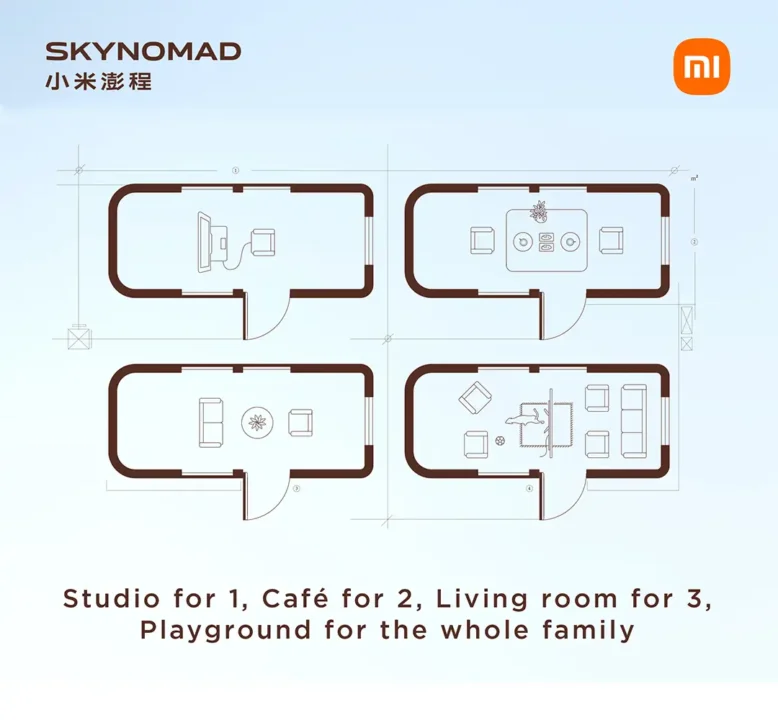
Built on a newly developed architecture featuring a completely flat floor and long slide rails, the vehicles allow seats and consoles to be rearranged dynamically. The lineup includes the N70 and the larger N90, which stretches nearly 5.3 meters long. Xiaomi is even pitching an N90 camping edition that includes a pop-top roof to provide standing room inside and an integrated bed, officially registered with regulators as a “cultural and lifestyle service vehicle.” Prices are expected to range from under 200,000 yuan ($27,500) to over 450,000 yuan.
SkyNomad will be a series under the main Xiaomi Auto umbrella. The company says it is targeting an incremental market of new buyers who previously hadn’t considered such vehicles. This optimism contrasts sharply with industry data showing that domestic EREV SUV sales actually declined by 9.7% year-over-year in the first five months of 2026, suggesting Xiaomi is entering a contracting space. But the automaker has little choice since the development of SkyNomad started as early as 2023, when EREV SUV sales were gaining significant momentum in China.
Incumbents face a financial squeeze
Xiaomi’s entry comes at a time when the current market leaders are locked in a fierce, margin-eroding battle. AITO and Li Auto currently dominate China’s EREV SUV sales, taking the top four spots in the first half of 2026. Yet, both are bleeding cash.
Seres shocked investors by forecasting a net loss of about $206 million to $248 million for the first half of 2026, despite AITO boasting some of the highest gross margins in the global auto industry. Company executives blame soaring supply chain costs — noting that memory chip prices have jumped fivefold and lithium carbonate prices have more than doubled to about $24,800 per ton, adding up to about $2,750 to the manufacturing cost of each vehicle.
Li Auto is facing similar pressures. Once the unquestionable leader in the EREV sector, the company posted a surprise net loss of about $317 million in the first quarter of 2026 as it lost premium market share to AITO.
In response, Li Auto is attempting a high-stakes gamble to rebuild its image from a manufacturer of traditional EVs to a high-tech powerhouse. Last month, the company unveiled its own proprietary AI chip, the Mach M100, and a custom AI model designed to process autonomous driving and in-car commands locally — on the vehicle through its own chip rather than on remote servers in the cloud. This cuts lag time and boosts privacy, but requires expensive, cutting-edge hardware that eats into profit margins. But if successful, this heavy R&D investment could help Li Auto survive the tech-heavy onslaught from Huawei and Xiaomi; if it fails, the financial burden could be devastating.
Global ambitions and delivery targets
For Xiaomi, the SkyNomad launch is critical to meeting its aggressive corporate targets. The company delivered 180,000 pure EVs in the first half of 2026. While impressive — its SU7 sedan and YU7 SUV rank highly in their respective categories — Xiaomi is still far from achieving its ambitious annual goal of up to 750,000 deliveries.
The pure EV market remains fiercely competitive. Although BYD is China’s overall EV market leader by far, in terms of individual models, Tesla’s Model Y is in No. 1 position, selling over 172,000 units in the first half of 2026. In several recent months, it has ranked as the best-selling individual model in the country — outpacing every single BYD model — and trailing only Geely’s entry-level Xingyuan hatchback model in first-half sales among all EVs.
By pivoting to EREVs, Xiaomi hopes to bypass the range anxiety that limits pure EV adoption, particularly in overseas markets where charging networks are sparse. SkyNomad is slated for an August launch, and its success — or failure — will test whether a smartphone giant can redefine the automotive living space, or if it will simply become another casualty in China’s brutal hybrid price war.
Feature photo: interior of Xiaomi SkyNomad, by Xiaomi
Sources