

By Huang Qingchun
Tencent (0700.HK) is quietly attempting the biggest overhaul in the history of WeChat, transforming China’s dominant super app from a collection of services navigated by taps into an AI-powered assistant that aims to become the single gateway for everything users do.
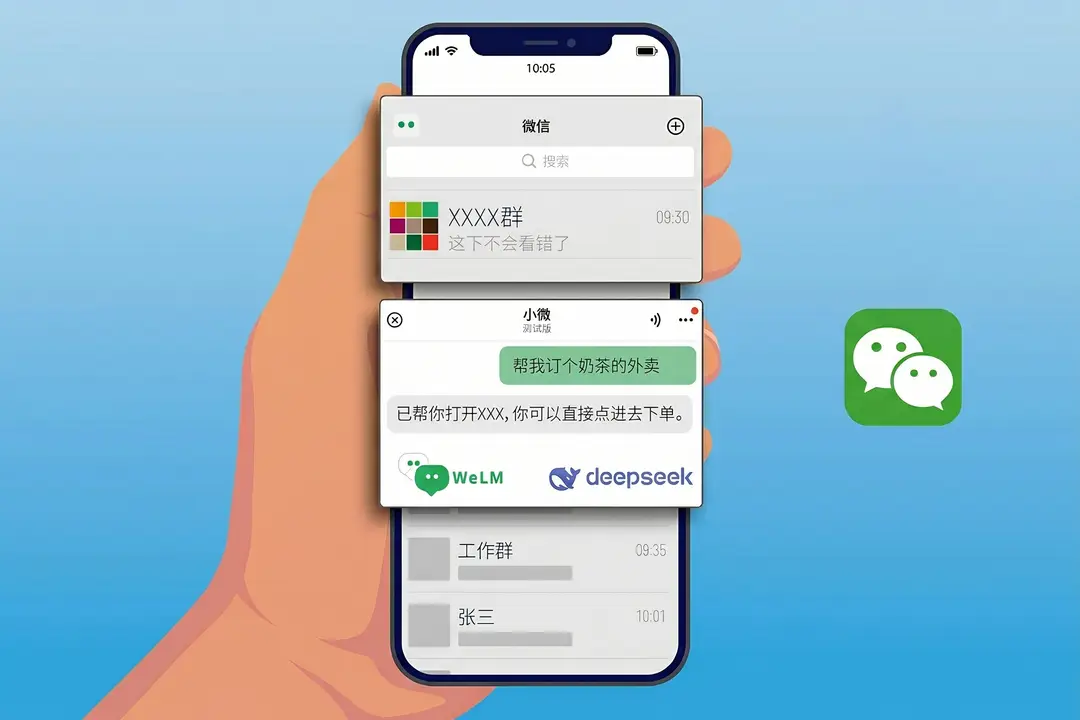
The company has begun limited testing of Xiaowei, a native AI assistant that replaces WeChat’s former “favorites” shortcut in the app’s top-left corner. Users can summon it with a swipe, asking it to summarize documents, draft messages, analyze images, transfer money, create reminders and interact with mini programs on their behalf.
Powered primarily by Tencent’s WeLM large language model, with some support from DeepSeek, Xiaowei has divided early users. Some testers see it as little more than another chatbot with useful but unremarkable productivity features. Others argue it represents the most disruptive update in WeChat’s history, particularly after experimenting with its ability to call mini programs automatically, create lightweight applications and manage social features.
Among office workers, document analysis and chat summaries have emerged as the most popular features. Xiaowei can summarize PDFs and PowerPoint presentations, interpret images, and extract key information, unread messages and action items from lengthy group chats.
AI becomes WeChat’s front door
The more profound change lies in how users navigate the app.
Since its launch, WeChat has relied on decentralized discovery, with users moving between chats, official accounts, video channels, mini programs and payments through separate entry points.
Xiaowei replaces that with conversation. Users simply describe what they want, while AI selects the appropriate service, drafts messages, creates reminders or pre-fills orders, leaving users to confirm the final action.
The shift represents more than a simpler user experience. It centralizes attention inside a conversational interface, making AI the primary gateway to WeChat’s 1.43 billion monthly active users worldwide.
That marks a notable departure from the product philosophy championed by WeChat founder Allen Zhang, who famously advocated products that users could “use and leave” without constant interruption. Historically, WeChat minimized recommendations and avoided aggressively pushing content.
Xiaowei instead proactively recommends services and content based on user behavior, moving from a model in which users searched for functions to one in which AI anticipates their needs. Its prominent placement underscores the strategic importance Tencent assigns to conversational AI. The top-left shortcut has previously hosted multitasking and saved-article features, both reportedly falling short of expectations.
A new balance of power
Tencent Chief Executive Pony Ma has said WeChat’s AI agents will preserve the platform’s decentralized philosophy while adding centralized capabilities. But the architecture of AI inevitably shifts power toward whoever controls the recommendation engine.
Previously, WeChat largely acted as infrastructure, providing tools and traffic while developers and merchants competed under common rules. With Xiaowei, Tencent increasingly becomes the ecosystem’s traffic controller.
Xiaowei’s recommendation system does not rely solely on traditional metrics such as views, shares or follower counts, but instead evaluates content quality and contextual relevance through AI models. Exactly how it ranks mini programs across factors such as service quality, pricing and user reviews remains unclear.
That opacity raises questions over how smaller developers will compete. Major platforms including Meituan, JD.com, Trip.com and Dewu already possess the technical resources to integrate deeply with WeChat’s AI interfaces, potentially strengthening their advantages.
The changes could also reshape WeChat’s content economy. AI-generated summaries may reduce incentives for users to read full articles, undermining advertising models built around page views while rewarding higher-quality original content that AI can identify as valuable.
Mini programs enter the AI era
The overhaul could prove even more significant for WeChat’s mini program ecosystem.
Rather than opening individual mini programs, users simply state their request and AI invokes the appropriate service automatically.
Tencent allows developers either to let AI analyze existing mini program code or package functions into standardized interfaces. That shifts development priorities from designing user interfaces to optimizing services for AI, making banners and other promotional elements less important.
Xiaowei can also generate simple interactive tools from natural-language prompts, potentially allowing non-programmers to create personalized applications without writing code.
Privacy questions remain
Tencent says Xiaowei accesses chats and files only when users explicitly request it. Nevertheless, AI will increasingly process sensitive documents, payment information and private conversations, while users have limited visibility into how data is stored or analyzed.
The assistant also includes an optional memory feature that retains conversations to personalize future responses.
Beyond data privacy lies a broader concern: the changing nature of human communication itself. As AI increasingly drafts messages, polishes wording and suggests replies, users remain responsible for approving communications, but not necessarily for creating them.
If AI eventually begins filtering messages, handling routine business interactions and maintaining aspects of users’ social lives, WeChat’s evolution could reshape not only how people use apps, but how they communicate with one another.
Source:
Huxiu