

By Fan Jialai
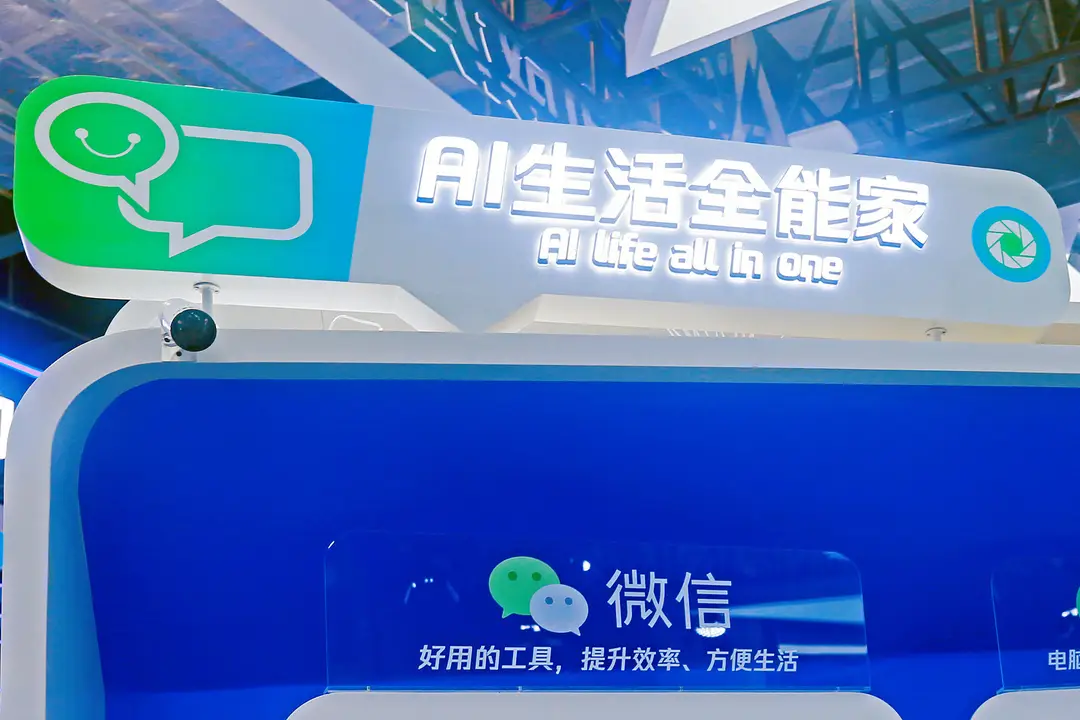
WeChat, Tencent’s super app that integrates messaging, payments, shopping and millions of mini-programs, has confirmed it is collaborating with major smartphone manufacturers to develop new AI-powered assistant capabilities.
Recent market speculation that WeChat could launch its own AI agent has fuelled strong interest in Tencent’s artificial intelligence strategy and contributed to significant fluctuations in the company’s share price.
According to widely circulated reports, WeChat is developing an AI assistant capable of carrying out tasks across Tencent’s vast ecosystem through natural-language commands. The proposed agent would potentially be able to access millions of mini-programs as well as WeChat Pay, official accounts, video channels, and the enterprise messaging platform WeCom.
Tencent customer service representatives told The Paper that WeChat is already working with smartphone manufacturers to introduce new assistant functions. Users of Honor smartphones can now use the company’s YOYO assistant to initiate WeChat voice and video calls and send messages to designated contacts. Tencent said similar collaborations are underway with smartphone makers Huawei, Xiaomi, Oppo and Vivo, with additional features expected to be rolled out gradually.
New products and upgrades
Under the arrangement, users interact with WeChat through their phone’s built-in system assistant. WeChat executes the requested action and returns the result. Tencent said the process uses a dual-authorisation mechanism designed to protect user privacy and security.
The Paper contacted the smartphone manufacturers for comment but had not received responses by publication time.
The developments come as Tencent prepares to unveil a new series of AI-agent products and upgrades to its underlying AI infrastructure, according to company disclosures.
As China’s largest technology groups increasingly embrace an “all-in AI” strategy, competition in the sector is intensifying. Tencent’s role in the emerging AI landscape has attracted particular attention from investors and industry observers.
Speaking at a recent shareholder meeting, Tencent CEO Pony Ma reflected on the company’s evolving position in artificial intelligence.
“A year ago we thought we had boarded the AI ship,” Ma said. “Then we discovered the ship was leaking. Now it feels like we’ve finally got on board, but we still haven’t found a seat. We hope the ship can move faster.”
Addressing weaknesses
Ma said Tencent may not always be the fastest company to seize new opportunities but remains committed to pursuing what it believes is the right long-term strategy while building on its existing strengths.
“We can’t simply see others doing something and rush over to take their territory,” he said. “We’ve tried that before and generally failed.”
He acknowledged that Tencent had not initially been among the strongest players in foundational AI capabilities but said the company had spent recent years addressing weaknesses through talent recruitment, organisational changes and internal training programmes.
One notable recruitment came in December when Tencent hired former OpenAI researcher Yao Shunyu. At the same time, the company announced a major overhaul of its large-language-model research structure, creating new AI infrastructure, AI data and data computing platform divisions.
Yao was appointed chief AI scientist within the office of Tencent’s chief executive and president, reporting directly to company president Martin Lau. He also assumed leadership roles in the AI Infrastructure and large-language-model departments.
Tencent said the AI Infrastructure division is responsible for building the technology platforms that support model training and inference. The unit focuses on areas such as distributed training systems and high-performance inference services, which are regarded as critical components of large-scale AI development.
Growth drivers
The company has also reported rapid growth in usage of its Hunyuan family of AI models. On May 7, Tencent said token consumption for its latest Hy3 preview model had surpassed that of the previous-generation Hy2 model by more than tenfold since launch.
Growth has been particularly strong in coding and AI-agent applications. Tencent said token usage across products such as WorkBuddy, CodeBuddy and QClaw had increased by more than 16.5 times.
Tencent’s AI push comes as competition among Chinese technology companies accelerates.
ByteDance’s Doubao large-language model is expected to begin offering paid content services later this month, according to information obtained by The Paper. If the rollout proceeds as planned, the company is expected to integrate e-commerce features during the third quarter and use subsidies to drive traffic to Douyin Mall before entering a more mature operational phase later in the year.
Meanwhile, JD.com announced on June 3 the open-sourcing of JoyAI-Echo, a framework designed to generate long-form audio and video content.
The company said the technology addresses several longstanding industry challenges, including maintaining character consistency, controlling voice characteristics and improving video-generation speed. JD.com added that JoyAI-Echo’s interactive editing capability allows creators to modify content during the production process rather than relying solely on one-off generation.
The company said the technology could find applications in video production, virtual-human livestreaming, brand marketing, education and game-content development.
As Chinese technology companies race to commercialise AI and integrate it into existing ecosystems, the battle for users, developers and computing resources is becoming increasingly intense.
Source:
The Paper