

By Da Cheung
The artificial intelligence boom is sweeping across global financial markets, creating a wave of speculative investment that is distorting valuations and draining liquidity from traditional industries. From hardware manufacturers and AI model developers to established internet tech companies, market participants are bathing in an AI bubble, navigating the frenzy in vastly different ways.
As capital floods into the sector, the ultimate question remains: who will emerge as the lasting winner in this high-stakes technological gold rush?
Hardware frenzy and market distortion
South Korea’s SK Hynix (000660.KS) is leveraging its dominance in AI memory chips to pursue a massive public offering on the Nasdaq that will raise roughly $29.5 billion. If successful, this blockbuster share sale will eclipse Alibaba’s 2014 New York debut to become the largest American Depositary Receipt (ADR) transaction in history,
SK Hynix’s aggressive move is fueled by its 57% global market share in High Bandwidth Memory (HBM) chips, a specialized memory interface that is a critical bottleneck for AI data center expansion. The company reported a record first-quarter operating profit of about 37.6 trillion won (roughly $24.5 billion), driven by insatiable demand for AI infrastructure.
However, this hardware frenzy is severely distorting market liquidity elsewhere, particularly in Hong Kong. A leveraged exchange-traded fund (ETF) — a type of investment fund that uses financial derivatives to amplify the returns of an underlying asset — tracking SK Hynix briefly became the largest ETF in Hong Kong. On June 22, the CSOP Asset Management’s 2x leveraged SK Hynix ETF saw its market capitalization surpass HK$130 billion ($16.5 billion), breaking the 27-year dominance of the Tracker Fund of Hong Kong.
The speculative fervor is so intense that the daily trading volume of this single ETF has routinely eclipsed Chinese tech giants like Tencent and SMIC. This highlights a broader liquidity crisis in Hong Kong, where the daily turnover is only one-tenth of mainland China’s A-share market, prompting institutions like Goldman Sachs to downgrade Hong Kong-listed H-shares to “equal weight” due to rising opportunity costs.
The valuation bubble of AI models
While hardware suppliers generate record profits, Chinese AI model developers are experiencing extreme valuation bubbles driven by speculative capital and low stock float — the limited number of shares available for public trading.
Knowledge Atlas Technology (Zhipu AI) (2513.HK) exemplifies this trend. On June 22, the company’s market capitalization briefly hit HK$1.1 trillion (about $140 billion), giving it one of the highest market values of any tech company listed in Hong Kong. Its shares have risen 20-fold since January’s IPO but the surge is highly speculative and unsupported by traditional financial metrics: the company reported annual revenue of just 700 million yuan (about $102 million) and a loss of 4.7 billion yuan for 2025. At its peak, Zhipu AI traded at a staggering 1200x price-to-sales ratio, compared with U.S. peer Anthropic’s 20x.
Market analysts attribute this bubble to a severe supply-demand imbalance. With less than 4% of Zhipu AI shares freely traded, a small influx of capital — such as the recent inclusion in the southbound Stock Connect trading link for mainland investors — can artificially inflate the stock price.
A looming liquidity stress test threatens these newly listed AI darlings. Massive lock-up expirations are scheduled for early July. Zhipu AI will see 5.76% of its shares unlocked, which could trigger a sharp sell-off in an already illiquid market, testing whether its current valuation is sustainable or merely a temporary mirage.
Traditional giants tread carefully
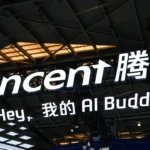
In stark contrast to the wild speculation surrounding pure-play AI stocks, traditional heavyweights are taking a more cautious and calculated approach. Tencent (0700.HK) is relying on heavy stock buybacks to support its valuation, purchasing 1.19 million shares for HK$501 million on June 23 alone.
Instead of rushing standalone AI products to market, Tencent is navigating strict regulatory compliance to integrate a proprietary, decentralized AI agent into its 1.4-billion-user WeChat ecosystem. According to Tencent CEO Pony Ma, the WeChat AI agent will act as an underlying link connecting products and services via mini programs, rather than acting as a centralized gatekeeper that monopolizes user traffic.
However, Tencent’s cautious pace has left it trailing in the consumer AI race. Its primary consumer AI application, Yuanbao, currently has about 110 million monthly active users, lagging significantly behind ByteDance’s Doubao, which boasts 330 million. While rumors suggested the WeChat AI agent could launch as early as this month, Tencent insiders told Caijing that the timeline remains uncertain due to the rigorous compliance required for a platform of WeChat’s scale.
As the AI bubble continues to inflate, the market remains divided. Hardware makers are cashing in on immediate infrastructure needs, AI startups are riding waves of speculative capital, and traditional internet giants are playing a long, cautious game.
Sources: