

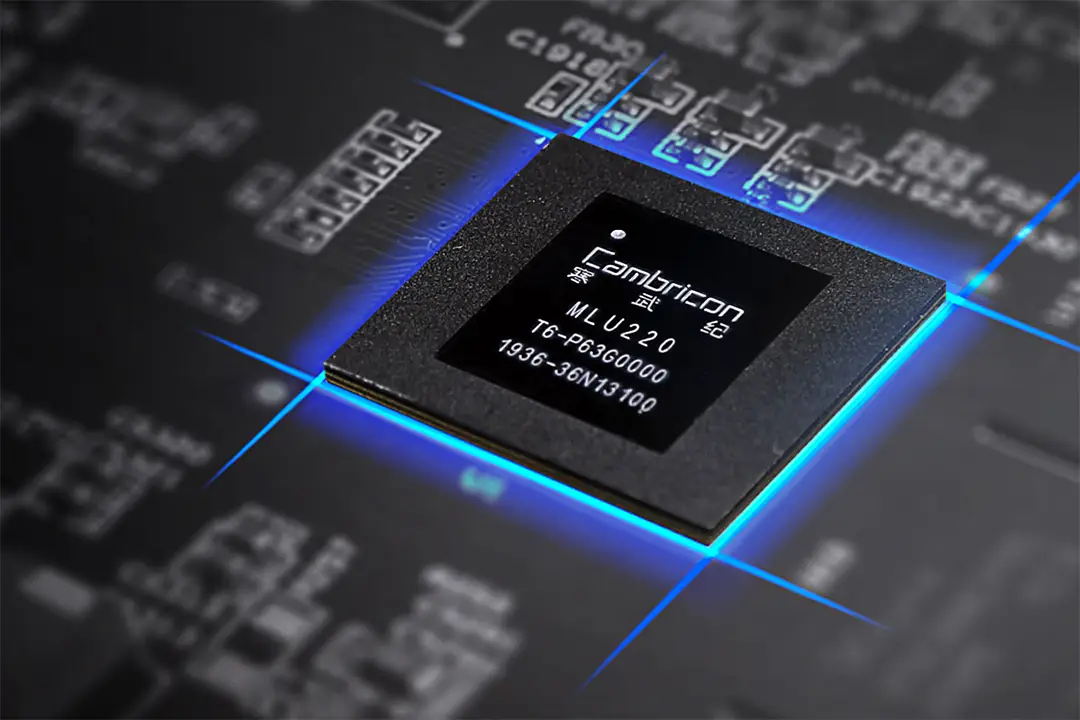
The STAR Market-listed chipmaker’s shares have surged 12-fold in two years, drawing global investors and cementing its position as a domestic alternative to Nvidia.
By Da Cheung
Chinese artificial intelligence chipmaker Cambricon (688256.SH) has become the first company listed on Shanghai’s tech-focused STAR Market to achieve a market capitalization of 1 trillion yuan ($137 billion), a milestone reached on June 30 when its shares jumped 7.7% to 1,595.55 yuan.
The stock has surged 12-fold over the past two years, driven by a domestic boom in AI computing power and the government’s aggressive push for semiconductor self-reliance amid growing geopolitical and economic tensions with the U.S. Cambricon’s position as a key local alternative to chips from foreign companies such as Nvidia, has pushed its revenue and profit to record highs — its first-quarter net profit jumped 185% year-on-year and its sales leapt 160% to 2.88 billion yuan.
The boom in the domestic semiconductor industry is drawing international investors into listed hardware firms. South Korean investors — known for their sensitivity to global tech cycles — made Cambricon their top Chinese stock purchase over the past month, buying nearly 130 million yuan (about $18 million) worth of shares, according to the 21st Century Business Herald.
U.S.-listed exchange-traded funds (ETFs) are also piling in. The Invesco China Technology ETF has seen a 30% growth in assets since the start of the second quarter, with its top 10 holdings including Chinese tech giants Cambricon, Tencent Holdings (0700.HK), Baidu (9888.HK) (BIDU.US), and Hua Hong Semiconductor (688347.SH). Global index provider MSCI recently added multiple Chinese hard-tech companies to its indexes, paving the way for increased passive foreign investment.
Breaking the software monopoly
For years, Nvidia has dominated the global AI market not just through its hardware, but through CUDA — a proprietary software platform that allows developers to easily program graphics processing units for general AI tasks. This entrenched software ecosystem has historically been the highest barrier to entry for rival chipmakers.
Cambricon claims to have broken this reliance with its proprietary software suite, NeuWare. The platform includes a “one-click GPU migration” tool designed to help developers transition their AI models from Nvidia chips to Cambricon’s hardware at a low cost, it says.
While claims of seamless software migration are common in corporate press releases and remain to be independently verified at scale by the broader developer community, they represent a critical strategic pivot for China’s autonomous AI ambitions.
Hardware gains and local manufacturing
On the hardware front, Cambricon’s flagship Siyuan 590 chip is the primary engine behind its recent revenue surge. In a note following the first-quarter results, Morgan Stanley said the company’s revenue growth exceeded both the bank’s and the market’s expectations, driven largely by strong shipments of the Siyuan 590.
Morgan Stanley also highlighted a key operational development: Cambricon’s prepayments jumped 155% quarter-on-quarter to roughly 1.9 billion yuan, backed by new chip production orders. Meanwhile, its contract manufacturing arrangement with local foundry Semiconductor Manufacturing International Corp. (688981.SH), (0981.HK) has now reached stable, scalable production — clearing previous supply bottlenecks. As a result, the bank projects shipments of the Siyuan 590 to triple from around 100,000 units in 2025 to 300,000 units in 2026.
Today, Cambricon’s cloud product line accounts for nearly 99.7% of its core revenue, with deployments across key sectors including telecom operators, financial institutions, and internet companies.
This localized supply chain positions the business to capture a significant share of surging domestic demand. According to IDC, Chinese chipmakers shipped 1.65 million AI accelerators to the local market in 2025 — representing over 41% of total shipments — underscoring the scale of the opportunity for domestic players like Cambricon.
The company is also actively integrating with China’s leading domestic AI models, signaling an increasingly self-reliant Chinese AI ecosystem with tight domestic integration. When the highly anticipated DeepSeek-V4 model launched in April, Cambricon announced it had achieved “Day 0” adaptation — meaning its chips could run the model immediately upon release. According to tech media outlet Synced, this was achieved using open-source frameworks including vLLM, a popular software library used for fast AI model processing and serving.
Dividend draws market scrutiny
While the company’s growth narrative is strong, one development has drawn market scrutiny — the sudden payment of a dividend in the first quarter which coincided with the exit of prominent investor Zhang Jianping from Cambricon’s top-10 shareholder list.
As of the end of 2025, Zhang held 6.81 million shares, but by March 31, 2026, he had vanished from the register—selling at least 4.79 million shares, with estimated proceeds exceeding 6 billion yuan, based on the quarter’s average trading price. The sale came shortly after Cambricon declared its first-ever cash dividend in March, a move that some market observers have linked to market regulations: under current shareholding reduction rules, controlling shareholders cannot sell stakes if the company has not paid a dividend in the previous three years, or if cumulative dividends fall below 30% of average annual net profit over that period. Cambricon’s 632 million yuan dividend comfortably exceeds that threshold, fueling speculation that the payout was aimed at unlocking the door for major shareholders to cash out. The company has denied any connection between the dividend and shareholder exits, but the timing of Zhang’s sizable profit-taking has kept the debate alive.
For now, foreign investors are shrugging off the dividend controversy as they bet on the geopolitical reality that China will continue to aggressively fund and adopt its own AI infrastructure, regardless of the friction it faces abroad.
Sources