By Su Da
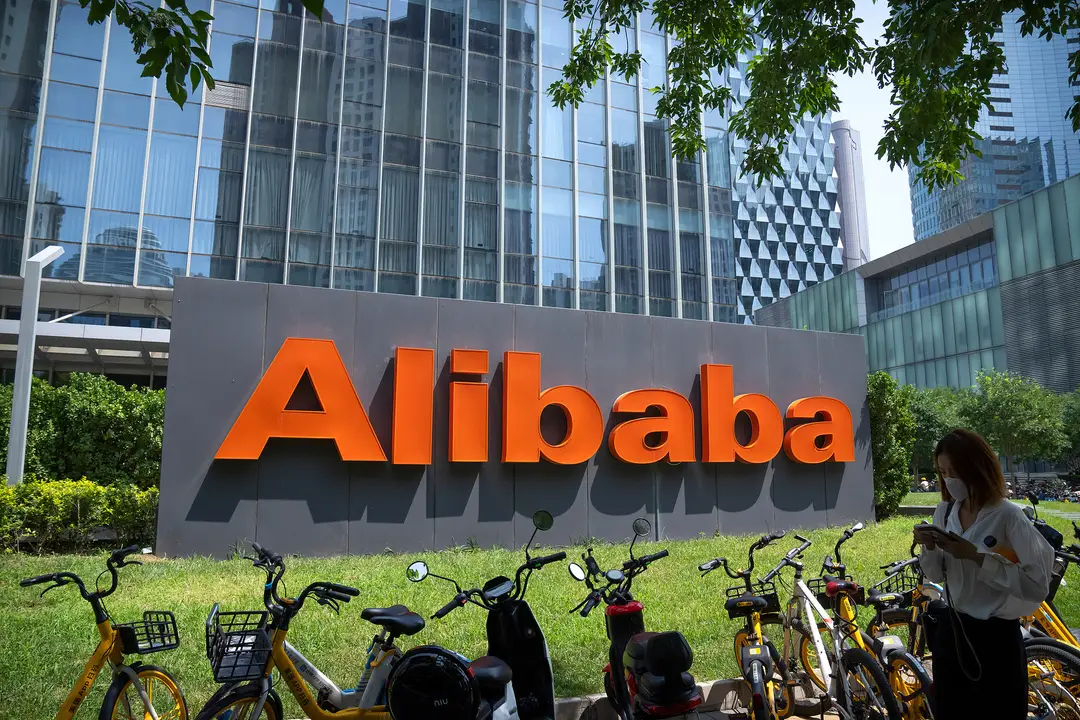
Alibaba’s (BABA.US) (9988.HK) valuation increasingly hinges on a question facing investors: is the company best understood as China’s answer to Google or as a Chinese version of Amazon?
The distinction matters because each comparison implies different assumptions about growth, profitability and strategic priorities.
Some analysts see Alibaba as the closest Chinese equivalent to Google’s vertically integrated AI ecosystem. Investment banks including Morgan Stanley and Goldman Sachs have highlighted the company’s efforts to build a complete technology stack spanning chips, cloud computing and foundation models.
Others continue to view Alibaba primarily as an e-commerce and cloud company, more akin to Amazon. Under that framework, AI remains a long-term option rather than a near-term earnings driver, limiting its impact on valuation.
The Google comparison offers greater upside. Alibaba has therefore spent the past two years reinforcing that narrative through heavy investment in chips, cloud infrastructure and its Qwen large language model.
Technology faction gains influence
The market’s enthusiasm for AI has been evident in its reaction to Alibaba’s product launches.
Qwen has undergone six major upgrades over the past year, including five in the first half of 2026 alone. Each iteration has generally been accompanied by gains in Alibaba’s share price. By contrast, the launch of AI agents and consumer-facing applications has generated a more muted response.
Even more significant have been management changes.
In June, reports emerged that Alibaba chief technology officer Wu Zeming had joined the company’s powerful partnership committee alongside founder Jack Ma, chairman Joe Tsai, chief executive Eddie Wu and e-commerce head Jiang Fan.
Investors interpreted the move as evidence that Alibaba’s technology faction had consolidated control over the company’s AI strategy. The shares rose sharply following the announcement, echoing a similar rally in April when Wu Zeming relinquished responsibility for the Taobao Flash Buy business to focus exclusively on AI infrastructure.
These personnel changes have had a greater impact on sentiment than many product launches. Investors appear convinced that strengthening the influence of engineers and AI specialists is essential if Alibaba is to sustain its Google-style narrative.
The instant retail dilemma
Officially, Alibaba argues that AI and instant retail are part of the same strategy.
Chairman Joe Tsai has described spending on instant retail as an investment in infrastructure for the AI era rather than a short-term profit opportunity. Eddie Wu has similarly argued that instant retail generates a valuable feedback loop of data, models and user interactions.
There is logic behind that argument. Although Alibaba possesses one of China’s largest digital ecosystems, it still trails rivals such as Tencent and ByteDance in certain dimensions of data richness and real-time consumer interactions. Instant retail transactions potentially provide the high-frequency data that AI systems require.
Investors remain unconvinced.
When Alibaba announced large-scale subsidies for Taobao Flash Buy in 2025, the market reaction was overwhelmingly negative. Subsequent commitments to continue investing heavily in instant retail were also followed by sharp share-price declines.
Analysts increasingly view the company as caught between two conflicting priorities: funding long-term AI development while financing an expensive battle for market share in food delivery and local services.
Who pays for Alibaba’s AI future?
Alibaba has attempted to bridge the gap by portraying e-commerce as the foundation supporting future AI growth.
At the company’s Yunqi conference in 2025, Eddie Wu described Alibaba as a “dual-engine” business. One engine consists of consumer platforms that generate cash flow. The other consists of AI and cloud technologies that will drive future growth and create long-term value.
In effect, e-commerce generates the cash while AI generates the valuation. This tension defines Alibaba’s current risk-reward profile, as it struggles with the friction between tech idealism and commercial reality.
According to Alibaba’s fiscal 2026 annual report, the Taotian domestic e-commerce retail unit generated adjusted earnings before interest, tax, and amortization (EBITA) of 107.5 billion yuan ($15.8 billion), a 44% decline on the previous year. Alibaba’s annual AI infrastructure expenditure sits at approximately 126 billion yuan, part of a broader 380 billion yuan three-year commitment. When paired with instant retail losses estimated at 70 billion yuan by various brokerages, the group’s total strategic spending topped 200 billion yuan. Because Alibaba Cloud only generated a modest adjusted EBITA of 14.3 billion yuan, and other business segments remained unprofitable, almost this entire 200 billion yuan bill had to be subsidized by core e-commerce profits. The group’s free cash flow swung into negative territory last year, showing an outflow of 46.6 billion yuan.
Recent developments suggest management may be acknowledging this tension. Under new leadership, Alibaba’s instant retail division has begun reducing subsidies and emphasizing profitability, with targets to halve losses and achieve positive unit economics by the end of fiscal 2027.
The promotion of Wu Zeming and the clearer separation between Alibaba’s technology and retail camps suggest the company is now pursuing two increasingly parallel narratives: AI as the engine of future value, and retail as the source of present-day cash flow.
Whether investors can eventually be persuaded that the two are mutually reinforcing remains to be seen. For now, the question is still: should Alibaba be valued more like Google or Amazon?
Source:
Mingliang Company