By Hualin Wuwang
Another traditional industry has officially fallen for AI.
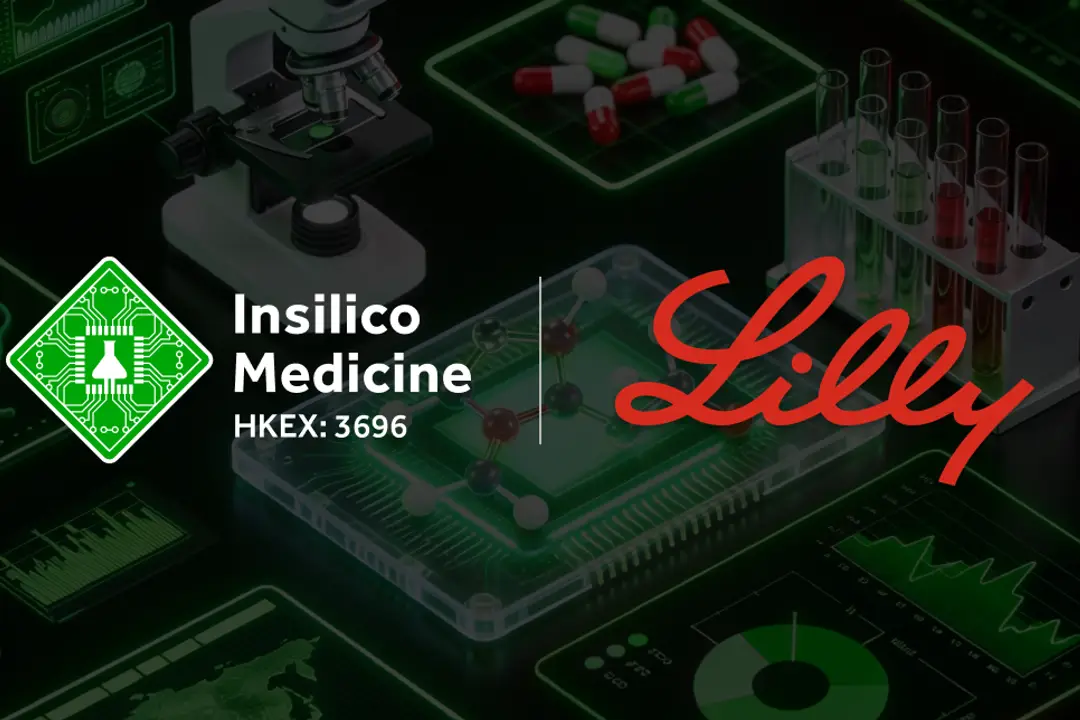
On March 29, US pharmaceutical giant Eli Lilly (LLY) announced a strategic partnership with Hong Kong-listed AI drug discovery firm Insilico Medicine (3696.HK). The deal includes an upfront payment of $115 milllion, with downstream milestone payments that could push the total to $2.75 billion, plus tiered royalties on future sales.
The sheer scale of the deal caused the industry to catch its collective breath. Has the “GPT moment” for AI-driven drug discovery finally arrived?
From story to serious money
Until recently, AI-driven drug discovery felt like a neverending story without a finale. There were funding rounds, tech-giant incursions, and academic endorsements — but the answer to whether these tools actually put medicine into patients’ hands remained frustratingly vague. Lilly’s outlay marks a definitive shift in posture.
Eli Lilly is in the throes of its own AI transformation. At the J.P. Morgan Healthcare Conference in March, it unveiled a $1 billion joint AI innovation lab with NVIDIA to tackle longstanding challenges in drug development. That same month, NVIDIA teamed up with Novo Nordisk to deploy Gefion, a sovereign AI supercomputer, to speed discovery.
Since the start of 2026, large AI-platform deals have proliferated across the pharmaceutical industry: Lilly, Sanofi, Novo Nordisk and Bayer are all racing to sign contracts. Analysts estimate the AI drug discovery market will be worth $5.1 billion this year, up from around $2.9 billion in 2025 and could balloon to over $13.4 billion by 2035. Yet, while the “hot money” is flowing in, fundamental hurdles remain.
Designing new molecules with AI
Insilico Medicine is no newcomer. Founded by a Chinese scientist and headquartered in Hong Kong, it is among the few firms to have advanced AI-generated drug candidates into clinical trials. Its core technology uses generative AI to design entirely new molecular structures, rather than merely screening existing compound libraries — a fundamental departure from traditional approaches.
Conventionally, drug discovery follows a laborious path: identify a biological target, screen millions of known compounds, find candidate molecules, and then optimise them over many years. The process can take more than a decade and cost billions.
Insilico’s approach is akin to sketching a key from scratch to fit a specific lock. Tell the AI what the lock looks like, and it generates molecules that might open it. Its end-to-end platform, Pharma.AI, spans target discovery, molecule generation and clinical outcome prediction. The company claims it has compressed parts of the process to as little as 18 months.
Its chief executive puts it bluntly: only Lilly itself is stronger than Insilico in AI capability. Bold words — but Lilly’s willingness to pay as much as $2.75 billion suggests a degree of endorsement.
Anatomy of the deal
The $115 million upfront payment is real money, paid today. The remaining $2.6 billion-plus consists of milestone payments that are contingent on Insilico delivering validated targets, advancing candidates into human trials, and ultimately navigating clinical development. Industry consensus is that such structures cap Lilly’s risk while maximising Insilico’s incentives: no delivery, no payment.
But therein lies the problem. AI-designed drugs must still pass human clinical trials, where failure rates are notoriously high. Roughly 90% of candidates do not survive Phase II. Whether AI-generated molecules can defy these odds remains unclear; the data are not yet sufficient. Without approved drugs reaching the market, AI drug discovery remains in an extended proof-of-concept phase.
AI enters the pharmaceutical mainstream
When a company like Lilly writes AI into its core strategy, rather than confining it to an experimental budget, the significance extends beyond a single contract. It signals the vertical penetration of AI into what has long been considered a conservative and heavily regulated sector. But the signal is now unmistakable: even the most cautious capital is beginning to move in.
There is also a deeper industrial logic. The success of Novo Nordisk’s Wegovy and Lilly’s own Zepbound in the obesity market has taught the industry a singular lesson: whoever finds the next blockbuster target wins the decade. AI is currently the most promising accelerator for that search.
The next two to three years will be decisive. If AI-derived candidates demonstrate statistically meaningful advantages in clinical trials, the revolution in drug discovery will truly begin. If they fail at the same rate as traditional molecules, the hype will evaporate. Dealmaking will slow, and companies like Insilico will face their sternest test.
No one knows how this will all end, but Lilly’s downpayment is the biggest vote of confidence to date.
Source: