

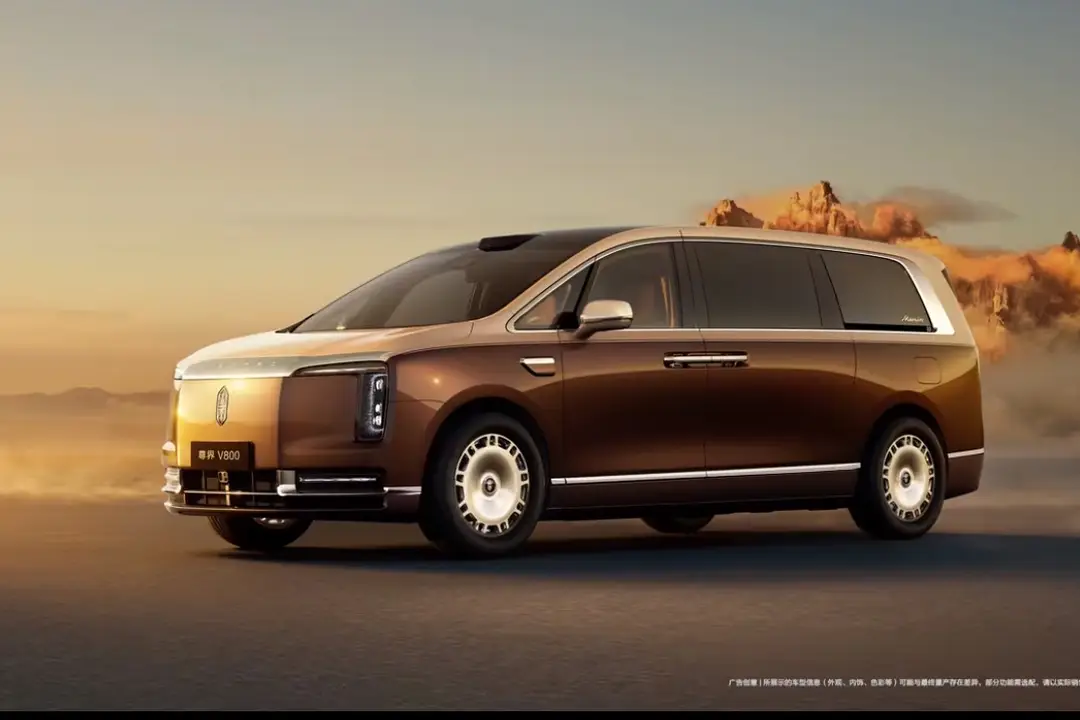
Pre-sales for the premium MPVs hit 4,800 orders in 24 hours, taking aim at long-time market leaders Toyota and Lexus.
By Lin Jianlan
Chinese auto giant JAC Group (600418.SH) has launched pre-sales for two electric ultra-luxury multi-purpose vehicles (MPVs) under the Maextro brand in collaboration with Harmony Intelligent Mobility Alliance (HIMA), the automotive alliance led by Chinese technology giant Huawei. The move marks an aggressive expansion into a high-margin segment traditionally dominated by foreign legacy automakers.
At a brand gala in Shanghai on June 25, the Maextro S800 Grand Design edition was unveiled alongside the pre-sale launch of the V800 and V680 MPVs. The flagship V800, positioned as a large seven-seat extended-range electric vehicle, is priced between 800,000 yuan and 1.2 million yuan ($110,000 to $165,000), while the V680 costs 650,000 yuan to 900,000 yuan.
The launch establishes a dual-flagship sedan and MPV strategy for Maextro in China’s million-yuan luxury market. The brand’s first model, the S800 luxury sedan, has delivered approximately 19,000 units in the 13 months since its launch in May 2025. That total surpassed the combined Chinese sales of the Mercedes-Benz S-Class and BMW 7 Series over the same period, signaling a growing willingness among wealthy Chinese buyers to pay premium prices for domestic electric vehicles.
Chasing a niche monopolized by foreign rivals
The million-yuan ultra-luxury MPV segment remains a highly lucrative but narrow niche in China. Combined domestic sales of the segment’s long-standing benchmarks, the Lexus LM and Toyota Alphard, totaled roughly 16,000 units in 2025, averaging 1,370 vehicles per month. That pace that slowed to 1,174 units per month in the first five months of 2026.
Legacy foreign models long benefited from a market structure where luxury vans served as critical social symbols for corporate hospitality. High demand allowed dealerships to command premiums of hundreds of thousands of yuan above the official 800,000 yuan list price for a Toyota Alphard, effectively treating the markup as a financial screening tool for wealthy buyers.
However, the consumer demographic in this elite tier is shifting. While traditional buyers came largely from the real estate, finance, and manufacturing sectors, the new generation of high-net-worth individuals stems from the technology, internet, and new consumer industries. These buyers show less historical loyalty to foreign heritage brands and prioritize technological features and cabin utility over traditional prestige.
Tech overhauls the executive cabin
Luxury vans are also transitioning from purely corporate transport into private offices and family vehicles, spurred by an increase in multi-child households upgrading to larger platforms. This has heightened demand for advanced cabin environments. Traditional Japanese alternatives offer limited automated driving capabilities and digital interfaces that reflect older hardware generations.
Maextro is capitalizing on this technological gap by leveraging Huawei’s full-stack engineering. The V800 is built on a physical layout featuring a length of almost 5.5 meters and a wheelbase of 3.43 meters, delivering over 3.8 meters of effective cabin space. Storage capacity reaches 758 liters under standard configurations and expands to as much as 2,713 liters.
Advanced chassis technology vs. legacy comfort
To close the generational gap with legacy rivals, Maextro is relying heavily on Huawei’s technology ecosystem. The V800 features Huawei’s proprietary Turing Longxing chassis platform, which integrates a fully active suspension chassis that adjusts the behavior of each wheel independently in real time. Rather than relying on traditional passive shock absorbers, the system uses predictive data from automated driving sensors and cloud networks to counteract body roll and mitigate the motion sickness common in large, top-heavy vans.
Initial market metrics indicate substantial interest from Maextro’s core demographic. Within one hour of opening pre-sales on June 25, combined orders for the V800 and V680 surpassed 3,200 units, with the more expensive V800 accounting for 84% of the volume. Total orders reached 4,800 units within 24 hours.
However, moving from pre-sales to mass production and sustained delivery remains a formidable challenge. While initial market indicators suggest that high-net-worth consumers are highly receptive to the brand, Maextro must prove that its early success in luxury sedans can be seamlessly replicated in the ultra-luxury van market.
Ultimately, the success of a single model can be attributed to strong product specifications, but defining a true ultra-luxury brand requires a sustained track record across multiple segments. Whether Maextro can cement its status at the apex of China’s premium market will depend entirely on the upcoming delivery data for the V800.
Source:
Late Post