

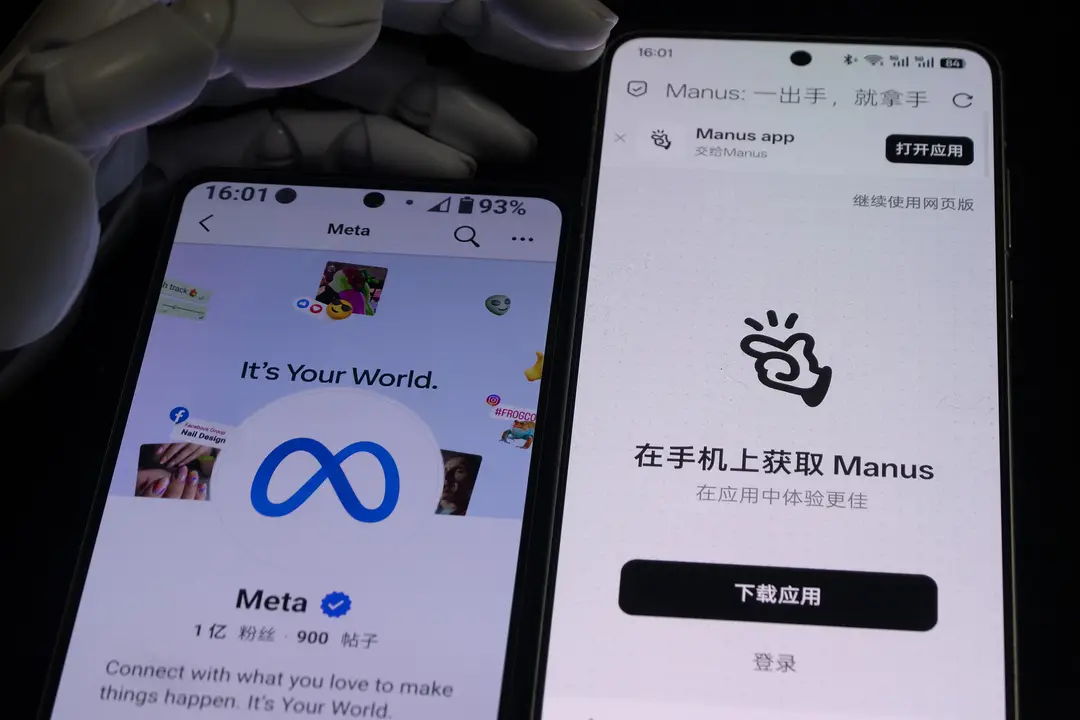
Manus is close to regaining independence from Meta after a landmark national security ruling, with Chinese investors leading a buyback that returns control to its founding team
By Guo Liqin
Meta’s $2 billion purchase of Chinese AI agent Manus is being unwound after Beijing banned the deal. The founder’s team is poised to regain control as a consortium of Chinese investors steps in to buy back the asset.
Manus has removed its “now part of Meta” announcement and replaced it with a statement that it will “soon resume operations as an independent company.” The move comes less than eight months after Meta’s acquisition of Butterfly Effect, Manus’s operating entity, and four months after China’s top economic planning agency, the National Development and Reform Commission (NDRC), ordered the deal unwound.
The NDRC said on April 27 that its foreign investment security review mechanism had prohibited the acquisition and ordered the parties to reverse the transaction.
Chinese investors lead the buyback
The crucial step, however, appears to be close.
The unwinding is complicated because Manus had become deeply integrated with Meta across personnel, technology, intellectual property, finances, operations and corporate governance. A person familiar with the process said the transaction “cannot be said to have been completed” yet.
Meta announced its acquisition of Manus on Dec. 29, 2025. Before the purchase, Butterfly Effect had raised $75 million from investors including Benchmark Capital, ZhenFund, HSG (formerly Sequoia China) and Tencent. Two people familiar with the matter said the unwinding centers on a new investment that will effectively buy Manus back from Meta. Given the NDRC’s prohibition on the foreign acquisition of the company, the new investors are expected to have Chinese backgrounds.
In early July, the buyback was being led by Tencent, with ZhenFund and HSG also participating, the sources said. Tencent is taking over Benchmark’s previous stake and is expected to become the single largest shareholder, with about 20%. HSG and ZhenFund are each expected to hold around 10%.
The outside investors are understood to be financial investors rather than controlling shareholders, with only minority shareholder protection rights. The founding team is therefore likely to regain actual control of Manus.
Sources also said communication among Meta, Manus and Chinese regulators had been smooth, with Meta expected to cooperate with the separation of technology and code.
Another clue came from a Manus notice saying that, to comply with regulatory requirements in certain jurisdictions, data generated by some users on or after Dec. 29, 2025 would be deleted between Aug. 23 and 24. Affected users can back up their data before Aug. 23, while data recovery will begin on Aug. 25.
Two industry veterans familiar with similar transactions said the data separation is a strong indication that the buyback agreement is nearing completion. The parties may already have reached a framework agreement on the core terms, or even signed a term sheet, with a legally binding agreement potentially to follow around the end of August.
Manus gets another chance to go global
Manus has experienced extraordinary growth since its launch in March 2025, when it attracted global attention by presenting itself as a general-purpose AI agent capable of completing complex tasks autonomously from a single initial prompt.
Its commercial development was almost as rapid. Within eight months of launching paid subscriptions, Manus had reportedly surpassed $100 million in annual recurring revenue. Its valuation rose from $500 million in its Series B round to $2 billion, while investment reports indicate that ARR later reached an estimated $400 million to $500 million.
The Meta deal triggered controversy because Manus had been developed using Chinese talent, data and intellectual property before being shifted overseas and acquired by a U.S. company. The case became a test of how China can protect national interests without unnecessarily restricting innovation.
Manus is expected to continue operating internationally after the unwinding, with its data stored in the U.S. and Singapore and its product aimed at overseas users. Founder Xiao Hong has noted in multiple interviews that overseas users’ willingness to pay for software may be five times that of Chinese users, with U.S. dollar pricing providing a 35x larger market opportunity.
The NDRC’s decision signals that transactions previously in a “grey zone” now fall under national security review, sending a clear warning: Chinese companies who develop sensitive technology domestically, shift the business offshore and then transfer control to foreign investors will face closer scrutiny.
At the same time, regulators did not impose penalties on Manus or Meta or demand changes to Manus’s existing corporate structure, suggesting a pragmatic approach that takes the company’s commercial realities into account.
The Manus saga may therefore prove to be more than an unusual corporate breakup. It could mark a clearer boundary for how Chinese technology companies can build, structure and internationalize businesses in sensitive sectors.
Source:
Caijing magazine