The Chinese AI lab’s latest ultra-low-cost V4-Flash model may have forced U.S. giants to slash prices, fuelling a brutal and potentially unsustainable market-clearing war.
By Da Cheung
Chinese AI startup DeepSeek released the official version of its V4-Flash model on July 31, which the company says offers top-tier performance at a fraction of the cost of its global competitors. The release comes as Western businesses are increasingly adopting a hybrid AI strategy, embedding highly affordable open-weight Chinese models into daily workflows for routine tasks, while reserving premium U.S. models exclusively for complex problem-solving.
DeepSeek’s aggressive pricing strategy is adding to pressure on major U.S. players to cut their prices. Just a day before the launch, OpenAI slashed the API (application programming interface) cost of its entry-level GPT-5.6 Luna model by 80%, dropping the input cost to $0.20 per million tokens, the units of text the AI reads and generates. For the V4-Flash model, a million tokens equate roughly to 750,000 English words.
While developers are celebrating the plummeting costs, analysts warn that this race to the bottom is an unsustainable market-clearing mechanism that will likely squeeze out independent startups in favor of deep-pocketed tech giants.
Squeezing power from limited chips
The AI industry has so far been dominated by the “Scaling Law” — the theory that models become proportionally smarter simply by increasing their parameters (the internal numerical values that determine how the AI processes data) and the computing power for training or inference. Parameters act like artificial brain synapses, and recent months have seen a race to the trillions. In April, DeepSeek’s V4-Pro preview launched with 1.6 trillion parameters, followed by Alibaba pushing its Qwen 3.8-Max to 2.4 trillion, and Moonshot AI reaching 2.8 trillion with its Kimi K3.
However, DeepSeek’s V4-Flash challenges this capital-intensive trend. The model maintains the exact same parameter count as its April preview but achieved major performance leaps through “post-training” — a process of refining and adjusting the model after its initial massive data ingestion.
We believe that DeepSeek’s focus on efficiency is partly born of necessity. Due to U.S. export controls, Chinese AI companies have limited access to top-tier Nvidia chips, and domestic alternatives cannot yet fully bridge the gap. DeepSeek’s approach demonstrates that while the Scaling Law is not dead, there is still significant untapped potential to squeeze out of current hardware limits.
DeepSeek says V4-Flash outperformed its own larger V4-Pro model in nine benchmark tests and nearly matched Anthropic’s Claude Opus 4.8 in others.
Independent evaluations show a persistent gap in peak performance. Research firm Artificial Analysis gave V4-Flash a score of 50 out of 100 on its Intelligence Index. This places it on par with Google’s Gemini 3.6 Flash, but behind Meta’s Muse Spark 1.1, Z.AI’s GLM-5.2, and Moonshot’s Kimi K3, which scored 57. The absolute cutting-edge models from OpenAI and Anthropic scored at least nine points higher. Furthermore, developers in overseas communities have flagged operational weaknesses in V4-Flash, including low input cache hit rates and frequent timeouts for its safety classifier.
A race to the bottom in AI pricing
Despite trailing the cutting edge, DeepSeek dominates on cost-efficiency. According to Artificial Analysis, V4-Flash is by far the cheapest well-known model to run globally.
DeepSeek charges $0.14 per million input tokens — the user’s query — when data is not cached, and $0.28 per million output tokens — the AI’s reply. For domestic Chinese users, the price for a cache miss, where the prompt isn’t already stored in the system, is approximately $0.14. Artificial Analysis estimates the average cost of running a standardized test on V4-Flash to be just 3 cents. By comparison, the same test costs 86 cents on Moonshot’s Kimi K3, $1.86 on OpenAI’s GPT-5.6 Sol, and $3.15 on Anthropic’s Claude Fable 5 — making the DeepSeek model more than 100 times cheaper than Anthropic’s offering.
This pricing has triggered a frenzy among developers. Western developer platforms like Nous Portal and Cline are even subsidizing DeepSeek’s API, offering it at steep discounts or for free to attract users.
Market clearing and survival
The rapid commoditization of AI coding tools is shifting the industry’s focus from benchmark scores to actual operating costs and customer retention. However, financial experts caution that the current pricing environment risks turning into a strategic bloodbath.
Ma Liang, chief technology industry analyst at SDIC Securities, told the STAR Market Daily that the current price war is fundamentally different from the software subsidy wars of the mobile internet era. Because every AI query requires physical computing power, there is a hard marginal cost that cannot be erased by simply scaling up the user base.
Ma views the price war as a mechanism to clear out weaker players with inefficient cost structures. For massive cloud providers and platform giants, AI coding tools can operate as a strategic loss leader for three to five years to keep developers locked into their ecosystems. Independent startups, however, face a rapidly closing window to prove their revenue growth to increasingly cautious investors.
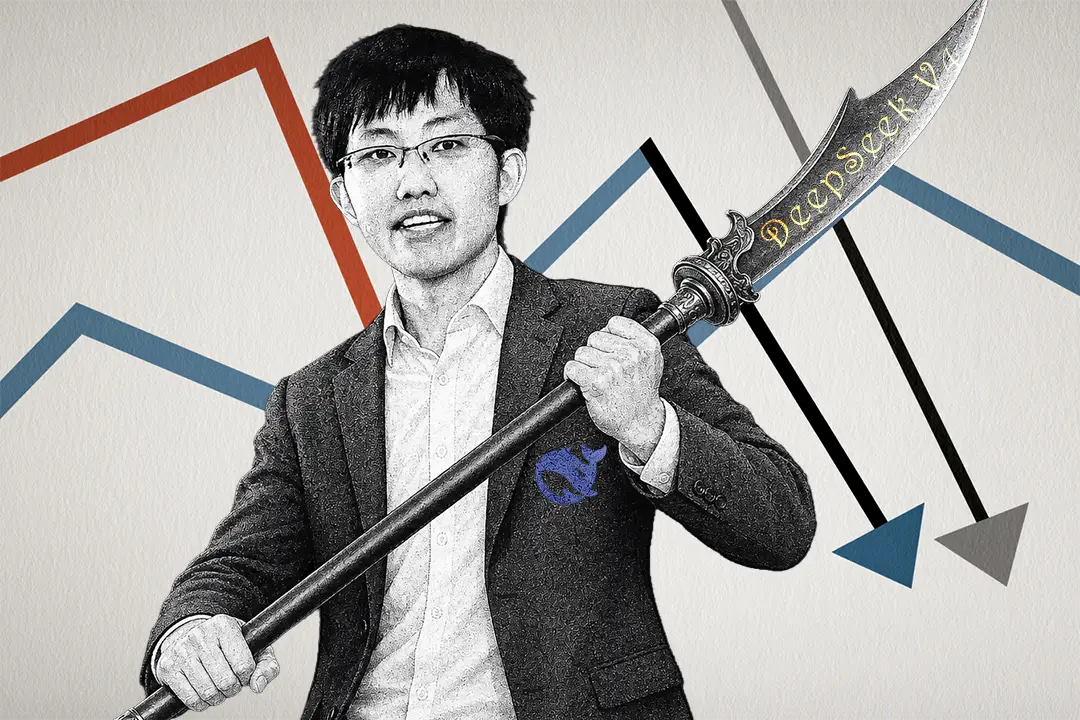
Feature photo: Illustration of DeepSeek’s Liang Wenfeng cuts down the API price, by ChatGPT and Mid Journey.
Sources