
Moonshot AI targets a $50 billion valuation as Chinese startups force U.S. rivals into a global price war.
By Da Chueng
On Wednesday, Chinese artificial intelligence startup Moonshot AI submitted a confidential filing for an initial public offering in Hong Kong, aiming to raise $3 billion at a $50 billion valuation, according to reports from Reuters and the Chinese tech publication LatePost.
The filing marks a pivotal moment in the global AI race. While U.S. developers like OpenAI and Anthropic are targeting near trillion-dollar valuations fueled by massive tech alliances, a wave of Chinese startups is aggressively disrupting the market through cost-efficiency, architectural innovation, and open-source ecosystems.
Moonshot AI, the developer behind the popular Kimi AI model, had previously denied August reports of an impending IPO. However, its rapid push toward public markets highlights a broader strategy among Chinese AI firms: securing capital to sustain the immense computing power required for model training, while undercutting U.S. competitors on price.
The price of intelligence
Chinese AI developers are gaining global traction by offering models that match the performance of top-tier U.S. counterparts at a fraction of the cost.
When Moonshot AI released its K3 model in July, it scored highly on independent industry benchmarks, matching the capabilities of leading proprietary models. According to the company, K3 utilizes a highly efficient architecture that activates only a small portion of its 2.8 trillion parameters — the underlying variables that determine an AI’s knowledge and capabilities — during any single task.
This efficiency translates directly to pricing power. Industry analysts calculate the cost of completing a single standardized task using K3 at $0.86. In contrast, the same task costs $1.23 on OpenAI’s GPT-5.6 Sol and $3.15 on Anthropic’s Claude Fable 5.
Similarly, DeepSeek, another leading Chinese AI firm, has disrupted global developer platforms with its V4-Flash model. As of Sept. 3, DeepSeek charges just $1.32 per million tokens — the fragments of words AI uses to process text — significantly undercutting U.S. rivals.
This aggressive pricing is forcing U.S. giants to respond. Shortly after K3’s release, Anthropic slashed the price of its Claude Opus 5 model by half, and OpenAI announced an 80% price reduction for its entry-level GPT-5.6 Luna model.
Now, any model that can’t outperform DeepSeek or Kimi but charges more is unlikely to survive in the market. In other words, Chinese models are now defining the bottom line for the global AI competition while trying to catch up.
Shifting metrics and commercial reality
As the initial hype around raw technological capability cools, the industry’s benchmark for success is shifting toward commercial viability. AI companies are increasingly judged by their Annual Recurring Revenue (ARR), a metric used to estimate yearly income based on recent performance.
Moonshot AI’s valuation surged following the release of K3. LatePost reported the company was valued at $4.3 billion in late 2025 and $20 billion in May. Its current $50 billion pre-IPO valuation reflects massive investor appetite driven by reported revenue spikes. Moonshot AI’s ARR reportedly crossed $300 million in mid-June, with enterprise API usage accounting for over 70% of its B2B income [12].
Other Chinese firms are reporting even larger figures. Z.AI (Zhipu AI) (2513.HK) and MiniMax (0100.HK) reported August ARRs of $1.6 billion and over $800 million, respectively.
However, these figures should be treated with caution. LatePost notes that Chinese AI companies are using the term “ARR” inconsistently. Some use it to mean Annual Recurring Revenue — a traditional software metric based on recurring revenue — while others use it as an Annual Run Rate, which simply annualizes a recent month’s revenue, including volatile project-based fees. This ambiguity makes it difficult to assess the underlying financial position and revenue durability of these startups.
Capital divides and market risks
The global AI landscape is currently defined by a stark capital divide. U.S. firms are raising unprecedented sums; Anthropic raised $65 billion in its May 2026 Series H, at a $965 billion post-money valuation. It was reportedly generating revenue at an rate of $65 billion by June. OpenAI raised $122 billion in its March 2026 funding round, at an $852 billion post-money valuation.
In contrast, top Chinese firms have raised significantly less. Moonshot AI has reportedly secured nearly $9.5 billion to date in several rounds of financing, while Z.AI and DeepSeek have reportedly each raised around $7 billion. DeepSeek is reportedly seeking a new funding round at a 500 billion yuan ($75 billion) valuation, though the company has not confirmed this figure.
To bridge this capital gap, Chinese firms are accelerating their IPO timelines, but this rush introduces significant market capacity risks. Investors warn that a crowded IPO pipeline could strain liquidity in the Hong Kong market. With DeepSeek widely expected to debut in 2027, and the lock-up period for Z.AI’s publicly traded shares expiring in January 2027, the market could soon be flooded with AI equity.
If these companies fail to deliver revenue growth that matches their soaring valuations, the current AI premium could quickly evaporate, leaving public market investors bearing the cost of the industry’s aggressive expansion.
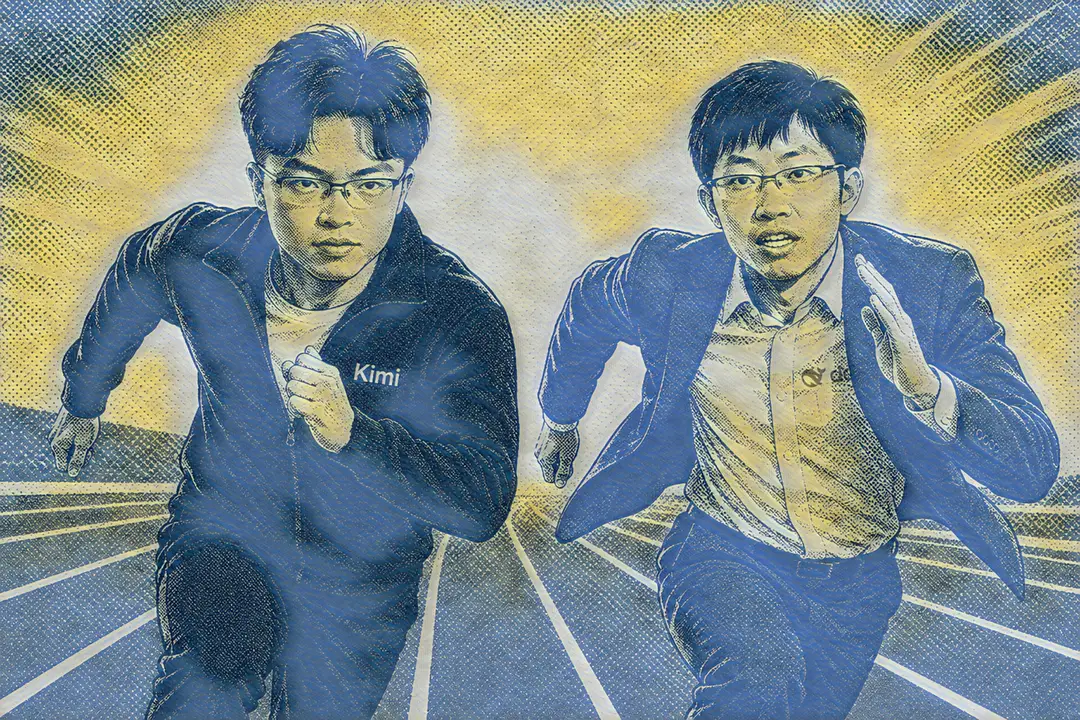
Feature photo: Illustration of Yang Zhilin of Moonshot and Liang Wenfeng of DeepSeek by ChatGPT.
Sources