
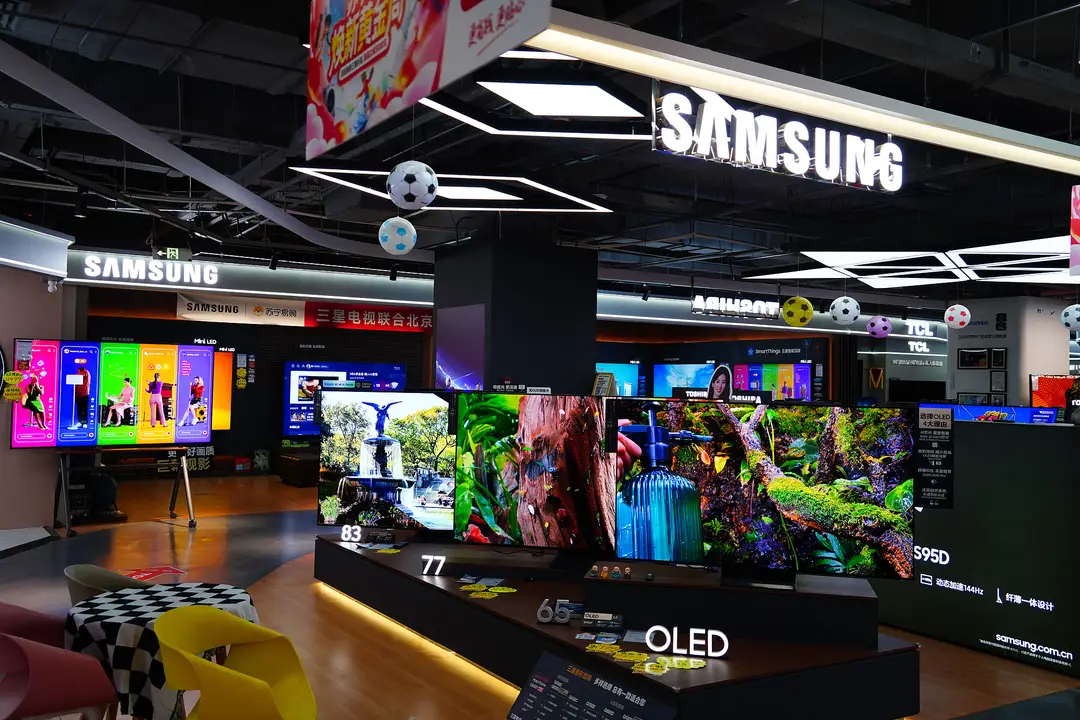
Just after the May Day holiday, Samsung Electronics (005930.KS) signalled the end of its home appliance business in mainland China with a notice of fewer than 200 words. There was no press conference, no valedictory statement, not even the customary “thank you for years of support”. The departure was clean, crisp — and quietly melancholy.
There was a time when Samsung was the undisputed benchmark for global consumer electronics. From the late 1990s into the early 2000s, the Samsung name represented premium quality, reliability and a futuristic sensibility in the minds of Chinese consumers. Its televisions, refrigerators and washing machines graced countless living rooms and kitchens across the country. Those were the golden years of foreign brands in China, and Samsung’s most glorious period in the market.
Strategic amputation, not just market failure
But interpreting this exit requires a lens that is often overlooked: this is not merely a forced market defeat, but also a proactive strategic amputation.
Consider the numbers. In the first quarter of 2026, Samsung’s semiconductor division posted operating profit of 53.7 trillion won ($36.5 billion), up nearly 48-fold year on year, accounting for 93.4% of the group’s total operating profit. Meanwhile, its video display and digital appliances business generated combined revenue of 14.3 trillion won, but operating profit was a meagre 200 billion won, and the division has long faced margin pressure.
On one side sits a semiconductor cash cow that underpins nine-tenths of group profits; on the other, a low-margin home appliance drag. Under this structure, the strategic standing of the appliances business had long been precarious. Its withdrawal was a matter of time.
Even more telling was the capital market’s reaction. On the day Samsung announced its exit from China’s appliance market, its shares closed up 14.4%, pushing its market capitalisation above $1 trillion for the first time, making it only the second Asian company after TSMC to reach that milestone. Investors voted with their money: cutting the business was the right call.
Semiconductor first, consumer last
Understanding that share price jump is more important than reading the 200-word notice. In the eyes of professional investors, Samsung’s home appliance presence in China had become a misallocation of resources. To sustain it would mean using profits from semiconductors to subsidise a consumer business with no realistic path to success in China. Cutting it free creates room for the businesses that can truly compete.
Samsung’s core profit pillars have long since shifted to high-margin sectors such as semiconductors, display panels and premium mobile devices. Its home appliance business accounts for a dwindling share of group revenue and has become essentially dispensable. In fact, the company’s strategic centre of gravity in China has already shifted quietly.
Samsung never truly intended to leave China. It is simply redefining its role: from a consumer brand selling televisions and refrigerators to an industrial player doubling down on semiconductors and B2B businesses. That logic also explains why, while exiting appliances, it explicitly said its mobile phone business would stay. Smartphones have little market share left in China, but they carry brand presence and technological image — the last consumer-facing card Samsung is unwilling to discard.
How did Samsung fall so far?
Globally, Samsung home appliances still command respect: No. 1 in TV market share, No. 2 in refrigerators and No. 3 in washing machines worldwide. Yet this global strength has not translated to China. According to AVC data for April 2026, Samsung’s share of China’s offline TV market by value was just 3.6%, with 0.4% for refrigerators and 0.38% for washing machines. Samsung’s TV sales in China are now just 5% of what they were at their peak, and home appliance sales a mere 1%.
The collapse is not the result of any single misstep but of multiple layers of failure. Most directly, domestic Chinese brands have mounted a systematic counteroffensive on four fronts simultaneously: technology, cost, distribution and ecosystem. In televisions, Hisense has spent nearly two decades catching up and then competing head-on in picture quality, with ULED and Mini LED production capabilities now matching Samsung on core metrics. TCL took a different route — integrating upstream through CSOT, giving it a structural cost advantage that no amount of brand marketing can bridge. In white goods, Midea and Haier have spent decades building service networks deep into markets Samsung never seriously engaged.
More troublesome still has been the cross-sector entry of technology companies such as Xiaomi and Huawei. They have redefined the value proposition of home appliances — not as standalone products but as nodes within smart-home ecosystems. From whole-home smart systems to livestreaming e-commerce channels, from ultra-thin built-in designs to county-level distribution, Samsung has consistently reacted half a beat too late.
A familiar script, and a warning for the winners
Samsung’s exit is not unique. Panasonic sold its TV business, Sharp was acquired by Foxconn and saw its brand value erode, Philips televisions survive only through brand licensing, and Toshiba’s appliance business long ago changed hands. One by one, once-renowned foreign brands have either shrunk or withdrawn from China. Samsung’s departure is simply louder because of its size and name recognition.
Yet this is not necessarily a signal for China’s appliance industry to celebrate unduly. Reduced external pressure often does not bring relief but rather reveals internal problems more sharply. Profit margins in the domestic appliance market are already painfully thin, and price wars have never truly ceased. As foreign competitors fade away, the battle will contract inward, and the intensity of “involution” will only increase.
The bigger test is globalisation. Hisense, TCL and others have run hard overseas, growing market share in North America, Europe and Latin America. But much of that growth still relies on value-for-money logic — “good enough and cheaper” — rather than brand equity that commands a premium. The question Chinese brands have yet to answer is whether they can make the transition from cost competitiveness to genuine brand recognition. Samsung’s failure in China is not just a mirror of Chinese appliance ascendancy but also a textbook case of where brand pricing power comes from — and how it is lost, bit by bit.
Source:
Node Finance (节点财经)