

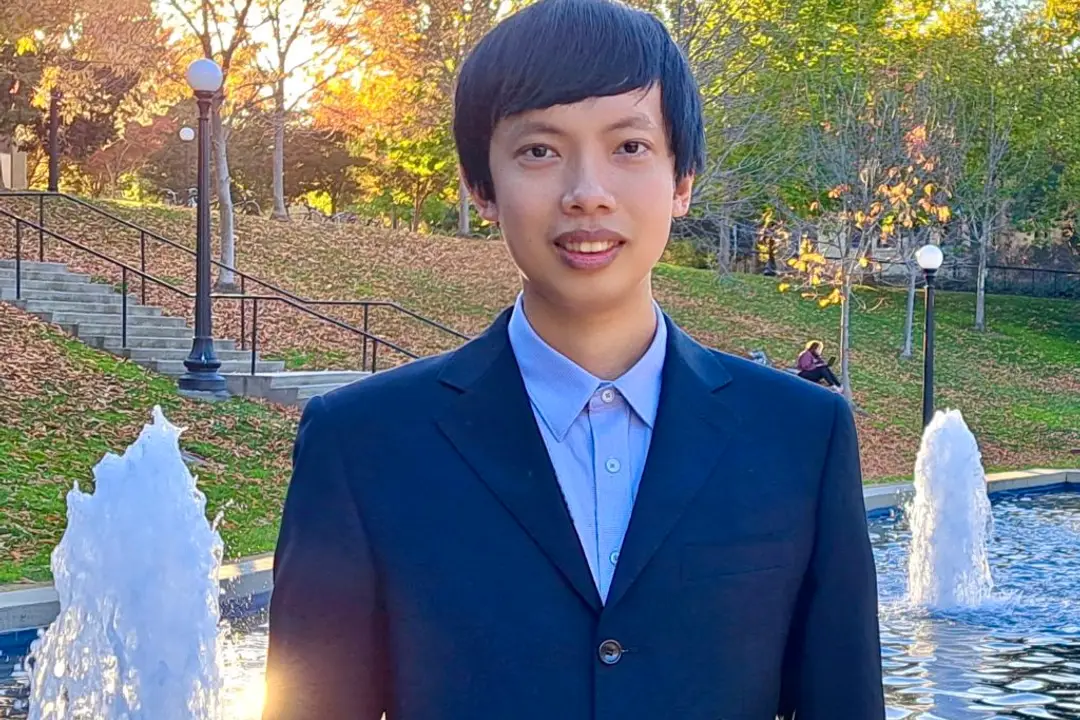
UniForce, founded by physicist Wu Tailin, is using AI to accelerate complex engineering simulations, with nuclear fusion as its first major test case.
By Liu Yanqiu
Shanghai stat-backed investment funds have led a nearly 50 million yuan ($7.4 million) funding round for UniForce AI, an artificial intelligence startup seeking to accelerate the simulation, design and control of complex engineering systems.
The angel+ round was jointly led by Shanghai Future Industry Fund and Shanghai Chuang Group, both backed by state-owned investment platform Shanghai State-Owned Capital Investment, with Fudan Science and Technology Innovation also leading the round. Longxin Venture Capital and Chengwei Capital participated, while Light Source Capital acted as sole financial adviser.
The geographic logic is clear. Force Engine’s first validation target is nuclear fusion, and Shanghai is a domestic hub for commercial fusion research. The funding will go toward generative simulation and intelligent control development, device-level validation in fusion and expansion into energy and advanced manufacturing.
From AI for science to AI for engineering
UniForce AI was founded by Wu Tailin, a physicist and AI researcher who is now an assistant professor and distinguished researcher at Westlake University in Hangzhou. He studied physics at Peking University, earned a doctorate in physics from the Massachusetts Institute of Technology and later conducted postdoctoral research in Stanford University’s computer science department.
The company is part of a still-emerging field known as AI for Engineering, which applies AI not just to scientific discovery but to the practical design, simulation, and control of physical systems.
Traditional engineering simulations can be highly accurate but computationally expensive. A simulation of a fluid, mechanical or plasma process can take hours or days, with each iteration adding to the time required to design or optimize a system. UniForce AI says its AI-based methods have accelerated simulations in areas including fluid dynamics, reservoir modeling and plasma physics by tens to hundreds of times, with some calculations reduced from hours or days to seconds.
Wu sees the technology as a potential common platform across industries. Many engineering problems share underlying characteristics, he argues, particularly the need to model multiple physical processes operating across different scales and then control them in real time.
The approach goes beyond simply replacing conventional computer-aided engineering software. UniForce AI trains its models using numerical simulations and experimental data while incorporating knowledge of physical laws. It then uses AI to predict how physical systems will evolve and to generate solutions, with intelligent agents potentially automating more complex, multistage engineering tasks.
Fusion first
The company’s first major test case is controlled nuclear fusion, one of the most demanding engineering problems in the field.
Magnetic-confinement fusion requires highly accurate simulation and control of plasma under extreme conditions, spanning multiple physical and temporal scales. Processes ranging from large-scale plasma behavior to microscopic turbulence interact with one another, making the system particularly difficult to model.
AI has already begun moving into real-world fusion experiments. Researchers have used deep reinforcement learning to control plasma configurations and avoid certain instabilities in tokamak devices. UniForce AI aims to push this further by combining simulation, state estimation and closed-loop control.
“Fusion is too important, and it is at a tipping point,” says Wu. “I expect demonstration commercialisation by 2040—near-infinite, cheap energy.” That timeline matters: AI itself will need vast energy supplies.
He argues that the technology’s demanding requirements for accuracy, speed and safety make fusion a useful way to test whether AI can handle highly complex physical systems. If it can, the same underlying methods could potentially be adapted for other industries, including aerospace, nuclear power and advanced manufacturing. The company says its algorithms have already been industrially deployed for large-scale reservoir simulations by Saudi Aramco.
The technical challenge remains substantial. Wu says current methods still struggle to produce high-fidelity simulations of tightly coupled systems operating across multiple scales. Fusion is not unique in this respect: similar problems occur when modeling chemical reactions and fluid flows, materials from the atomic to the macroscopic scale, and biological systems from molecules to organs.
A physicist’s bet on AI
Wu’s route into AI was itself an unconventional one. In 2016, during his fourth year of a physics doctorate at MIT, funding for his quantum-computing laboratory was suddenly cut, leaving his research stalled.
Rather than move to another laboratory and continue working on quantum computing, Wu decided to switch fields. Inspired partly by the growing prominence of AI after AlphaGo defeated South Korean Go champion Lee Sedol, he spent a month considering the decision before moving into AI and physics research.
He describes the move as an all-or-nothing gamble. To accelerate his transition, he moved to Los Angeles six months before an internship at Google and spent his time discussing research with his mentor there. It took more than a year before his new research began producing results, with several breakthroughs emerging in 2019. Wu estimates that switching from quantum computing to AI effectively required him to do another doctorate in three and a half years.
His experience has shaped his view that AI must eventually move beyond learning from static data and interact directly with the physical world. An intelligent system, he argues, should be able to enter a new environment, learn how it works through interaction and progressively improve its ability to achieve a given goal.
That is also the longer-term ambition for UniForce AI: to build a general engineering AI infrastructure that can learn from physical systems and eventually help design and control machines across different industries.
For now, however, the company is starting with one of the hardest problems available — using AI to understand and control nuclear fusion.
Source:
Chinaventure.com.cn