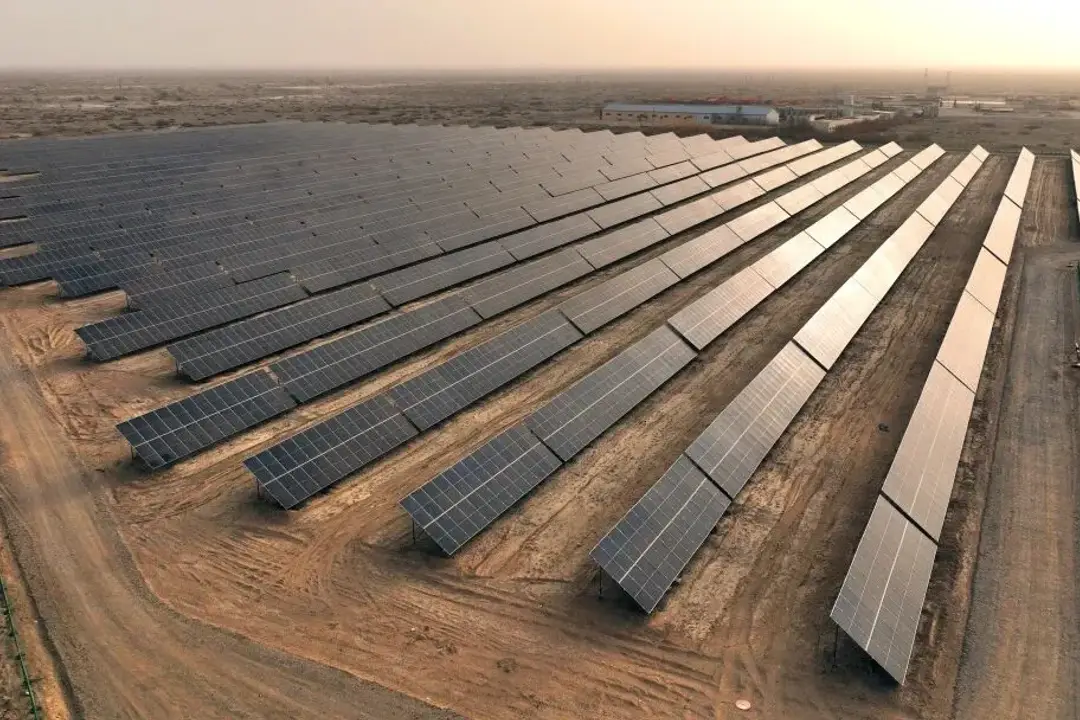
JinkoSolar is building a second business around strategic investments in AI and other frontier technologies as its core solar operations struggle with overcapacity.
By Doug Young
JinkoSolar Holding (JKS.US) is dropping “solar” from its English name as the company seeks to build a second growth engine alongside its struggling solar business.
The company’s board has approved a proposal to rename it Jinko Holdings Ltd., although shareholders still need to approve the change at an Oct. 21 meeting. Its NYSE-listed shares are expected to continue trading under the JKS ticker.
The proposed name change reflects a broader restructuring. Jinko says it will operate through two complementary businesses: its industrial holdings, centered on majority ownership of Shanghai-listed Jinko Solar (688223.SH), and a strategic investment business targeting high-growth sectors.
Those investments will focus on artificial intelligence, renewable energy, advanced materials, commercial space and other frontier technologies.
The move comes as China’s solar industry struggles with severe overcapacity following years of rapid capacity expansion. Falling prices for panels and the materials used to produce them have pushed manufacturers across the supply chain into heavy losses.
From solar giant to investment company
Beijing has taken steps to tackle the glut, including encouraging consolidation and forcing older, less-efficient production capacity out of the market. But the process has been slow, while investors have grown increasingly skeptical about the sector’s prospects.
Jinko’s shares have suffered accordingly. The stock has fallen sharply this year, leaving the company with a market value of well below $1 billion.
Its underlying business has deteriorated significantly. Revenue from solar operations fell 45% from its peak in 2023 to 2025, while second-quarter revenue this year dropped another 31.3% year on year to 12.36 billion yuan ($1.82 billion). JinkoSolar reported a net loss attributable to shareholders of 697 million yuan for the quarter.
Against that backdrop, the company is looking beyond its traditional business.
“We are pursuing opportunities arising from the global energy transition while selectively investing in artificial intelligence and other frontier technologies,” CEO Wei “Dimi” Du said in a statement announcing the proposed name change.
Du took over as CEO in August after previously serving as JinkoSolar’s vice president of strategic investment, putting the investment strategy at the center of his new role.
Betting on AI startups
Jinko has been building its investment portfolio quietly since the beginning of this year. It says it has deployed about 400 million yuan across eight companies, with several of its largest investments going into AI startups.
The company invested about 100 million yuan in StepFun, 70 million yuan in AI infrastructure company SiliconFlow and 69 million yuan in Moonshot AI, the developer of the Kimi large language model.
Other investments include 15 million yuan in robotics company Noetix Robotics and 8.6 million yuan in advanced materials maker Janbon Metallic Materials. Jinko has also invested in renewable-energy companies Laplace Renewable Energy and Hangzhou Gold Electronic Equipment (301669.SZ).
Some of those investments have already generated substantial paper or realized gains.
Jinko said it received more than 300 million yuan in cash proceeds during the first half of the year after disposing of a substantial portion of its stake in Laplace, generating cumulative realized gains of more than 250 million yuan since its initial investment.
Its investment in Hanghou Gold Electronic also generated more than 400 million yuan in fair-value gains during the first half of 2026. The company listed on Shenzhen’s ChiNext market during the second quarter.
Those results provide an obvious incentive for Jinko to keep investing. But they also illustrate the risks of the strategy.
From one bubble to another?
AI startups are currently commanding huge valuations while burning substantial amounts of cash to develop increasingly expensive products and infrastructure. That can make early-stage investments highly profitable when valuations continue rising.
The danger is what happens when the cycle reverses.
If AI valuations fall sharply, Jinko could be left holding minority stakes worth substantially less than when it bought them. That risk may be particularly significant for a company whose own core business is already consuming cash and generating losses.
Jinko had about 17 billion yuan in cash at the end of June, down from 22.8 billion yuan three months earlier. Its financial resources give it room to pursue investments but also raise the question of whether capital would be better used to shore up its struggling solar operation.
Jinko is not alone in seeking an escape route from the solar downturn. Solar materials maker Daqo New Energy (DQ.US) (688303.SH) announced in June that it would expand into electrical equipment for AI data centers, drawing on capabilities it had before entering polysilicon manufacturing.
Investors have also been skeptical of that strategy, with Daqo’s U.S.-listed shares falling substantially since the announcement.
For Jinko, the logic behind diversification is easy to understand. Its solar business faces a prolonged industry shakeout, while its new investment arm offers access to sectors with much higher growth potential.
But there is a danger in moving from one overheated market into another. If China’s solar bubble is finally deflating just as the AI investment boom reaches its peak, Jinko could find that its new source of potential gains becomes another source of losses.
To subscribe to Bamboo Works weekly free newsletter, click here